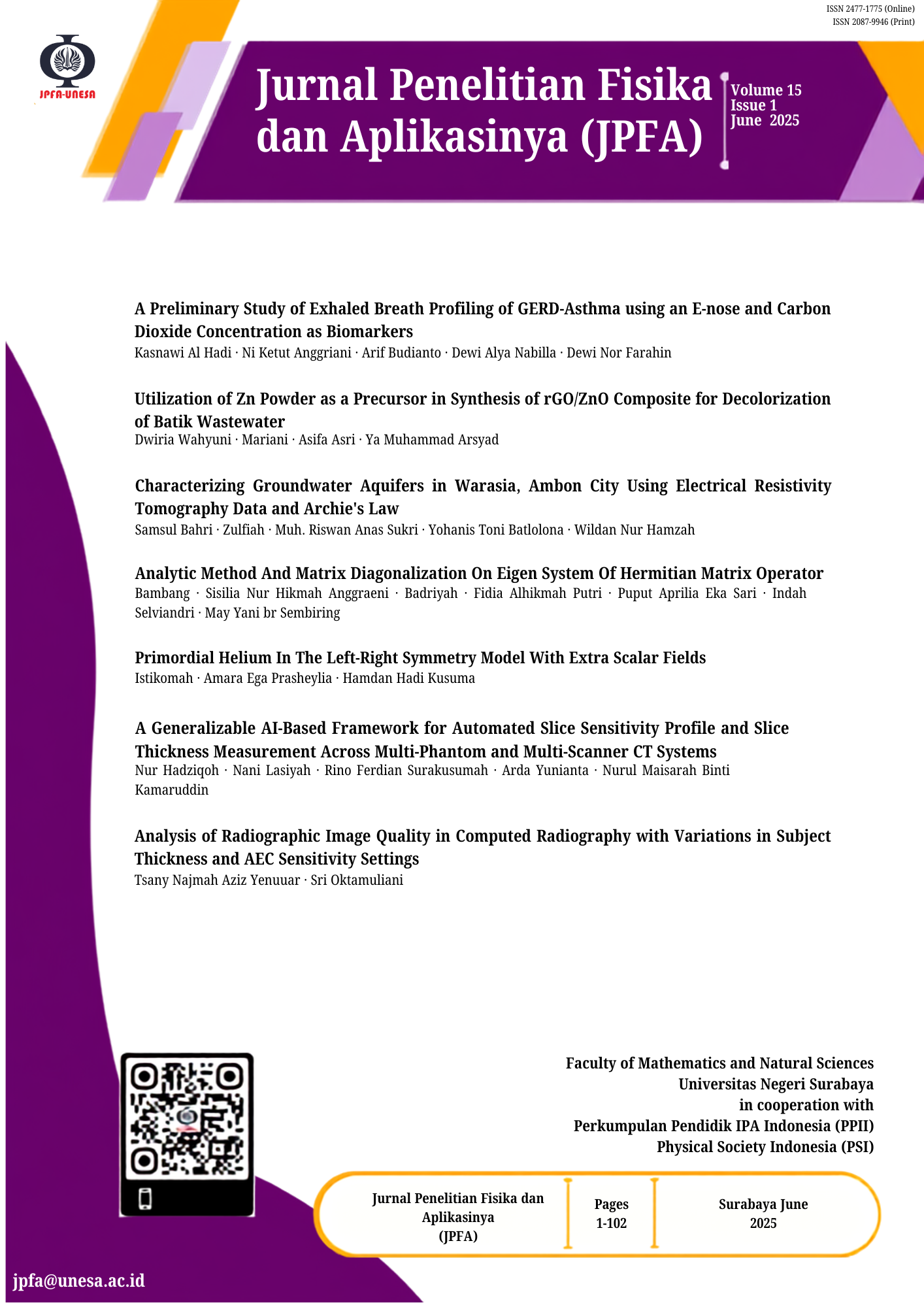
A Preliminary Study of Exhaled Breath Profiling of GERD-Asthma using an E-nose and Carbon Dioxide Concentration as Biomarkers
DOI:
https://doi.org/10.26740/jpfa.v15n1.p1-11Keywords:
biomarker, carbon dioxide, electric nose, GERD, ashtmaAbstract
Carbon dioxide plays a vital role in the human body. Many studies confirm that changes in carbon dioxide concentrations can serve as biomarkers for various health problems. This biomarker can be detected using several techniques, including an electronic nose (e-nose). However, there is a limitation in the e-nose's function and development in specific health cases, especially in respiratory or other systems. In line with this, this study aims to develop an economical, simple e-nose based on a CO2 (carbon dioxide) gas sensor and to establish an exhaled breath profile related to asthma and GERD (gastroesophageal reflux disease), which are common daily health problems. For this purpose, 90 exhaled breath samples from three different health conditions were obtained as the primary breath profiling samples: healthy, GERD, and asthma. The samples were measured and analyzed using a simple e-nose based on a high-sensitivity carbon dioxide sensor. The e-nose was calibrated and tested under laboratory-scale procedures, including linearity, accuracy, and sensitivity examinations. Then, the collected samples were classified, analyzed, and interpreted to produce a profile prediction for those health problems. The results show that the e-nose system can measure CO2 gas concentrations in the range of 400-9700 ppm. There are three selective profiles of the exhaled breath samples: healthy (450 to 899 ppm), GERD (3327 to 5381 ppm), and asthma (6612 to 9706 ppm). It can be concluded that the developed e-nose can classify different health conditions. There is a significant difference between healthy, GERD, and asthma samples (p < 0.05). These differences were interpreted as breath profiles with an accuracy level of 84%. This research may contribute to a preliminary investigation of breath profiles for specific health problems, with a rapid response time and high accuracy.
References
[1] Kim HH, Park GY, Lee JH, et al. Concentrations of particulate matter, carbon dioxide, VOCs, and risk assessment inside Korean taxis and ships. Environmental Science and Pollution Research. 2019; 26: 9619–31. DOI: https://doi.org/10.1007/s11356-019-04361-5.
[2] Bierwirth P. Carbon Dioxide Toxicity and Climate Change: A significant unapprehended risk for human health. Research Gate Working Paper. 2021; 1–25. DOI: https://doi.org/10.13140/RG.2.2.16787.48168.
[3] Schenck EJ, Hoffman K, Goyal P, Choi J, Torres L, Rajwani K, et al. Respiratory mechanics and gas exchange in COVID-19–associated respiratory failure. Ann Am Thorac Soc. 2020; 17:158–1161. DOI: https://doi.org/10.1513/AnnalsATS.202005-427RL.
[4] Scarlata S, Pennazza G, Santonico M, Pedone C, Antonelli Incalzi R. Exhaled breath analysis by electronic nose in respiratory diseases. Expert Rev Mol Diagn. 2015; 15: 933–56. DOI: https://doi.org/10.1586/14737159.2015.1043895.
[5] Stanek LW, Brown JS, Stanek J, Gift J, Costa DL. Air pollution toxicology — a brief review of the role of the science in shaping the current understanding of air pollution health risks. Toxicological Sciences. 2011; 120: 8–27. DOI: https://doi.org/10.1093/toxsci/kfq367.
[6] Mekontso Dessap A, Bagate F, Repesse X, Blayau C, Fartoukh M, Canoui-Poitrine F, et al. Low-flow ECCO2R conjoined with a renal replacement therapy platform to manage pulmonary vascular dysfunction with refractory hypercapnia in ARDS. Heliyon. 2024; 10. DOI: https://doi.org/10.1016/j.heliyon.2023.e23878.
[7] Melberg MB, Flaa A, Andersen GØ, Sunde K, Bellomo R, Eastwood G, et al. Effects of mild hypercapnia on myocardial injury after out-of-hospital cardiac arrest. A sub-study of the TAME trial. Resuscitation. 2024; 201. DOI: https://doi.org/10.1016/j.resuscitation.2024.110295.
[8] Sharma P, Muthuchellappan R, Bharadwaj S, Chakrabarti D, Srijithesh PR, Raja P, et al. Carbon dioxide-induced cerebral vasomotor reactivity in moderate-to-severe cerebral venous thrombosis patients and its impact on prognosis: A transcranial doppler-based prospective exploratory study. Journal of Clinical Neuroscience. 2024; 128. DOI: https://doi.org/10.1016/j.jocn.2024.110779.
[9] Ziemann AE, Allen JE, Dahdaleh NS, Drebot II, Coryell MW, Wunsch AM, et al. The amygdala is a chemosensor that detects carbon dioxide and acidosis, thereby eliciting fear behavior. Cell. 2009; 139: 1012–21. DOI: https://doi.org/10.1016/j.cell.2009.10.029.
[10] Chen F, Zhang W, Mfarrej MFB, Saleem MH, Khan KA, Ma J, et al. Breathing in danger: Understanding the multifaceted impact of air pollution on health impacts. Ecotoxicol Environ Saf. 2024; 280. DOI: https://doi.org/10.1016/j.ecoenv.2024.116532.
[11] Jaiswal S, Jalbert I, Schmid K, Tein N, Wang S, Golebiowski B. Smoke and the eyes: A review of the harmful effects of wildfire smoke and air pollution on the ocular surface. Environmental Pollution. 2022; 309. DOI: https://doi.org/10.1016/j.envpol.2022.119732.
[12] Vasilescu A, Hrinczenko B, Swain GM, Peteu SF. Exhaled breath biomarker sensing. Biosens Bioelectron. 2021; 182. DOI: https://doi.org/10.1016/j.bios.2021.113193.
[13] Shanmugasundaram A, V Manorama S, Kim DS, Jeong YJ, Weon Lee D. Toward point-of-care chronic disease management: Biomarker detection in exhaled breath using an e-nose sensor based on rgo/sno2 superstructures. Chemical Engineering Journal. 2022; 448. DOI: https://doi.org/10.1016/j.cej.2022.137736.
[14] Gaidamavichute V, Knyazeva M, Khozina E, Men’shchikov I, Safaev R, Shkolin A. A LA-BTC MOF as a sensor element of an electronic nose for selective adsorption of biomarkers of diseases: Molecular dynamics simulations of adsorption. Mater Today Commun. 2024; 38. DOI: https://doi.org/10.1016/j.mtcomm.2023.107787.
[15] Jeon JY, Park SJ, Ha TJ. Wearable nitrogen oxide gas sensors based on hydrophobic polymerized ionogels for the detection of biomarkers in exhaled breath. Sens Actuators B Chem. 2022; 360. DOI: https://doi.org/10.1016/j.snb.2022.131672.
[16] Beduk T, Durmus C, Hanoglu SB, Beduk D, Salama KN, Goksel T, et al. Breath, as the mirror of our body, is the answer really blowing in the wind? Recent technologies in exhaled breath analysis systems as non-invasive sensing platforms. TrAC - Trends in Analytical Chemistry. 2021; 143. DOI: https://doi.org/10.1016/j.trac.2021.116329.
[17] Mule NM, Patil DD, Kaur M. A comprehensive survey on investigation techniques of exhaled breath (EB) for diagnosis of diseases in human body. Inform Med Unlocked. 2021; 26. DIO: https://doi.org/10.1016/j.imu.2021.100715.
[18] Shetty SS, Jayarama A, Bhat S, Satyanarayan, Karunasagar I, Pinto R. A review on metal-oxide based trace ammonia sensor for detection of renal disease by exhaled breath analysis. Mater Today Proc. 2022; 55: 113–7. DOI: https://doi.org/10.1016/j.matpr.2021.12.411.
[19] Zhu R, Gao J, Tian Q, Li M, Gao Q, Wu X, et al. Optical chemical gas sensor based on spectral autocorrelation: A method for online detection of nitric oxide and ammonia in exhaled breath. Sens Actuators B Chem. 2025; 422: 136694. DOI: https://doi.org/10.1016/j.snb.2024.136694.
[20] Chen T, Liu T, Li T, Zhao H, Chen Q. Exhaled breath analysis in disease detection. Clinica Chimica Acta. 2021; 515: 61–72. DOI: https://doi.org/10.1016/j.cca.2020.12.036.
[21] Zhang Z, Zheng Z, He X, Liu K, Debliquy M, Zhou Y, et al. Electronic nose based on metal oxide semiconductor sensors for medical diagnosis. Progress in Natural Science: Materials International. 2024; 34: 74–88. DOI: https://doi.org/10.1016/j.pnsc.2024.01.018.
[22] Brinkman P, Wagener AH, Hekking PP, Bansal AT, Maitland-van der Zee AH, Wang Y, et al. Identification and prospective stability of electronic nose (eNose)–derived inflammatory phenotypes in patients with severe asthma. Journal of Allergy and Clinical Immunology. 2019; 143: 1811-1820.e7. DOI: https://doi.org/10.1016/j.jaci.2018.10.058.
[23] Budianto A, Wardoyo AYP, Masruroh, Dharmawan HA, Nurhuda M. Performance test of an aerosol concentration measurement system based on quartz crystal microbalance. IOP Conf Ser Earth Environ Sci. 2021; 1811. DOI: https://doi.org/10.1088/1742-6596/1811/1/012033.
[24] Shwetha HR, Sharath SM, Guruprasad B, Rudraswamy SB. MEMS based metal oxide semiconductor carbon dioxide gas sensor. Micro and Nano Engineering. 2022; 16. DOI: https://doi.org/10.1016/j.mne.2022.100156.
[25] Budianto A. A propanol gas measurement system using a quartz crystal microbalance as a mass sensor. Journal of Environmental Engineering and Sustainable Technology. 2022; 9: 70–4.
[26] Yani A, Wardoyo AYP, Anggraeni D, Budianto A. Development of a measurement system of ethanol gas based on TGS-2600, TGS-2603, and MQ-138 sensors. AIP Conf Proc. 2024; 3112. DOI: https://doi.org/10.1063/5.0211681.
[27] Eeftens M, Phuleria HC, Meier R, Aguilera I, Corradi E, Davey M, et al. Spatial and temporal variability of ultrafine particles, NO2, PM2.5, PM2.5 absorbance, PM10 and PMcoarse in Swiss study areas. Atmos Environ. 2015; 111: 60–70. DOI: https://doi.org/10.1016/j.atmosenv.2015.03.031.
[28] Gonzalez Viejo C, Fuentes S, Godbole A, Widdicombe B, Unnithan RR. Development of a low-cost e-nose to assess aroma profiles: An artificial intelligence application to assess beer quality. Sens Actuators B Chem. 2020; 308. DOI: https://doi.org/10.1016/j.snb.2020.127688.
[29] Fleming L, Gibson D, Hutson D, Ahmadzadeh S, Waddell E, Song S, et al. Breath emulator for simulation and modelling of expired tidal breath carbon dioxide characteristics. Comput Methods Programs Biomed. 2021; 200. DOI: https://doi.org/10.1016/j.cmpb.2020.105826.
[30] Wu G, Du H, Pakravan K, Kim W, Cha YL, Chiang ST, et al. Polyaniline/Ti3C2Tx functionalized mask sensors for monitoring of CO2 and human respiration rate. Chemical Engineering Journal. 2023; 475. DOI: https://doi.org/10.1016/j.cej.2023.146228.
[31] Bakali U, Killawala C, Monteagudo E, Dikici E, Deo SK, Daunert S. Exhaled breath analysis applications for evaluating occupational and environmental exposures. TrAC - Trends in Analytical Chemistry. 2024; 177. DOI: https://doi.org/10.1016/j.trac.2024.117787.
[32] Mojumder S, Das T, Mondal T, Ghosh S, Saha D, Ghosh CK, et al. Improved ammonia sensing performance achieved through defect modulation by Li doping in cauliflower-like ZnO for exhaled breath analysis towards renal diseases detection: An experimental venture supported by DFT calculation. TrAC - Trends in Analytical Chemistry. 2024; 180. DOI: https://doi.org/10.1016/j.trac.2024.117896.
[33] Langhan ML, Zonfrillo MR, Spiro DM. Quantitative end-tidal carbon dioxide in acute exacerbations of asthma. Journal of Pediatrics. 2008; 152: 829–32. DOI: https://doi.org/10.1016/j.jpeds.2007.11.032.
Downloads
Published
How to Cite
Issue
Section
License
Copyright (c) 2026 Jurnal Penelitian Fisika dan Aplikasinya (JPFA)

This work is licensed under a Creative Commons Attribution-NonCommercial 4.0 International License.
Author(s) who wish to publish with this journal should agree to the following terms:
-
- Copyright of articles published in Jurnal Penelitian Fisika dan Aplikasinya (JPFA) is held by Jurnal Penelitian Fisika dan Aplikasinya (JPFA).
- The author(s) grant JPFA the right to publish, reproduce, distribute, and make the article available in all forms and media.
- The published article is licensed under a Creative Commons Attribution-Non Commercial 4.0 License (CC BY-NC) that allows others to share the work with an acknowledgement of the work's authorship and initial publication in this journal for noncommercial purposes.
- Author(s) are able to enter into separate, additional contractual arrangements for the non-exclusive distribution of the journal's published version of the work (e.g., post it to an institutional repository or publish it in a book), with an acknowledgement of its initial publication in this journal.
The publisher publishes and distributes the article with copyright notice to Jurnal Penelitian Fisika dan Aplikasinya (JPFA) under the Creative Commons Attribution-NonCommercial 4.0 International License (CC BY-NC 4.0).
 Abstract views: 225
,
Abstract views: 225
, PDF Downloads: 365