Integrating Ghanaian Ethnomathematical Practices into the Teaching of Trigonometry in Senior High Schools
DOI:
https://doi.org/10.26740/jimes.v4n2.p69-79Keywords:
convergent mixed methods, ethnomathematics, Ghanaian cultural practices, teacher strategies, trigonometryAbstract
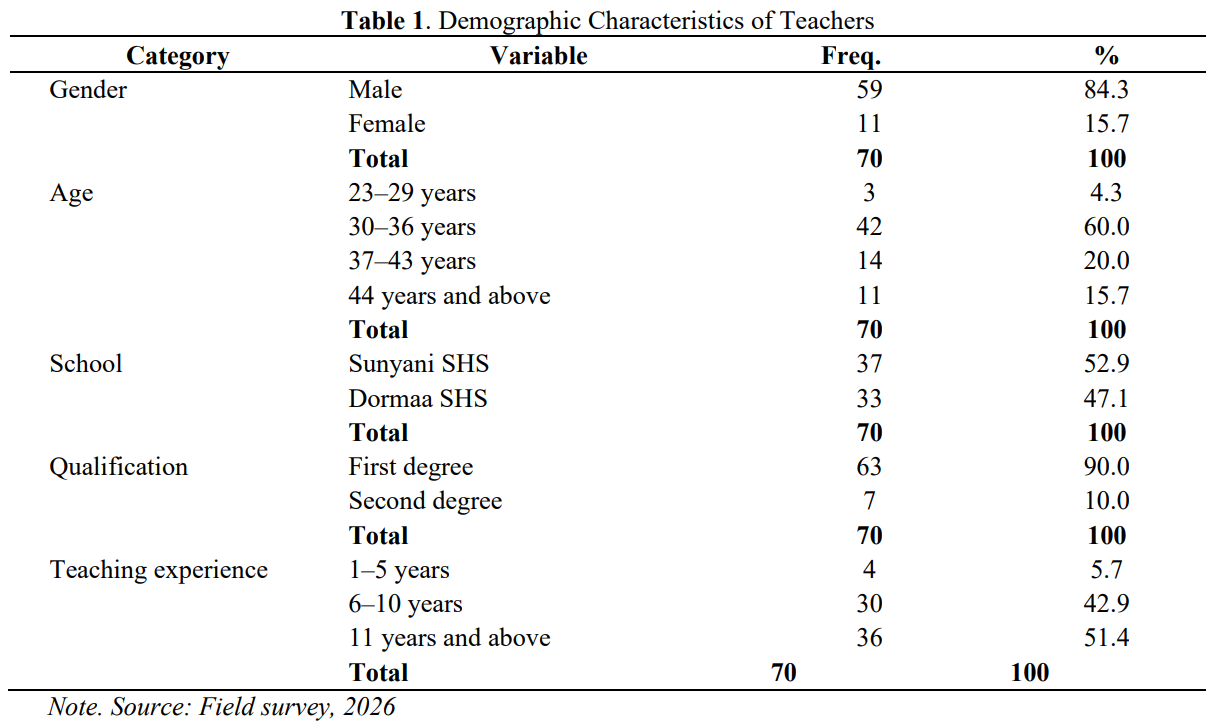
This study explored how Ghanaian ethnomathematical practices can be integrated into the teaching of trigonometry in Senior High Schools (SHSs), focusing on instructional strategies, teachers’ perspectives, and the challenges associated with implementation. A convergent parallel mixed-methods design was employed. Quantitative data were collected from 70 mathematics teachers using structured questionnaires and analysed using one-sample t-tests and effect sizes. Qualitative data were gathered through semi-structured interviews with four purposively selected teachers and analysed thematically, and the two strands were merged in a joint display during interpretation. The findings revealed strong teacher support for ethnomathematical integration, with teachers reporting that local examples, cultural symbols, collaborative activities, local languages, and indigenous tools enhanced students’ understanding, participation, motivation, and confidence (overall M = 4.14, d = 1.46). Despite these benefits, challenges including inadequate professional development (d = 0.83), limited instructional materials (d = 0.80), insufficient time, and weak institutional support hindered implementation (overall M = 3.64, d = 0.48). The integrated analysis showed that the barriers teachers rated most highly were the same structural gaps they elaborated in interview, while learner comprehension was not a significant barrier. The study recommends structured professional development, curriculum support, and the development of culturally relevant instructional resources for effective ethnomathematical teaching in Ghanaian SHSs.
References
Asiamah, N., Mensah, H., & Oteng-Abayie, E. F. (2017). General, target, and accessible population: Demystifying the concepts for effective sampling. The Qualitative Report, 22(6), 1607–1621. https://doi.org/10.46743/2160-3715/2017.2674
Atta, S. A., Bonyah, E., Boateng, F. O., & Kusi, P. (2025). The Akan ethnomathematics as pedagogical tool under the context of technology integration in promoting conceptual understanding in mensuration. African Educational Research Journal, 13(3), 342–351. https://doi.org/10.5281/zenodo.16881518
Creswell, J. W., & Plano Clark, V. L. (2023). Revisiting mixed methods research designs twenty years later. Handbook of Mixed Methods Research Designs, 1(1), 21–36.
D’Ambrosio, U. (1985). Ethnomathematics and its place in the history and pedagogy of mathematics. For the Learning of Mathematics, 5(1), 44–48. https://www.jstor.org/stable/40247876
Dookurong, I. D., Arthur, Y. D., & Akwerty, E. (2025). A systematic review of the integration of collaborative learning and Polya’s problem-solving strategy for enhancing pre-service teachers’ critical thinking. International Journal of Studies in Education and Science, 6(4), 395–428. https://doi.org/10.46328/ijses.5520
Eatmon, C. C. (2025). Teachers’ perception of the mathematics content and pedagogical knowledge essential to teach multilingual learners in high school algebra 1 [Doctoral dissertation, George Mason University]. https://www.proquest.com/openview/42b56fb815e72ac2a666c89b3563255f/1?pq-origsite=gscholar&cbl=18750&diss=y
Enworo, O. C. (2023). Application of Guba and Lincoln’s parallel criteria to assess trustworthiness of qualitative research on indigenous social protection systems. Qualitative Research Journal, 23(4), 372–384. https://doi.org/10.1108/QRJ-08-2022-0116
Erdmann, A., & Potthoff, S. (2023). Decision criteria for the ethically reflected choice of a member check method in qualitative research. International Journal of Qualitative Methods, 22, 16094069231177664. https://doi.org/10.1177/16094069231177664
Gay, G. (2021). Culturally responsive teaching: Ideas, actions, and effects. In M. C. Brown II & T. E. Dancy II (Eds.), Handbook of urban education (pp. 212–233). Routledge.
Hatem, G., Zeidan, J., Goossens, M., & Moreira, C. (2022). Normality testing methods and the importance of skewness and kurtosis in statistical analysis. BAU Journal Science and Technology, 3(2), Article 7. https://doi.org/10.54729/KTPE9512
Herbert, S., & Bragg, L. A. (2021). Factors in a professional learning program to support a teacher’s growth in mathematical reasoning and its pedagogy. Mathematics Education Research Journal, 33(3), 409–433. https://doi.org/10.1007/s13394-020-00310-5
Knief, U., & Forstmeier, W. (2021). Violating the normality assumption may be the lesser of two evils. Behavior Research Methods, 53(6), 2576–2590. https://doi.org/10.3758/s13428-021-01587-5
Kusi, P., Boateng, F. O., & Teku, E. (2025). The effect of technology integration on college of education students’ achievement in quadratic equations: The perspective of Photomath utilization. Eurasia Journal of Mathematics, Science and Technology Education, 21(1), em2561. https://doi.org/10.29333/ejmste/15799
Mudaly, V., & Narriadoo, D. (2023). Solving word problems by visualising. African Journal of Research in Mathematics, Science and Technology Education, 27(1), 47–59. https://hdl.handle.net/10520/ejc-saarmste_v27_n1_a47
Owusu-Darko, I., Sabtiwu, R., Doe, F., Owusu-Mintah, B., & Ofosu, E. K. (2023). Akan ethnomathematics: Demonstrating its pedagogical action on the teaching and learning of mensuration and geometry. Journal of Mathematics and Science Teacher, 3(2), 1–12. https://doi.org/10.29333/mathsciteacher/13281
Sunzuma, G., & Maharaj, A. (2019). Teacher-related challenges affecting the integration of ethnomathematics approaches into the teaching of geometry. Eurasia Journal of Mathematics, Science and Technology Education, 15(9), em1744. https://doi.org/10.29333/ejmste/108457
Suriandjo, H. S. (2024). The role of grounded theory in understanding urban society and design: A review based on Creswell and Poth. Global Science, 5(2), 1–4. https://globalscience.nusantara.ac.id/index.php/gs/article/view/42/46
Weber, K. (2010). Mathematics majors’ perceptions of conviction, validity, and proof. Mathematical Thinking and Learning, 12(4), 306–336. https://doi.org/10.1080/10986065.2010.495468
Zygmont, C. S. (2023). Managing the assumption of normality within the general linear model with small samples: Guidelines for researchers regarding if, when and how. The Quantitative Methods for Psychology, 19(4), 302–332. https://doi.org/10.20982/tqmp.19.4.p302
Downloads
Published
How to Cite
Issue
Section
License
Copyright (c) 2026 Journal of the Indonesian Mathematics Education Society

This work is licensed under a Creative Commons Attribution-ShareAlike 4.0 International License.
 Abstract views: 131
,
Abstract views: 131
, PDF Downloads: 150