POLICIES Focus and ScopeEditorial TeamReviewerAuthor GuidelinesPublication EthicsInformed ConsentPeer Review ProcessPeer Review PoliciesPublication EthicsAuthor FeeOpen Access Policy Manuscript Template




.png)
.png)

The International Disability Innovation Journal (IDIJ) is a peer-reviewed academic publication that examines disability-related issues, the rights of individuals with disabilities, inclusive education, and innovative strategies for advancing accessibility and inclusion in society. It highlights research on novel approaches, assistive technologies, and policies that drive progress in disability studies and promote a more equitable world. It is published by the Disability Innovation Center, under the Center of Research and Disability Services at Universitas Negeri Surabaya, Surabaya. This journal welcomes high-quality, research driven submission from diverse discipline, emphasising scientific inquiry and innovation approaches to disability studies, accessibility and inclusion.
International Disability Innovation Journal (IDIJ), under the Disability Innovation Center (DIC) at Universitas Negeri Surabaya (UNESA), has signed a Memorandum of Understanding (MoU) with the Asosiasi Profesional Ortopedagogik Indonesia (APOI) on July 22, 2025. The MoU was formalized by Prof. Dr. Sujarwanto, M.Pd. as Chairperson of APOI, and Silfia Asning Tias, Ph.D. as Editor-in-Chief of IDIJ, at UNESA Lidah Wetan Campus, Surabaya. Here is the link.
This collaboration is designed to strengthen academic cooperation in disability and inclusion studies through scientific publications. The agreement includes cooperation in article contributions, reviewer engagement, editorial participation, and journal dissemination. Valid for three years, this partnership supports mutual goals in advancing disability research and inclusive education across national and international platforms.
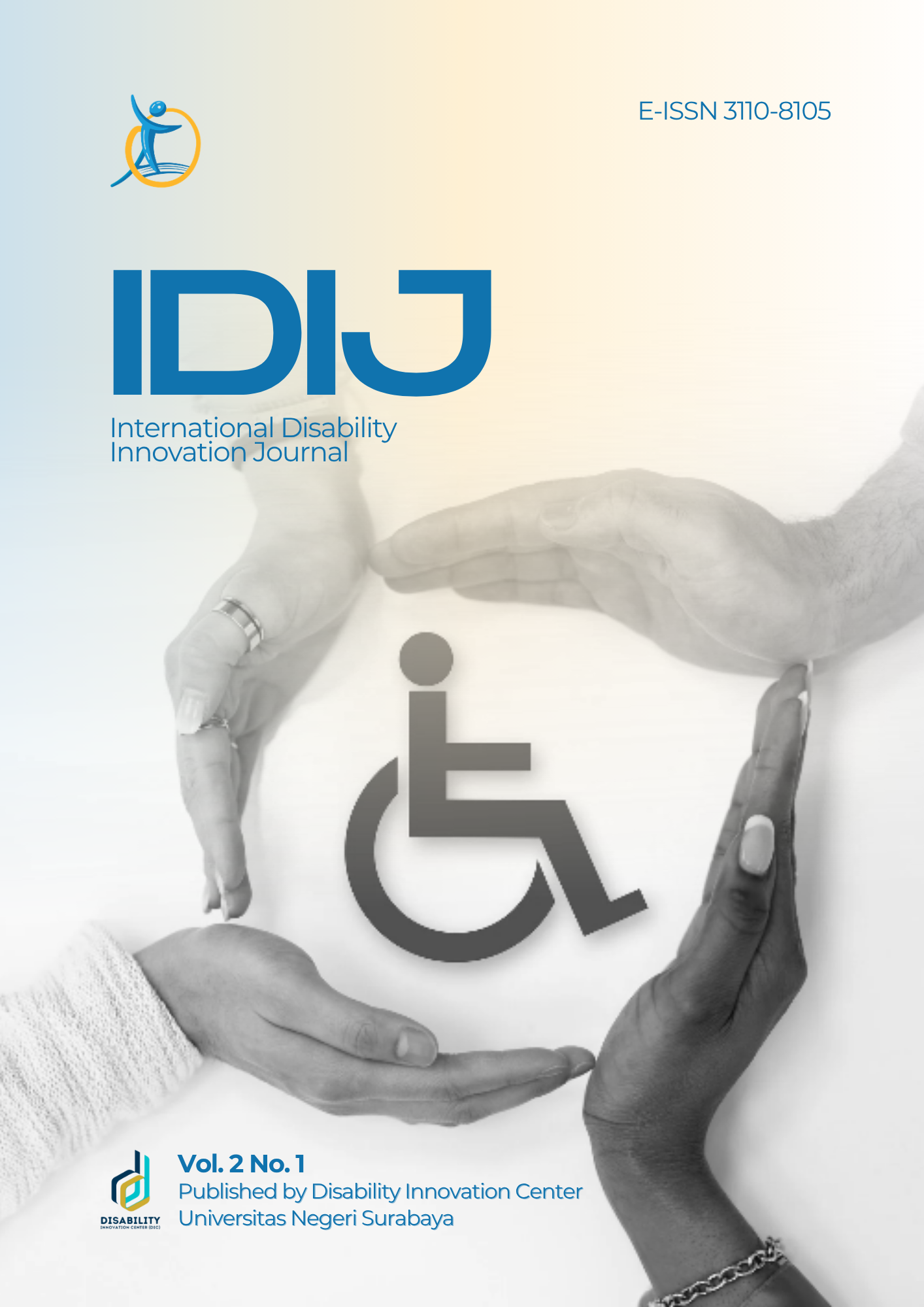
The International Disability Innovation Journal (IDIJ) is pleased to present Volume 2, Issue 1, which showcases diverse perspectives on disability research spanning inclusive education, accessibility, social justice, public policy, and lived experiences of persons with disabilities. The articles in this issue collectively emphasize that meaningful inclusion extends beyond policy commitments to require accessible environments, equitable educational practices, and the dismantling of structural and attitudinal barriers. By bringing together interdisciplinary research from different contexts, this issue contributes valuable evidence to advance disability scholarship and practice while encouraging collaboration among researchers, educators, practitioners, and policymakers in building more inclusive and equitable societies worldwide. All articles in this issue (6 original research articles) were authored/co-authored by 16 authors from 3 countries (Indonesia, Japan, and Tanzania)
 Shanita Septias Anaway,
Universitas Negeri Surabaya,
Indonesia Erinna Destanya Putri,
Universitas Negeri Surabaya,
Indonesia
Shanita Septias Anaway,
Universitas Negeri Surabaya,
Indonesia Erinna Destanya Putri,
Universitas Negeri Surabaya,
Indonesia 
 Abstract views: 114
,
Abstract views: 114
, PDF downloads: 81
Diva Aisya Cherynata,
Universitas Negeri Surabaya,
Indonesia Aura Dyka's Qurrota A'yun,
Universitas Negeri Surabaya,
Indonesia Ayu Novia Rahmatillah,
Universitas Negeri Surabaya,
Indonesia Tyas Mardiana,
Universitas Negeri Surabaya,
Indonesia Muhammad Iqbal Panji Satrio,
Universitas Negeri Surabaya,
Indonesia Abstract views: 124
, PDF downloads: 94
Hussein Hussein,
Department of Research and Education,
Tanzania, United Republic of Abstract views: 148
, PDF downloads: 115
Shanon Wangner Santoso,
Ritsumeikan Asia Pacific University,
Japan Silfia Asning Tias,
Universitas Negeri Surabaya,
Indonesia Abstract views: 150
, PDF downloads: 91
Intan Sri Wardani,
Universitas Negeri Yogyakarta,
Indonesia Lusi Nurhayati,
Universitas Negeri Yogyakarta,
Indonesia Abstract views: 82
, PDF downloads: 93
Lily Eka Sari,
Universitas Kristen Petra,
Indonesia Fiona Christie Antoro,
Petra Christian University,
Indonesia Christy Imanuella Sampouw,
Universitas Kristen Petra,
Indonesia Jeremy Chrystofer,
Universitas Kristen Petra,
Indonesia Abstract views: 87
, PDF downloads: 84
PDF downloads: 81
Diva Aisya Cherynata,
Universitas Negeri Surabaya,
Indonesia Aura Dyka's Qurrota A'yun,
Universitas Negeri Surabaya,
Indonesia Ayu Novia Rahmatillah,
Universitas Negeri Surabaya,
Indonesia Tyas Mardiana,
Universitas Negeri Surabaya,
Indonesia Muhammad Iqbal Panji Satrio,
Universitas Negeri Surabaya,
Indonesia Abstract views: 124
, PDF downloads: 94
Hussein Hussein,
Department of Research and Education,
Tanzania, United Republic of Abstract views: 148
, PDF downloads: 115
Shanon Wangner Santoso,
Ritsumeikan Asia Pacific University,
Japan Silfia Asning Tias,
Universitas Negeri Surabaya,
Indonesia Abstract views: 150
, PDF downloads: 91
Intan Sri Wardani,
Universitas Negeri Yogyakarta,
Indonesia Lusi Nurhayati,
Universitas Negeri Yogyakarta,
Indonesia Abstract views: 82
, PDF downloads: 93
Lily Eka Sari,
Universitas Kristen Petra,
Indonesia Fiona Christie Antoro,
Petra Christian University,
Indonesia Christy Imanuella Sampouw,
Universitas Kristen Petra,
Indonesia Jeremy Chrystofer,
Universitas Kristen Petra,
Indonesia Abstract views: 87
, PDF downloads: 84

