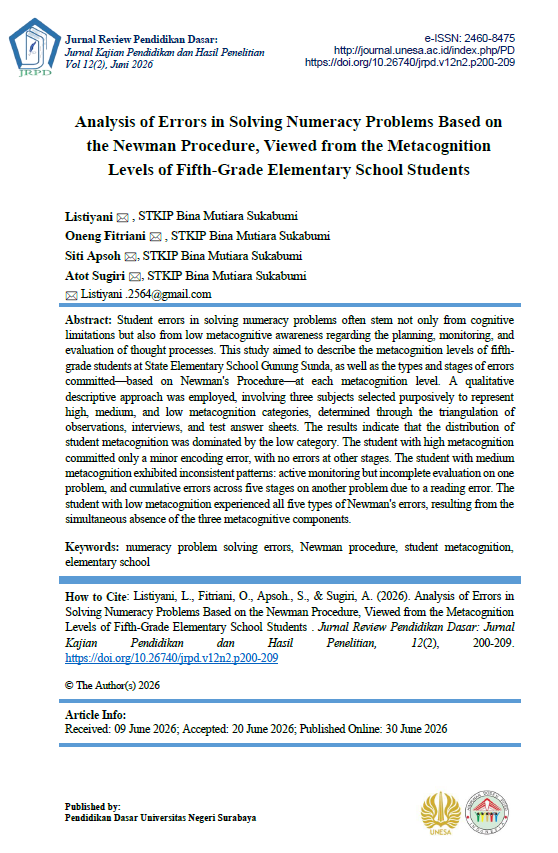
Analysis of Errors in Solving Numeracy Problems Based on the Newman Procedure, Viewed from the Metacognition Levels of Fifth-Grade Elementary School Students
DOI:
https://doi.org/10.26740/jrpd.v12n02.p200-209Keywords:
numeracy problem solving errors, newman procedure, student metacognition, elementary schoolAbstract
Student errors in solving numeracy problems often stem not only from cognitive limitations but also from low metacognitive awareness regarding the planning, monitoring, and evaluation of thought processes. This study aimed to describe the metacognition levels of fifth-grade students at State Elementary School Gunung Sunda, as well as the types and stages of errors committed—based on Newman's Procedure—at each metacognition level. A qualitative descriptive approach was employed, involving three subjects selected purposively to represent high, medium, and low metacognition categories, determined through the triangulation of observations, interviews, and test answer sheets. The results indicate that the distribution of student metacognition was dominated by the low category. The student with high metacognition committed only a minor encoding error, with no errors at other stages. The student with medium metacognition exhibited inconsistent patterns: active monitoring but incomplete evaluation on one problem, and cumulative errors across five stages on another problem due to a reading error. The student with low metacognition experienced all five types of Newman's errors, resulting from the simultaneous absence of the three metacognitive components.
References
REFERENCES
Hartana, D. D., Yenni, Y., & Hartantri, S. D. (2023). Analisis kesalahan menyelesaikan soal cerita matematika melalui prosedur Newman pada siswa sekolah dasar. Jurnal Basicedu, 7(3). https://doi.org/10.31004/basicedu.v7i3.5440
Husema, S., Rahmawati, R., & Nirfayanti, N. (2021). Kemampuan metakognisi dalam pemecahan masalah matematika siswa kelas VIII.A SMP Hang Tuah Makassar. EQUALS: Jurnal Ilmiah Pendidikan Matematika, 4(1).
Kurniawan, P., & Wijayanti, P. (2022). Profil metakognisi siswa dalam memecahkan masalah matematika. MATHEdunesa: Jurnal Ilmiah Pendidikan Matematika, 11(1). https://doi.org/10.26740/mathedunesa.v11n1
Mawardi, M. (2022). Analisis kemampuan siswa dalam menyelesaikan soal literasi numerasi pada Asesmen Kompetensi Minimum. HISTOGRAM: Jurnal Pendidikan Matematika, 6(1).
Miles, M. B., Huberman, A. M., & Saldana, J. (2014). Qualitative data analysis: A methods sourcebook (3rd ed.). Sage Publications.
Moleong, L. J. (2018). Metodologi penelitian kualitatif. Remaja Rosdakarya.
Mursyidah, D., Lidinillah, D. A. M., & Muharram, M. R. W. (2023). Analisis kesalahan siswa SD dalam menyelesaikan soal AKM konten analisis data dan peluang berdasarkan Prosedur Newman. Jurnal Cendekia: Jurnal Pendidikan Matematika, 7(3), 3174–3191. https://doi.org/10.31004/cendekia.v8i1.2773
OECD. (2018). PISA 2018 assessment and analytical framework. OECD Publishing.
OECD. (2023). PISA 2022 results: The state of learning and equity in education (Volume I). OECD Publishing.
Riani, D., Kurniawan, H., & Saputra, E. (2022). Faktor penyebab kesalahan siswa dalam menyelesaikan soal matematika sekolah dasar. Jurnal Pendidikan Matematika Indonesia, 7(2).
Shodikin, A., Subanji, & Sisworo. (2022). Analisis kesalahan siswa dalam pemecahan masalah matematika ditinjau dari kemampuan metakognisi. Jurnal Pendidikan Matematika, 16(1).
Supriyanto, A., Mariana, N., Wiryanto, W., & Hendratno, H. (2024). Profil kemampuan numerasi siswa sekolah dasar dalam pembelajaran abad 21. Kognitif: Jurnal Riset HOTS Pendidikan Matematika, 4(4), 1531–1544. https://doi.org/10.51574/kognitif.v4i4.2303
Downloads
Published
How to Cite
Issue
Section
License
Copyright (c) 2026 Jurnal Review Pendidikan Dasar : Jurnal Kajian Pendidikan dan Hasil Penelitian

This work is licensed under a Creative Commons Attribution 4.0 International License.
 Abstract views: 143
,
Abstract views: 143
, PDF Downloads: 101