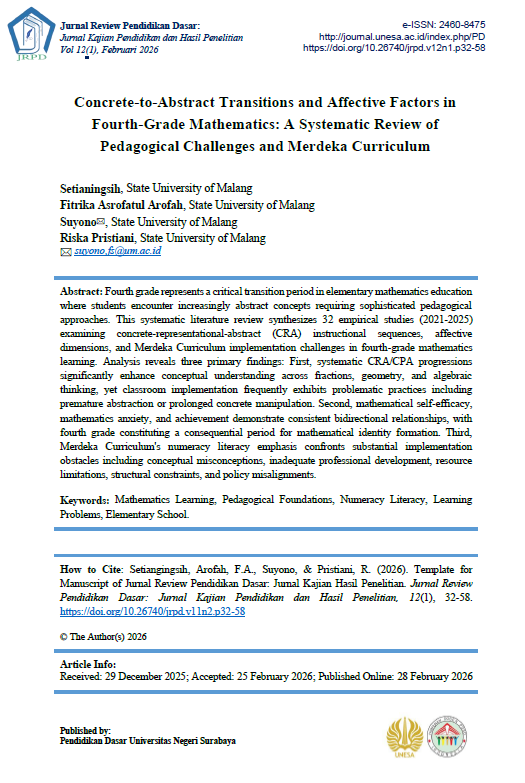
Concrete-to-Abstract Transitions and Affective Factors in Fourth-Grade Mathematics
A Systematic Review of Pedagogical Challenges and Merdeka Curriculum
DOI:
https://doi.org/10.26740/jrpd.v12n1.p32-58Keywords:
Mathematics learning, Pedagogical Foundation, Numeracy Literacy, Learning Problem, Elementary SchoolAbstract
Fourth grade represents a critical transition period in elementary mathematics education where students encounter increasingly abstract concepts requiring sophisticated pedagogical approaches. This systematic literature review synthesizes 32 empirical studies (2021-2025) examining concrete-representational-abstract (CRA) instructional sequences, affective dimensions, and Merdeka Curriculum implementation challenges in fourth-grade mathematics learning. Analysis reveals three primary findings: First, systematic CRA/CPA progressions significantly enhance conceptual understanding across fractions, geometry, and algebraic thinking, yet classroom implementation frequently exhibits problematic practices including premature abstraction or prolonged concrete manipulation. Second, mathematical self-efficacy, mathematics anxiety, and achievement demonstrate consistent bidirectional relationships, with fourth grade constituting a consequential period for mathematical identity formation. Third, Merdeka Curriculum's numeracy literacy emphasis confronts substantial implementation obstacles including conceptual misconceptions, inadequate professional development, resource limitations, structural constraints, and policy misalignments.
References
Al-Salahat, M. M. S. (2022). The Effect of Using Concrete-Representational-Abstract Sequence in Teaching the Perimeter of Geometric Shapes for Students with Learning Disabilities. International Journal of Education in Mathematics, Science and Technology. https://doi.org/10.46328/ijemst.2403
Alghtani, O., & Abdulhamied, N. A. (2010). The Effectiveness of Geometric Representative Approach in Developing Algebraic Thinking of Fourth Grade Students. Procedia - Social and Behavioral Sciences, 8, 256–263. https://doi.org/10.1016/j.sbspro.2010.12.035
Asmahasanah, S., Chairunnissa, I. C., & Hakim, N. (2023). Navigating Merdeka curriculum in first grade: teacher challenges and strategies. Journal of Integrated Elementary Education. https://doi.org/10.21580/jieed.v3i2.17592
Basuki, G., Ahmad, M., & Zulaikha, S. (2023). Implementation Of Merdeka Curriculum In Public School In Menteng Central Jakarta. International Conference On Digital Advance Tourism, Management And Technology. https://doi.org/10.56910/ictmt.v1i2.120
Clements, D., Lizcano, R., & Sarama, J. (2023). Research and Pedagogies for Early Math. Education Sciences. https://doi.org/10.3390/educsci13080839
Du, C., Qin, K., Wang, Y., & Xin, T. (2021). Mathematics interest, anxiety, self-efficacy and achievement: Examining reciprocal relations. Learning and Individual Differences. https://doi.org/10.1016/j.lindif.2021.102060
Guntur, M., & Purnomo, Y. (2024). Unravelling the interplay of self-efficacy, self-regulation, metacognition in alleviating math anxiety among primary school student: a conditional process analysis. Education 3-13. https://doi.org/10.1080/03004279.2024.2396096
Hasriani, H., Yanto, Y., Mayaputri, V., & Mahendra, O. (2024). A study on teacher’s obstacles in implementing the Merdeka Curriculum at elementary school. Journal of Professional Teacher Education. https://doi.org/10.12928/jprotect.v2i2.1109
Hidayah, I. R., Sa’dijah, C., Anwar, L., Yerizon, Y., & Arnawa, I. (2024). Empowering students’ numeracy skills: Mathematics teachers’ perceptions regarding the effectiveness and challenges of Indonesian national curriculum and the programs – A mixed method study. Infinity Journal. https://doi.org/10.22460/infinity.v14i1.p163-188
Hung, C.-M., Huang, I., & Hwang, G.-J. (2014). Effects of digital game-based learning on students’ self-efficacy, motivation, anxiety, and achievements in learning mathematics. Journal of Computers in Education, 1, 151–166. https://doi.org/10.1007/s40692-014-0008-8
Hussein, M. H., Ow, S. H., Elaish, M. M., & Jensen, E. O. (2022). Digital game-based learning in K-12 mathematics education: a systematic literature review. Education and Information Technologies, 27(2), 2859–2891. https://doi.org/10.1007/s10639-021-10721-x
Kaskens, J., Segers, E., Goei, S., Luit, J., & Verhoeven, L. (2020). Impact of Children’s math self-concept, math self-efficacy, math anxiety, and teacher competencies on math development. Teaching and Teacher Education, 94, 103096. https://doi.org/10.1016/j.tate.2020.103096
Katz, S. (2015). Enhancing Self-efficacy of Elementary School Students to Learn Mathematics. Journal of Combinatorial Theory, Series A, 4, 42–55. https://doi.org/10.5430/jct.v4n1p42
Khomaria, I., & Jupri, A. (2024). Teachers’ Perception of Numeracy in Mathematics Learning in the Merdeka Curriculum. Mimbar Sekolah Dasar. https://doi.org/10.53400/mimbar-sd.v11i2.71808
Mahmudah, W. N., Hermanto, Diri, E., Matematika, H. B., & Pembelajaran, D. (2024). Self Efficacy on Mathematics Learning Outcomes of Elementary School Students The Impact of Online Learning. JPI (Jurnal Pendidikan Indonesia). https://doi.org/10.23887/jpiundiksha.v13i1.43030
Mulabbiyah, Desmawanti, R., & Sulong, R. (2024). Teacher Readines And Challenges In Implementation Of Merdeka Curriculum In Madrasah Ibtidaiyah. El Midad. https://doi.org/10.20414/elmidad.v16i1.9895
Nurhaswinda, Fitriani, A., Putri, A., Prorida, D., Valensi, O., Anggraini, P., & Anjani, T. (2025). Implementasi Pembelajaran Literasi dan Numerasi Berbasis Kurikulum Merdeka di Kelas IV SD Negeri 007 Bangkinang. Jurnal Pengabdian Masyarakat Dan Riset Pendidikan. https://doi.org/10.31004/jerkin.v3i4.1410
Pellegrini, M., Lake, C., Neitzel, A., & Slavin, R. (2021). Effective Programs in Elementary Mathematics: A Meta-Analysis. AERA Open, 7. https://doi.org/10.1177/2332858420986211
Pittalis, M., Sproesser, U., Demosthenous, E., & Odysseos, E. (2024). Enhancing functional thinking in grade 5–6 students through a dynamic mathematics intervention program. Education and Information Technologies, 30, 1329–1361. https://doi.org/10.1007/s10639-024-12865-y
Ramdhani, R. A., Mujiwati, Y., Damayanti, A. M., Safiudin, K., & Kholis, N. (2024). Substantial Feasibility of Implementing the Merdeka Curriculum: Analysis of Teachers’ Teaching Perspectives in Elementary School. Madako Elementary School. https://doi.org/10.56630/mes.v3i1.232
Reyes, J. (2024). Effectiveness of Abstract – Visual – Concrete Approach in Enhancing Students’ Level of Conceptual Understanding and Mathematical Self-Efficacy. International Journal of Contemporary Sciences (IJCS). https://doi.org/10.55927/ijcs.v1i12.11722
Ruijia, Z., Talib, O., Burhanuddin, N. A. N. B., & Wenling, L. (2022). The Effect of Math Self-Concept and Self-Efficacy on the Math Achievement of Sixth-Grade Primary School Students. International Journal of Academic Research in Progressive Education and Development. https://doi.org/10.6007/ijarped/v11-i3/14721
Rustini, T., Komariah, K., Wahyuningsih, Y., Dewi, D. A., Fujiyana, A., Asti, I. S., & Zahrana, Z. (2023). Implementation Workshop of the Merdeka Curriculum for Elementary School Teachers in Pangandaran Regency. Jurnal Pengabdian Masyarakat. https://doi.org/10.32815/jpm.v4i2.1883
Safiyah, S., & Widyastuti. (2022). The Relationship Between Academic Self-Efficacy and Mathematics Anxiety in Upper Elementary School Students. Academia Open. https://doi.org/10.21070/acopen.7.2022.5459
Saleh, M., Prahmana, R., Isa, M., & Murni, M. (2017). Improving The Reasoning Ability Of Elementary School Student Through The Indonesian Realistic Mathematics Education. Journal on Mathematics Education, 9, 41–54. https://doi.org/10.22342/jme.9.1.5049.41-54
Sephiawardani, N. A., & Bektiningsih, K. (2023). Review of Teacher Readiness in Implementing Merdeka Curriculum at Public Elementary Schools. Jurnal Pendidikan Dan Pengajaran. https://doi.org/10.23887/jpp.v56i3.67628
Sutinah, C., Riyadi, A., Muftianti, A., Wulandari, M., & Ruqoyyah, S. (2024). Navigating Change: An Analysis of Elementary School Teachers’ Readiness and Implementation Challenges with the Merdeka Curriculum. AL-ISHLAH: Jurnal Pendidikan. https://doi.org/10.35445/alishlah.v16i2.5142
Tarkar, A., Matalka, B., Cartwright, M., & Kloos, H. (2022). Student-Guided Math Practice in Elementary School: Relation among Math Anxiety, Emotional Self-Efficacy, and Children’s Choices When Practicing Math. Education Sciences. https://doi.org/10.3390/educsci12090611
Thu, H. L. T., & Linh, H. V. (2024). Some Measures to Develop Abstract and Generalizing Thinking for 4th-Grade Students in Teaching the Topic of Calculations with Fractions. International Journal of Social Science and Human Research. https://doi.org/10.47191/ijsshr/v7-i10-85
Tran, T. A., & Duong, V. (2023). Improving Mathematics Learning Outcomes Using Concrete Props in Grade V Elementary School Students. IRAONO: Journal of Elementary and Childhood Education. https://doi.org/10.56207/iraono.v1i1.115
Umuhoza, R., & Hakizimana, T. (2024). Concrete Pictorial Abstract Approach Use in Teaching Mathematics on Secondary Students’ Participation in Six Selected Schools in Kicukiro District, Rwanda. African Journal of Empirical Research. https://doi.org/10.51867/ajernet.5.4.102
Yu, S., Jantharajit, N., & Srikhao, S. (2024). An instructional approach in mathematics learning for fourth-grade students based on collaborative learning and inquiry-based learning. Asian Journal of Contemporary Education. https://doi.org/10.55493/5052.v8i2.5099
Yunitasari, D., Suastra, W., Lasmawan, W., Jl, H., Tgkh, M., Abdul, Z., No, M., & 132, S. (2023). Implementation challenges of merdeka curriculum in primary schools. Prisma Sains : Jurnal Pengkajian Ilmu Dan Pembelajaran Matematika Dan IPA IKIP Mataram. https://doi.org/10.33394/j-ps.v11i4.8079
Živković, M., Pellizzoni, S., Doz, E., Cuder, A., Mammarella, I., & Passolunghi, M. (2023). Math self-efficacy or anxiety? The role of emotional and motivational contribution in math performance. Social Psychology of Education, 1–23. https://doi.org/10.1007/s11218-023-09760-8
Downloads
Published
How to Cite
Issue
Section
License
Copyright (c) 2026 Jurnal Review Pendidikan Dasar : Jurnal Kajian Pendidikan dan Hasil Penelitian

This work is licensed under a Creative Commons Attribution 4.0 International License.
 Abstract views: 669
,
 PDF Downloads: 737