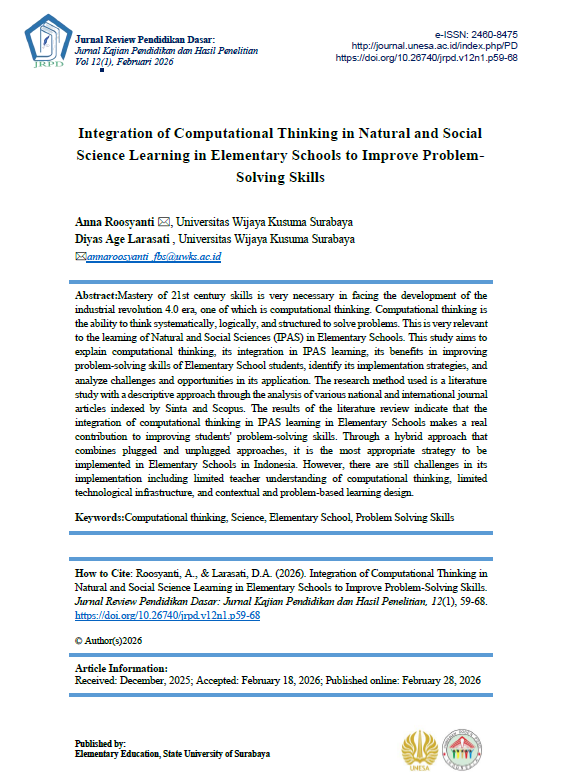
Integration of Computational Thinking in Natural and Social Science Learning in Elementary Schools to Improve Problem-Solving Skills
DOI:
https://doi.org/10.26740/jrpd.v12n1.p59-68Abstract
Mastery of 21st century skills is very necessary in facing the development of the industrial revolution 4.0 era, one of which is computational thinking. Computational thinking is the ability to think systematically, logically, and structured to solve problems. This is very relevant to the learning of Natural and Social Sciences (IPAS) in Elementary Schools. This study aims to explain computational thinking, its integration in IPAS learning, its benefits in improving problem-solving skills of Elementary School students, identify its implementation strategies, and analyze challenges and opportunities in its application. The research method used is a literature study with a descriptive approach through the analysis of various national and international journal articles indexed by Sinta and Scopus. The results of the literature review indicate that the integration of computational thinking in IPAS learning in Elementary Schools makes a real contribution to improving students' problem-solving skills. Through a hybrid approach that combines plugged and unplugged approaches, it is the most appropriate strategy to be implemented in Elementary Schools in Indonesia. However, there are still challenges in its implementation including limited teacher understanding of computational thinking, limited technological infrastructure, and contextual and problem-based learning design.
Kata kunci: Computational thinking, IPAS, Sekolah Dasar, Keterampilan Pemecahan Masalah
References
Bell, A., & Rahardjo, S. (2021). Pengembangan aktivitas unplugged untuk pembelajaran IPAS SD. Jurnal Ilmiah Pendidikan Dasar, 9(1), 71–83.
Bell, T., Witten, I. H., & Fellows, M. (2015). Computer science unplugged: Teaching computer science without computers. Christchurch, New Zealand: University of Canterbury.
Bocconi, S., Chioccariello, A., Dettori, G., Ferrari, A., & Engelhardt, K. (2016). Developing computational thinking in compulsory education. European Journal of Education, 51(3), 371–389.
Brennan, K., & Resnick, M. (2019). New frameworks for teaching computational thinking. Journal of Computing Education Research, 13(4), 5–15.
Chen, C., et al. (2023). Computational thinking in elementary education: A meta-review. Computers & Education Open, 5, 22–35.
Denning, P. J., & Tedre, M. (2021). Computational thinking: A disciplinary perspective. Cambridge, MA: MIT Press.
Dewi, E., & Hasanah, L. (2023). Peran guru dalam pembelajaran computational thinking di SD. Jurnal Pendidikan Guru Sekolah Dasar, 9(3), 115–127.
Fagerlund, M., & Hannikainen, J. (2023). Computational thinking as part of science inquiry. Education and Information Technologies, 28, 223–238.
Fitriani, S., & Yulianto, R. (2022). Computational thinking dan kepemimpinan sekolah. Jurnal Kepemimpinan Pendidikan, 5(1), 77–88.
Gunawan, H. S., Maylia, E. C., Amelia, A. P., & Anasta, N. D. C. (2025). Project-Based Learning (PBL) Model in Improving Critical Thinking of Elementary School Students in Indonesian Language Learning. Jurnal Review Pendidikan Dasar: Jurnal Kajian Pendidikan dan Hasil Penelitian, 11(1), 86-100. https://doi.org/10.26740/jrpd.v11n1.p86-100
Grover, J. (2022). Computational thinking across disciplines: Meta-synthesis findings. Computers & Education, 182, 104–139.
Hsu, R., Chang, L., & Hung, C. (2020). Meta-analysis on the effect of computational thinking on students’ problem solving. Educational Technology & Society, 22(2), 11–27.
Kafai, Y. B., & Brennan, K. (2022). Computational participation in children’s learning. Educational Technology Research and Development, 58(1), 1–27.
Kalelioglu, D., Gulbahar, Y., & Kukul, G. (2016). A framework for computational thinking based on a systematic review. Computers & Education, 94, 17–32.
Karimah, S., & Widiastuti, D. (2022). Pembelajaran IPAS berbasis computational thinking. Jurnal Pendidikan IPA Indonesia, 11(3), 279–288.
Kartika, N., & Supriyadi, S. (2023). Model hibrida dalam pembelajaran computational thinking di SD. Jurnal Pembelajaran Dasar, 5(1), 12–25.
Koehler, B., & Mishra, M. (2020). Framework for interdisciplinary computational thinking. Educational Technology Journal, 13(2), 61–72.
Lestari, P., & Rahayu, M. (2021). Kendala implementasi computational thinking pada kurikulum SD di Indonesia. Jurnal Pendidikan Dasar Nusantara, 9(1), 15–27.
Li, L., & Xu, T. (2023). Integrating computational thinking in primary science. International Journal of Educational Research, 117, 102–114.
Lye, R., Koh, K., & Tan, C. (2021). Computational thinking integrated learning: A framework for STEM in primary schools. Computers in Human Behavior, 125, 106–120.
Lye, S. Y., & Koh, J. H. L. (2020). Review on integrating computational thinking in primary education. Computers & Education, 143, 103–117.
Page, M. J., McKenzie, J. E., Bossuyt, P. M., Boutron, I., Hoffmann, T. C., Mulrow, C. D.,Moher, D. (2021). PRISMA 2020: An updated guideline for reporting systematic reviews. BMJ, 372, n71.
Polya, G. (1957). How to solve it: A new aspect of mathematical method. Princeton, NJ: Princeton University Press.
Pramono, N. (2020). Computational thinking dalam pendidikan abad ke-21. Jurnal Pendidikan dan Pembelajaran Abad 21, 5(2), 93–106.
Rafia, Maulidiyah, A., Haeruddin, & Jamhari, M. (2025). The Effect of Critical Thinking Ability and Learning Motivation on IPAS Learning Outcomes. Jurnal Reviu Pendidikan Dasar: Jurnal Kajian Pendidikan dan Hasil Penelitian, 11(1), 12-22. https://doi.org/10.26740/jrpd.v11n1.p12-22
Rahman, D., & Lubis, H. (2022). Kontekstualisasi pembelajaran computational thinking di Indonesia. Jurnal Pendidikan Dasar Inovatif, 11(2), 88–101.
Rahmawati, F., & Wulandari, S. (2022). Implementasi computational thinking di sekolah dasar. Jurnal Pendidikan Dasar Nusantara, 10(2), 144–159.
Saputra, A. (2022). Dampak pembelajaran computational thinking terhadap self-efficacy siswa SD. Jurnal Teknologi Pendidikan Indonesia, 8(1), 41–55.
Sengupta, A., Dickes, A., & Farris, P. (2016). Development of disciplined interpretation using computational modeling. Journal of Science Education and Technology, 25(5), 760–774.
Shute, V. J., Sun, C., & Asbell-Clarke, J. (2019). Demystifying computational thinking. Educational Research Review, 22, 100–120.
Tan, R. R. (2021). Barriers to computational thinking integration in primary schools. Journal of Educational Information Technology, 25, 321–333.
Tedre, M., & Denning, P. (2021). Computational thinking as a cognitive practice. Communications of the ACM, 64(7), 27–33.
Voss, A., & Jackson, J. (2022). Computational thinking in science classrooms. International Journal of STEM Education, 9(3), 88–102.
Weintrop, G., Beheshti, E., Horn, M., Orton, K., Jona, K., Wilensky, U., & Trouille, L. (2016). Defining computational thinking for science classrooms. Journal of Science Education and Technology, 25(1), 127–147.
Wing, J. M. (2006). Computational thinking. Communications of the ACM, 49(3), 33–35.
Wong, A., & Hiew, S. (2022). Challenges in implementing computational thinking in low-resource schools. Asian Journal of Educational Research, 8(3), 112–125.
Wulandari, M., & Arifin, E. (2023). Instrumen penilaian computational thinking siswa SD. Jurnal Penelitian Pendidikan Dasar, 6(2), 99–112.
Yadav, A., Hong, S., & Stephenson, K. (2020). Measuring teachers’ understanding of computational thinking for science instruction. Journal of Science Teacher Education, 31(3), 258–273.
Yoon, S., & Kim, K. (2023). Exploring computational thinking across science curricula. International Journal of Science Education, 45(1), 33–52.
Downloads
Published
How to Cite
Issue
Section
License
Copyright (c) 2026 Jurnal Review Pendidikan Dasar : Jurnal Kajian Pendidikan dan Hasil Penelitian

This work is licensed under a Creative Commons Attribution 4.0 International License.
 Abstract views: 366
,
Abstract views: 366
, PDF Downloads: 301