The Effectiveness of Pair Programming in Enhancing Elementary School Students’ Creative Thinking Skills in Coding Lessons
DOI:
https://doi.org/10.26740/jrpd.v12n1.p18-31Keywords:
Pair Programing, Coding Learning, Creative Thinking, Collaborative, Elementary SchoolAbstract
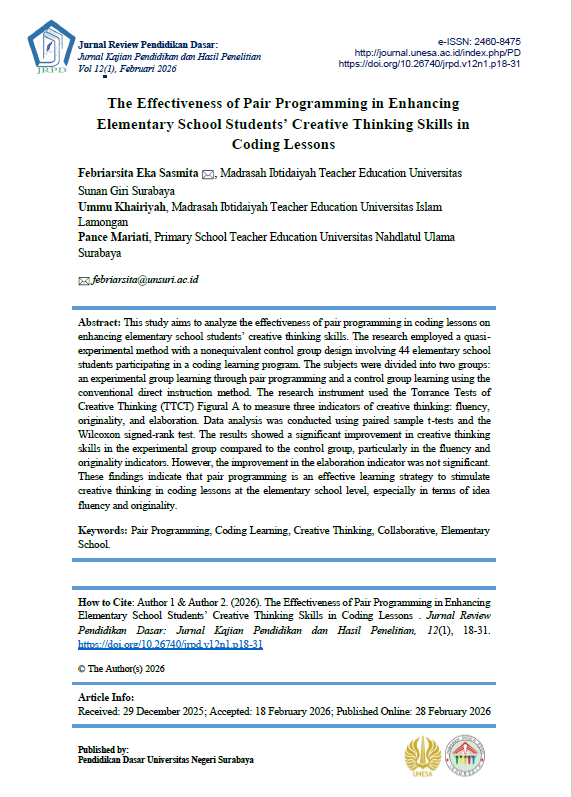
This study aims to analyze the effectiveness of pair programming in coding lessons on enhancing elementary school students’ creative thinking skills. The research employed a quasi-experimental method with a nonequivalent control group design involving 44 elementary school students participating in a coding learning program. The subjects were divided into two groups: an experimental group learning through pair programming and a control group learning using the conventional direct instruction method. The research instrument used the Torrance Tests of Creative Thinking (TTCT) Figural A to measure three indicators of creative thinking: fluency, originality, and elaboration. Data analysis was conducted using paired sample t-tests and the Wilcoxon signed-rank test. The results showed a significant improvement in creative thinking skills in the experimental group compared to the control group, particularly in the fluency and originality indicators. However, the improvement in the elaboration indicator was not significant. These findings indicate that pair programming is an effective learning strategy to stimulate creative thinking in coding lessons at the elementary school level, especially in terms of idea fluency and originali.ty.
References
Angraini, L. M., Sohibun, S., & Arcat, A. (2022). Computational Thinking Berbasis Multimedia Interaktif. Global Research And Consulting Institute (Global-RCI).
Aprilia, E. F. (2025). Implementing Literacy Culture and Digital Literacy in the Early Grades of Primary School. Jurnal Review Pendidikan Dasar: Jurnal Kajian Pendidikan Dan Hasil Penelitian, 11(1), 23–39.
Awaluddin, A., & Hadi, M. S. (2025). Integrasi Pembelajaran Coding Dan Kecerdasan Buatan Di Sekolah Dasar: Tantangan Dan Peluang. Pendas: Jurnal Ilmiah Pendidikan Dasar, 10(01), 1081–1086.
Ayub, M., Karnalim, O., Risal, R., Senjaya, W. F., & Wijanto, M. C. (2019). Utilising Pair Programming to Enhance the Performance of Slow-Paced Students on Introductory Programming. Journal of Technology and Science Education, 9(3), 357–367.
Beghetto, R. A., & Kaufman, J. C. (2010). Nurturing creativity in the classroom. Cambridge University Press.
Clark, V. L. P., Creswell, J. W., Green, D. O., & Shope, R. J. (2008). Mixing quantitative and qualitative approaches. Handbook of Emergent Methods, 363, 363–387.
Cresswell, T. (2014). Place: an introduction. John Wiley & Sons.
Creswell, J. W. (2013). Steps in conducting a scholarly mixed methods study.
Cropley, A. (2006). In praise of convergent thinking. Creativity Research Journal, 18(3), 391–404.
Fraenkel, J. R., & Wallen, N. E. (1990). How to design and evaluate research in education. ERIC.
Grover, S., & Pea, R. (2018). Computational thinking: A competency whose time has come. Computer Science Education: Perspectives on Teaching and Learning in School, 19(1), 19–38.
Guilford, J. P. (1967). Creativity: Yesterday, today and tomorrow. The Journal of Creative Behavior, 1(1), 3–14.
Hanks, B. (2008). Empirical evaluation of distributed pair programming. International Journal of Human-Computer Studies, 66(7), 530–544.
Hannay, J. E., Dybå, T., Arisholm, E., & Sjøberg, D. I. K. (2009). The effectiveness of pair programming: A meta-analysis. Information and Software Technology, 51(7), 1110–1122.
Herman, T., Akbar, A., Farokhah, L., Febriandi, R., Zahrah, R. F., Febriani, W. D., Kurino, Y. D., & Abidin, Z. (2024). Kecakapan abad 21: Literasi matematis, berpikir matematis, dan berpikir komputasi. Indonesia Emas Group.
Hilton, M. L., & Pellegrino, J. W. (2012). Education for life and work: Developing transferable knowledge and skills in the 21st century. National Academies Press.
Jeffrey*, B., & Craft, A. (2004). Teaching creatively and teaching for creativity: Distinctions and relationships. Educational Studies, 30(1), 77–87.
Kim, K. H. (2017). The torrance tests of creative thinking-figural or verbal: Which one should we use? Creativity. Theories–Research-Applications, 4(2), 302–321.
Lui, K. M., & Chan, K. C. C. (2006). Pair programming productivity: Novice–novice vs. expert–expert. International Journal of Human-Computer Studies, 64(9), 915–925.
Lye, S. Y., & Koh, J. H. L. (2014). Review on teaching and learning of computational thinking through programming: What is next for K-12? Computers in Human Behavior, 41, 51–61.
Lye, S. Y., & Koh, J. H. L. (2018). Case studies of elementary children’s engagement in computational thinking through scratch programming. In Computational thinking in the STEM disciplines: Foundations and research highlights (pp. 227–251). Springer.
Mardiana, M., & Emmiyati, E. (2024). Implementasi kurikulum merdeka dalam pembelajaran: Evaluasi dan pembaruan. Jurnal Review Pendidikan Dasar: Jurnal Kajian Pendidikan Dan Hasil Penelitian, 10(2), 121–127.
Naufal, H. A. (2021). Literasi digital. Perspektif, 1(2), 195–202.
Nuraini, R., Pattiasina, P. J., & Ulfah, A. (2022). Peran literasi teknologi dalam dunia pendidikan. Al-Madrasah: Jurnal Ilmiah Pendidikan Madrasah Ibtidaiyah, 6(3), 659–666.
Popat, S., & Starkey, L. (2019). Learning to code or coding to learn? A systematic review. Computers & Education, 128, 365–376.
Putro, Y. T. M., & Astuti, R. (2020). Penerapan Scratch dalam Pembelajaran Coding Siswa Sekolah Dasar. Emergent: Journal of Educational Discoveries and Lifelong Learning (EJEDL), 1(4), 21.
Resnick, M. (2017). Lifelong kindergarten: Cultivating creativity through projects, passion, peers, and play. MIT press.
Runco, M. A. (2008). Creativity and education. New Horizons in Education, 56(1), n1.
Runco, M. A., & Jaeger, G. J. (2012). The standard definition of creativity. Creativity Research Journal, 24(1), 92–96.
Salleh, N., Mendes, E., & Grundy, J. (2014). Investigating the effects of personality traits on pair programming in a higher education setting through a family of experiments. Empirical Software Engineering, 19(3), 714–752.
Sawyer, R. K., & Henriksen, D. (2024). Explaining creativity: The science of human innovation. Oxford university press.
Suhendar, A. M., Ali, S., & Suratman, A. (2021). Membangun Berpikir Kreatif, Sistematis Dan Logis Matematis Melalui Pembelajaran Koding. Jurnal Perspektif, 5(2), 176–190.
Torrance, E. P. (1966). Torrance tests of creative thinking. Educational and Psychological Measurement.
Torrance, E. P. (1977). Creativity in the Classroom; What Research Says to the Teacher.
Trilling, B., & Fadel, C. (2009). 21st century skills: Learning for life in our times. John Wiley & Sons.
Vygotsky, L., & Cole, M. (2018). Lev Vygotsky: Learning and social constructivism. Learning Theories for Early Years Practice. UK: SAGE Publications Inc, 68–73.
Williams, L. A., & Kessler, R. R. (2000). All I really need to know about pair programming I learned in kindergarten. Communications of the ACM, 43(5), 108–114.
Wing, J. (2011). Research notebook: Computational thinking—What and why. The Link Magazine, 6, 20–23.
Wu, L., Looi, C.-K., Multisilta, J., How, M.-L., Choi, H., Hsu, T.-C., & Tuomi, P. (2020). Teacher’s perceptions and readiness to teach coding skills: A comparative study between Finland, Mainland China, Singapore, Taiwan, and South Korea. The Asia-Pacific Education Researcher, 29(1), 21–34.
Downloads
Published
How to Cite
Issue
Section
License
Copyright (c) 2026 Jurnal Review Pendidikan Dasar : Jurnal Kajian Pendidikan dan Hasil Penelitian

This work is licensed under a Creative Commons Attribution 4.0 International License.
 Abstract views: 361
,
Abstract views: 361
, PDF Downloads: 421