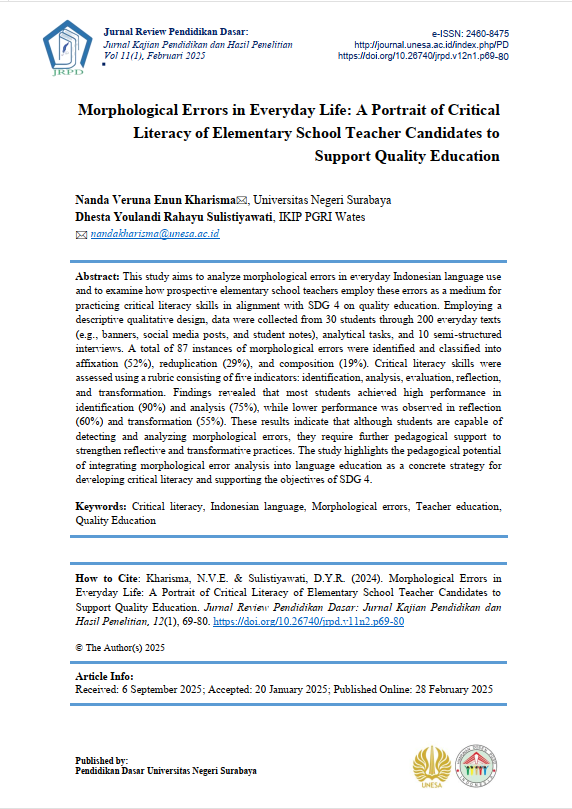
Morphological Errors in Everyday Life: A Portrait of Critical Literacy of Elementary School Teacher Candidates to Support Quality Education
DOI:
https://doi.org/10.26740/jrpd.v12n1.p69-80Keywords:
Critical literacy, Indonesian language, Morphological errors, Teacher education, Quality EducationAbstract
This study aims to analyze morphological errors in everyday Indonesian language use and to examine how prospective elementary school teachers employ these errors as a medium for practicing critical literacy skills in alignment with SDG 4 on quality education. Employing a descriptive qualitative design, data were collected from 30 students through 200 everyday texts (e.g., banners, social media posts, and student notes), analytical tasks, and 10 semi-structured interviews. A total of 87 instances of morphological errors were identified and classified into affixation (52%), reduplication (29%), and composition (19%). Critical literacy skills were assessed using a rubric consisting of five indicators: identification, analysis, evaluation, reflection, and transformation. Findings revealed that most students achieved high performance in identification (90%) and analysis (75%), while lower performance was observed in reflection (60%) and transformation (55%). These results indicate that although students are capable of detecting and analyzing morphological errors, they require further pedagogical support to strengthen reflective and transformative practices. The study highlights the pedagogical potential of integrating morphological error analysis into language education as a concrete strategy for developing critical literacy and supporting the objectives of SDG 4.
References
Adeoye, M. A., Prastikawati, E. F., & Abimbowo, Y. O. (2024). Empowering Learning: Pedagogical Strategies for Advancing 21st Century Skills and Quality Education. Journal of Nonformal Education, 10(1), 10–21. https://doi.org/10.15294/jone.v10i1.1451.
Afriana, R., & Yuliawan, T. (2024). Analysis of Language Errors at the Morphological Level in Students’ Papers at the Islamic University of Riau. RETORIKA: Jurnal Ilmu Bahasa, 10(2), 440–454. https://doi.org/10.55637/jr.10.2.9745.440-454.
Asaad, H. Q. M. (2024). The Role of Morphological Awareness in L2 Postgraduates’ Academic Writing: Is Vocabulary Knowledge a Mediating Variable?. Cogent Education, 11(1), 2327787. https://doi.org/10.1080/2331186X.2024.2327787
Creswell, J. W. (2018). Research Design: Qualitative, Quantitative, and Mixed Methods Approaches (5th ed.). Thousand Oaks, CA: Sage.
Elola, I., & Oskoz, A. (2022). Reexamining Feedback on L2 Digital Writing. Studies in Second Language Learning and Teaching, 12(4), 575-595.
Erdoğan, V. (2005). Contribution of Error Analysis to Foreign Language Teaching. Mersin Üniversitesi Eğitim Fakültesi Dergisi, 1(2), 261–270. https://doi.org/10.17860/EFD.22900.
Ferdoush, Z., & Jahan, R. (2024). Exploring the Challenges Encountered by EFL Teachers in Promoting Critical Thinking Skills. International Journal of Research and Innovation in Social Science, 8(3s), 2053–2062. https://doi.org/10.47772/IJRISS.2024.803148S.
Halid, E. (2022). Analisis Kesalahan Bahasa dalam Bidang Morfologi pada Surat Kabar Kompas.com (Edisi November-Desember 2021). IdeBahasa, 4(1), 39–52. https://doi.org/10.37296/idebahasa.v4i1.81.
Hardianti, M. (2024). Indonesian Higher Education Students’ Perception on Critical Literacy. Englisia: Journal of Language, Education, and Humanities, 11(2), 111–123. https://doi.org/10.22373/ej.v11i2.20003.
Janks, H. (2013). The Importance of Critical Literacy. In J. Pandya & J. Ávila (Eds.), Moving Critical Literacies Forward (pp. 32–44). New York, NY: Routledge.
Jobeen, A., Kazemian, B., & Shahbaz, M. (2015). The Role of Error Analysis in Teaching and Learning of Second and Foreign Language. Education and Linguistics Research, 1(2), 52–62. https://doi.org/10.5296/elr.v1i2.8189.
Khalil, A., Baig, S., & Javed, F. (2023). The Application of Sustainable Development Goal 4 (Quality Education) in BS English Language & Literature Curriculum. Pakistan Languages and Humanities Review, 7(4), 711–717. https://doi.org/10.47205/plhr.2023(7-iv)62.
McLaughlin, M., & DeVoogd, G. (2004). Critical Literacy as Comprehension: Expanding Reader Response. Journal of Adolescent & Adult Literacy, 48(1), 52–62.
Miles, M. B., Huberman, A. M., & Saldaña, J. (2014). Qualitative Data Analysis: A Methods Sourcebook (3rd ed.). Thousand Oaks, CA: Sage.
Mitter, R., & Brissett, N. O. (2017). For Function or Transformation? A Critical Discourse Analysis of Education Under the Sustainable Development Goals. Journal for Critical Education Policy Studies, 15(1), 181–205.
Molden, K. (2007). Critical Literacy, the Right Answer for the Reading Classroom: Strategies to Move Beyond Comprehension for Reading Improvement. Reading Improvement, 44(1), 50–57.
Sidorkin, A. M. (2025). Form-Substance Discrimination: Concept, Cognition, and Pedagogy. arXiv Preprint, arXiv:2504.00412. https://doi.org/10.48550/arXiv.2504.00412.
Siswanto, B. E., Wahida, S. N., Habibie, R. K., & Puspita, A. M. I. (2025). The Role of Social Media in the Formation of Language Politeness of Elementary School Students. Scaffolding: Jurnal Pendidikan Islam dan Multikulturalisme, 7(1), 232-244. https://doi.org/10.37680/scaffolding.v7i1.7016
Sulistyaningrum, S., & Astuti, E. (2019). Aspects of Language Error at Morphological Level in Students’ Descriptive Texts. In Proceedings of the Third International Seminar on Recent Language, Literature, and Local Culture Studies (pp. 20–29). https://doi.org/10.4108/eai.
Vaniev, A., & Malt-Cullen, M. (2025). Mapping Pedagogies of Education for Sustainable Development in Scottish Higher Education Institutions. Journal of Adult and Continuing Education, 31(1), 211–231. https://doi.org/10.1177/14779714241260528.
Wang, C., & Wang, Z. (2025). Investigating L2 Writers' Critical AI Literacy in AI-Assisted Writing: An APSE Model. Journal of Second Language Writing, 67, 101187. https://doi.org/10.1016/j.jslw.2025.101187
Weng, T. H. (2023). Creating Critical Literacy Praxis: Bridging the Gap Between Theory and Practice. RELC Journal, 54(1), 197–207. https://doi.org/10.1177/0033688220982665.
Ydo, Y. (2022). Reaching SDG 4: Our Shared Responsibility and Renewed Commitment to Action. Prospects, 52(3), 223–229. https://doi.org/10.1007/s11125-022-09628-3.
Yin, X., Saad, M. R. B. M., & Halim, H. B. A. (2023). A Systematic Review of Critical Thinking Instructional Pedagogies in EFL Writing: What Do We Know from a Decade of Research?. Thinking Skills and Creativity, 49, 101363. https://doi.org/10.1016/j.tsc.2023.101363.
Downloads
Published
How to Cite
Issue
Section
License
Copyright (c) 2026 Jurnal Review Pendidikan Dasar : Jurnal Kajian Pendidikan dan Hasil Penelitian

This work is licensed under a Creative Commons Attribution 4.0 International License.
 Abstract views: 195
,
Abstract views: 195
, PDF Downloads: 301