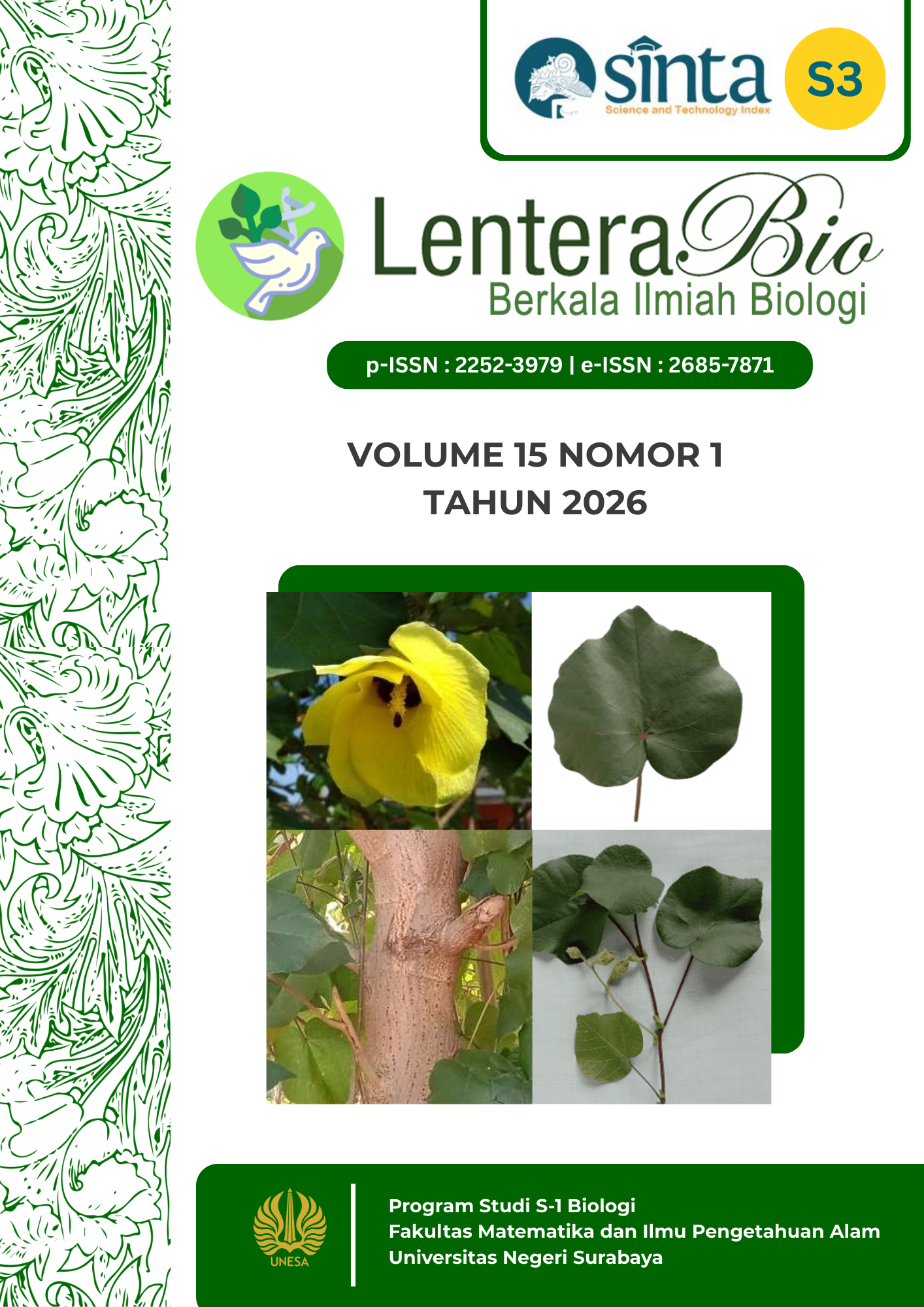
Carbon Stock Analysis of Waru and Bidara in the Campus Forest of Universitas Negeri Surabaya
DOI:
https://doi.org/10.26740/lenterabio.v15n1.p25-32Keywords:
Hibiscus tiliaceus, Ziziphus mauritiana, plant morphology, conservationAbstract
This study evaluated the carbon stock of Hibiscus tiliaceus (Waru) and Ziziphus mauritiana (Bidara) in the UNESA Campus Forest, Surabaya, Indonesia. Its main objective is to analyze the morphological and physiological features that influence their capacity for carbon sequestration, in support of urban reforestation efforts. Non-destructive measurements of chest height diameter (DBH), wood density, and allometric equations were used to estimate biomass and carbon stocks, supplemented by physiological assessments including chlorophyll content and leaf surface. The results of the study showed that Waru showed better morphological characteristics, with an average leaf area of 24,003.28 ± 15,212.06 cm², a stem diameter of 20.26 ± 9.49 cm, and a chlorophyll content of 16.77 ± 6.95 mg/L, producing a biomass of 1923.99 ± 367.03 kg per tree and a carbon stock of 885.04 ± 168.83 kg per tree. In contrast, Bidara has smaller leaves (797.56 ± 72.96 cm²), stem diameter (9.20 ± 4.75 cm), and lower chlorophyll (13.09 ± 5.39 mg/L), with a biomass of 305.37 ± 52.58 kg and a carbon stock of 140.47 ± 24.19 kg. Statistical analysis showed a strong positive correlation between rod diameter and biomass (r = 0.878, p < 0.01) and carbon stock, suggesting that morphological characteristics significantly affect carbon uptake. These findings demonstrate Waru's potential as a strategic urban carbon sink, informing the city's environmental conservation and forestry policies that are aligned with sustainable development goals.
References
Amin M, Ahmed S, and Ali I, 2021. Environmental factors influencing tree biomass and carbon stock in forest ecosystems. Ecological Engineering: 157, 105-113.
Brown S, 1997. Estimating Biomass and Biomass Change of Tropical Forest. a Primer. Rome : FAO.
Chave J, Andalo EC, Brown ES, Cairns MA, Chambers JQ, Eamus ED, Folster EH, Fromard EF, Higuchi N, Kira ET, Lescure EJP, Nelson EBP, Ogawa H, Puig EH, Riera EB and Yamakura ET, 2005. Tree allometry and improved estimation of carbon stocks and balance in tropical forests. Ecologia 145(1): 87-99.
Dahlan EN, 2008. Jumlah emisi gas CO₂ dan pemilihan jenis tanaman berdaya rosot sangat tinggi: studi kasus di kota Bogor. Media Konservasi 13(2): 85–89.
Fatima M, Khan S and Ali A, 2020. The role of forests in carbon sequestration and climate change mitigation. Environmental Science & Policy 105: 45-57.
Ibrahim A dan Muhsoni FF, 2020. Estimation of carbon stock in the mangrove forest ecosystem in Lembung Paseser Village, Sepuluh District, Bangkalan Regency. Juvenil: Jurnal Ilmiah Kelautan dan Perikanan 1(4): 498–507.
Irundu D, Beddu MA, dan Najmawati N, 2020. Potensi biomassa dan karbon tersimpan tegakan di ruang terbuka hijau kota Polewali, Sulawesi Barat. Jurnal Hutan dan Masyarakat 12 (1): 49-57.
IPCC, 2006. IPCC Guidlines for National Greenhouse Gas Inventories. Prepared by the National Greenhouse Gas Inventories Programme, Eggleston HS, Buendia L, Miwa K, Ngara T and Tanabe K. (eds) IGES. Japan: IGES.
Kauffman JB and Donato DC, 2012. Protocols for the measurement, monitoring and reporting of structure, biomass and carbon stocks in mangrove forests. Bogor: CIFOR.
Ketterings QM, Coe R, van Noordwijk M and Palm CA, 2001. Reducing uncertainty in the use of allometric biomass equations for predicting above-ground tree biomass in mixed secondary forests. Forest Ecology and Management 146(1–3): 199–209.
Kumar BM and Kunhamu TK, 2021. Carbon sequestration potential of agroforestry systems in India: A synthesis. In: Udawatta, R. P., and Jose, S. (eds.). Agroforestry and Ecosystem Services: 247-264.
Kurniawan J, Razak A, Syah N, Diliarosta S, and Azhar A, 2024. Pemanasan Global : Faktor, Dampak, dan Upaya Penanggulanagan. INSOLOGI: Jurnal Sains dan Teknologi; 3(6): 646-655.
Maisura M dan Jamidi J, 2020. Respon pertumbuhan dan hasil tanaman padi (Oryza sativa L.) varietas IPB 3S pada beberapa sistem jajar legowo. Jurnal Agrium; 17(1) : 45-53.
Marliza H, Ananta IGBT, Rusmalina S, Malo KH, Meray NW, Khasanah K dan Pratiwi D, 2023. Kimia dasar: teori komprehensif. Jakarta: PT. Sonpedia Publishing Indonesia.
Misra S, Singh A and Patel M, 2022. Chlorophyll content and its relationship with photosynthetic efficiency in tropical plants. Journal of Tropical Plant Science: 56(3): 234-249.
Nahuda FA, Fakhruzy F and Zulmardi Z, 2021. Pendugaan cadangan karbon pada hutan mangrove Kampung Olo Kecamatan Bungus Teluk Kabung Kota Padang Provinsi Sumatera Barat. Sumatera Tropical Forest Research Journal; 5(2): 115-123.
Nedhisa PI dan Tjahjaningrum IT, 2019. Estimasi biomassa, stok karbon, dan sekuestrasi karbon mangrove pada Rhizophora mucronata di Wonorejo Surabaya dengan persamaan allometrik. Jurnal Sains dan Seni ITS 8(2): 61-65.
Nuranisa S, Sudiana E dan Yani E, 2020. Hubungan umur dengan biomassa, stok karbon dioksida, tegakan pohon duku (Lansium parasiticum) di Desa Kalikajar Kecamatan Kaligondang Kabupaten Purbalingga. BioEksakta: Jurnal Ilmiah Biologi Unsoed 2(1): 146.
Pahrurrozi, Muazzasari F, Suyantri E and Sania NO, 2025. Estimation of Carbon Stock in Mangrove Seedling and Sediment in The Muara Gembong Area, Bekasi, West Java. Journal of Biology, Environment, and Edu-Tourism 1(1): 39-48.
Posumah, D. (2017). Uji Kandungan Klorofil Daun Tanaman Cabai Merah (Capsicum annumL.) melalui Pemanfaatan Beberapa Pupuk Organik Cair. Jurnal Mipa, 6(2), 101-104.
Renjana E, Angio MH and Metusala D, 2024. Carbon stock estimation of trees and poles in Karendan Forest, North Barito, Central Kalimantan, In: Conference Series: Earth and Environmental Science 1433(1).
Sammi RK., Srinivasarao C, Girija VV, Prasad JVNS, Sharma KL, Sumanta K, and Singh AK, 2021. Mitigation strategies to enhance carbon sink potential in climate vulnerable districts of Eastern India. Climate and Development; 13(4): 360–373.
Sari S, Hidayat R and Taufik M, 2021. The relationship between tree diameter and biomass in tropical forests. Forest Ecology and Management 477: 118-127.
Sugiatmo S, Poedjirahajoe E, Pudyatmoko S, and Purwanto RH, 2023. Carbon stock at several types of mangrove ecosystems in Bregasmalang, Central Java, Indonesia. Biodiversitas Journal of Biological Diversity; 24(1).
Taiz L and Zeiger E, 2015. Plant physiology and development. 6th edition. Sunderland: Sinauer Associates.
Windarni C, 2017. Estimation of stored carbon in the mangrove forest of Margasari Village, Labuhan Maringgai District, East Lampung Regency. Jurnal Sylva Lestari 6(1): 66-75.
Zakiyah M, Manurung TF, & Wulandari RS, 2018. Chlorophyll content of leaves in four tree species at the Sylva Indonesia PC Arboretum, Tanjungpura University. Sustainable Forest Journal; 6(1).
Downloads
Published
How to Cite
Issue
Section
License
Copyright (c) 2026 LenteraBio : Berkala Ilmiah Biologi

This work is licensed under a Creative Commons Attribution-NonCommercial 4.0 International License.
Hak Cipta (c) LenteraBio: Berkala Ilmiah Biologi

Karya ini dilisensikan di bawah Lisensi Internasional Creative Commons Attribution-NonCommercial 4.0.
Pemberitahuan Hak Cipta.
Hak cipta dari artikel yang diterima untuk diterbitkan akan diberikan kepada jurnal sebagai penerbit jurnal. Hak cipta yang dimaksud meliputi hak untuk menerbitkan artikel dalam berbagai bentuk (termasuk cetak ulang). Jurnal mempertahankan hak penerbitan atas artikel yang diterbitkan.
 Abstract views: 813
,
Abstract views: 813
, PDF Downloads: 280