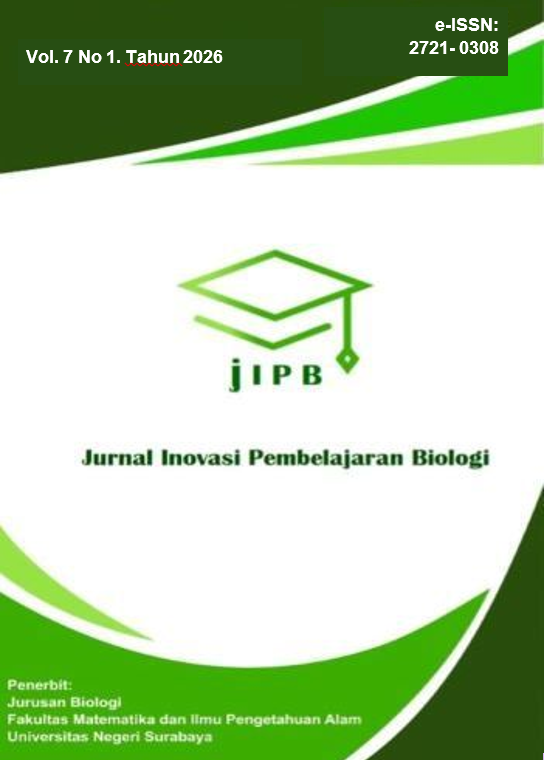
Inovasi Pembelajaran: Pengembangan Eco-Explorer Game Terintegrasi SDGS Terhadap Dimensi Bergotong Royong dan Hasil Belajar Kognitif
DOI:
https://doi.org/10.26740/jipb.v7n1.p1-20Keywords:
Media pembelajaran, Dimensi Bergotong royong, Hasil belajar kognitif, Life on Land, biology learning innovationAbstract
Learning ecosystem material can be taught in line with efforts to realize the Sustainable Development Goals, one of which is the point of Life on Land. Learning media plays a crucial role in facilitating effective learning and offers advantages, especially in terms of flexibility and interactivity. This development aims to produce a website-assisted learning product, the Eco-Explorer Game, which is effective in improving the dimensions of mutual cooperation and cognitive learning outcomes. The development process follows the Lee & Owens model, which consists of five stages: analysis, design, development, implementation, and evaluation. In the implementation stage, this study used a pre-experimental design with a one-group pretest-posttest technique, with a sample consisting of 36 tenth-grade students at SMAN 1 Singosari. Quantitative data were collected through two main instruments: pretest and posttest scores to measure cognitive learning outcomes, and observation sheets equipped with a quantitative assessment rubric to measure the dimensions of mutual cooperation (collaboration, caring, and sharing). The data analysis technique to measure the improvement of both variables used the N-Gain test. The collected data shows that the game is proven to be effective in improving the dimensions of mutual cooperation and students' cognitive learning outcomes as indicated by the increase in the average achievement results of each indicator both in the dimensions of mutual cooperation (from the initial 56.1 to 88.7) and also cognitive learning outcomes (from the initial 66.8 to 87.7). The N-Gain score obtained from the observation sheet for the dimensions of mutual cooperation shows a high score of 0.7. Furthermore, cognitive learning outcomes show an N-Gain score of 0.62, which is included in the moderate category. Based on these findings, it can be concluded that the Eco-Explorer Game is very effective in improving the dimensions of mutual cooperation of students and is quite effective in improving their cognitive learning outcomes.
References
Adnin, A. B., Rahmanto, Y., & Puspaningrum, A. S. (2022). Pembuatan Game Edukasi Pembelajaran Kata Imbuhan untuk Tingkat Sekolah Dasar (Studi Kasus SD Negeri Karang Sari Lampung Utara). Jurnal Informatika Dan Rekayasa Perangkat Lunak (JATIKA), 3(2), 202–212.
Aka, K.A., Akbar, S., & Sehartian, J. (2018). Development of Validation Instrument for Interactive Multimedia Learning Implementation Plan. Proceedings of The 1st International Conference on Early Childhood and Primary Education , 118-123. Paris, France: Atlantis Press.
Agredo, D. V., Collazos, C. A., Fardoun, H. M., & Safa, N. (2017). Collaboration Increase Through Monitoring and Evaluation Mechanisms of The Collaborative Learning Process. Lecture Notes in Computer Science, 1(1), 20–31.
Ahmad, C. V. (2021). Causes of Students’ Reluctance to Participate in Classroom Discussions ASEAN Journal of Science and Engineering Education. ASEAN Journal of Science and Engineering Education, 1(1), 47–62.
Amanda, D. A., & Putri, A. R. (2019). Pengembangan Game Edukasi pada Mata Pelajaran Matematika Materi Bangun Datar Berbasis Android di SDN 1 Jepun. Journal of Education and Information Communication Technology, 3(2), 160–168.
Anderson, L. W., Krathwohl Peter W Airasian, D. R., Cruikshank, K. A., Mayer, R. E., Pintrich, P. R., Raths, J., & Wittrock, M. C. (2001). Taxonomy For Assessing a Revision of Bloom Taxonomy of Educational Objectives. New york: Addison Wesley Longman, Inc.
Anwar, S., & Jasiah. (2024). Pengembangan Media Pembelajaran Berbasis Game Educaplay untuk Meningkatkan Keaktifan Siswa pada Mata Pelajaran SKI. Jurnal Budi Pekerti Agama Islam, 3(1), 355–373.
Arends, R. (2012). Arends_2012 (9th ed.). New York: McGraw-Hill.
Ayu, D. D., & Wibowo, C. (2015). Pengaruh Permainan Kartu Kwartet terhadap Kemampuan Mengingat Kosakata Bahasa Jepang. PSIKODIMENSIA: Kajian Ilmiah Psikologi, 14(1), 135–152.
Castro, H., Pinto, N., Pereira, F., Ferreira, L., Ávila, P., Bastos, J., Putnik, G. D., & Cruz-Cunha, M. (2021). Cyber-Physical Systems Using Open Design: An Approach Towards an Open Science Lab for Manufacturing. Procedia Computer Science, 196(1), 381–388.
Cha, S. S., & Seo, B. K. (2018). Smartphone Use and Smartphone Addiction in Middle School Students in Korea: Prevelence, Social Networking Service, and Game Use. Health Psychology Open, 5(1), 1–15.
Chagas, C. M. D. S., Pontes E Silva, T. B., Reffatti, L. M., Botelho, R. B. A., & Toral, N. (2018). Rango Cards, A Digital Game Designed to Promote a Healty Diet: A Randomized Study Protocol. BMC Public Health, 18(1), 18–28.
Chen, Y. (2023). Integrating a Game-Based App to Enhance Translation Learners’ Engagement, Motivation, and Performance. International Journal of Instruction, 16(2), 759–782.
Clark, D. B., Tanner-Smith, E. E., & Killingsworth, S. S. (2016). Digital Games, Design, and Learning: A Systematic Review and Meta-Analysis. Review of Educational Research, 86(1), 79–122.
Corrégé, J. B., & Michinov, N. (2021). Group Size and Peer Learning: Peer Discussions in Different Group Size Influence Learning in a Biology Exercise Performed on a Tablet With Stylus. Frontiers in Education, 6(1), 1–13.
Farihin, Hidayah, N., Fathoni, M., Primajati, G., & Rusandi, H. (2022). Meningkatkan Kesadaran Masyarakat Akan Pentingnya Kebersihan Lingkungan. Jurnal Mengabdi Dari Hati, 1(2), 75–82.
Gabrito, R. C., Ibañez, R. Y., Frederick, J. P., Campus, C., & Espinosa, E. B. (2023). Impact of Online Gaming on the Academic Performance of DEBESMSCAT-Cawayan Campus Students. Scientific Journal of Informatics, 10(4), 423–435.
Hafzah, N., Amalia, K. P., Lestari, E., Annisa, N., Adiatmi, U., & Saifuddin, F. (2020). Meta-Analisis Efektivitas Penggunaan Media Pembelajaran Digital dalam Peningkatan Hasil dan Minat Belajar Biologi Peserta Didik di Era Revolusi Industri 4.0. Jurnal Biodik: Jurnal Ilmiah Pendidikan Biologi, 6(4), 541–549. https://online-journal.unja.ac.id/biodik
Hanif, R. F., & Susilowati, E. (2021). Penerapan Model Problem Solving Dilengkapi Game Quizizz untuk Meningkatkan Kemampuan Berpikir Analisis dan Prestasi pada Materi Reaksi Redoks Kelas X Lintas Minat Kimia 5 SMA Negeri 5 Surakarta. Jurnal Pendidikan Kimia, 10(1), 96–100.
Haryanto, N. J., Suryandari, K. C., & Hidayah, R. (2024). Peningkatan Kepedulian Lingkungan Melalui Pembelajaran Berbasis Lingkungan dengan Media Game Online pada Siswa Sekolah Dasar. Kalam Cendekia: Jurnal Ilmiah Kependidikan, 12(3), 1718–1729.
Herwani. (2022). Peran Guru sebagai Pelaku Perubahan. Educatioanl Journal: General and Specific Research, 2(3), 391–396.
Huan, Y., & Zhu, X. (2022). Interactions Among Sustainable Development Goal 15 (life on land) and Other Sustainable Development Goals: Knowledge for Identifying Global Conservation Actions. Sustainable Development Journal, 31(1), 1–13. https://doi.org/10.1002/sd.2394
Johnson, L., Becker, A. S., Cummins, M., Estrada, V., Freeman, A., & Ludgate, H. (2013). Horizon Report 2013 Higher Education Edition NMC. Texas: The New Media Consortium.
Kementerian Pendidikan Kebudayaan, R. dan T. (2022). Profil Pelajar Pancasila: Dimensi Bergotong Royong. Jakarta: Pusat Penguatan Karakter Kementerian Pendidikan, Kebudayaan, Riset, dan Teknologi
Kimmig, A. C. S., Andringa, G., & Derntl, B. (2018). Potential Adverse Effects of Violent Video Gaming: Interpersonal- Affective Traits Are Rather Impaired Than Disinhibition in Young Adults. Frontiers in Psychology, 9(1), 1–11.
Kurniawan, E. S., Mundilarto, & Istiyono, E. (2024). Improving Student Higher Order Thinking Skills Using Synectic-HOTS-Oriented Learning Model. International Journal of Evaluation and Research in Education, 13(2), 1132–1140.
Listyoningsih, E., & Niawati, D. (2022). Penggunaan Metode Diskusi dalam Meningkatkan Kemampuan Bertanya pada Pembelajaran Pendidikan Kewarganegaraan Kelas VI SD Islam Nurul Hikmah Sugio Lamongan. Jurnal Wahana Pendidikan Dasar, 9(2), 9–19.
Maksum, M., Mas’udi, M., Suparta, M., Mintarti, N., Hasanudin, & Purwakananta, A. (2018). Fikih Zakat on SDG’s. Bandung: Mumtaza Press.
Mattiev, B. (2022). The Importance of Setting Goals And Objectives In The Classroom, Students’ Worldview and Method of Setting Learning Objectives. European Scholar Journal (ESJ), 3(2), 46–50.
Meidianti, A., Kholifah, N., & Sari, N. I. (2022). Kemampuan Pemahaman Konsep Matematis Peserta Didik dalam Pembelajaran Matematika. Jurnal Ilmiah Mahasiswa Pendidikan Matematika, 2(2), 134–144.
Monalia, Asfiyanti, N. A., & Putri, S. E. (2021). Computers and Information Technology as a Source of Learning Media for Elementary School Teachers. International Journal of Natural Science and Engineering, 5(3), 96–103.
Mundelsee, L., & Jurkowski, S. (2021). Think and pair before share: Effects of collaboration on students’ in-class participation. Learning and Individual Differences, 88(1), 1–11.
Naeini, F. H., & Masood, M. (2012). Effect of Educational Computer Games on Student Creativity. Research Journal of Applied Sciences, Engineering and Technology, 4(23), 5280–5284.
Najuah, Sidiq, R., & Simamora, R. S. (2022). Game Edukasi: Strategi dan Evaluasi Belajar Sesuai Abad 21. Medan: Yayasan Kita Menulis.
Prensky, M. (2001). Digital Digital Game-Based Game-Based Learning Learning. New York: Mc-Graw Hill.
Puspitasari, E., & Amirudin, A. (2016). Integrasi Berpikir Kritis dan Peduli Lingkungan Melalui Pembelajaran Geografi dalam Membentuk Karakter Peserta Didik SMA. Jurnal Pendidikan: Teori, Penelitian, Dan Pengembangan, 1(2), 122–126.
Rianti, R., Syahid, A., & Qamariah, Z. (2022). The Effectiveness of Pair Work Activities on Students’ Speaking Anxiety and Speaking Ability. Jurnal Educatio, 8(4), 1471–1477.
Rosmawati, R., & Sritresna, T. (2021). Kemampuan Pemahaman Konsep Matematis ditinjau dari Self-Confidence Siswa pada Materi Aljabar dengan Menggunakan Pembelajaran Daring. Jurnal Pendidikan Matematika, 1(1), 275–290.
Salim, N. A. , Avicenna, A. , Suesilowati., Ermawati, E. A. , Panjaitan, M. M. J. , Yustita, A. D. , Susanti, S. S. , Saputro, A. N. C. , Muslimin, T. P. , Soputra, D. , Lestari, H. , Yuniwati, I. , Suhartati, T. , & Sari, I. N. (2022). Dasar-Dasar Pendidikan Karakter. Medan: Yayasan Kita Menulis.
Samsirin. (2017). Nilai-Nilai Pendidikan Karakter Menurut Konsep Yusuf Qardhawi. Jurnal Educan, 01(01), 47–57.
Sappaile, B. I., Pristiwaluyo, T., & Deviana, I. (2021). Hasil Belajar dari Perspektif Dukungan Orangtua dan Minat Belajar Siswa. Gowa: Global-RCI.
Sayer, J., Sheil, D., Galloway, G., Riggs, R. A., Mewett, G., Macdicken, K. G., Arts, B., Boedhihartono, A. K., Langston, J., & Edwards, D. P. (2019). Chapter 15 SDG 15: Life on Land-The Central Role of Forests in Sustainable Development (9th ed.). Cambridge: Cambridge University Press.
Septiana, N. N., Prastowo, A., & Frasandy, R. N. (2024). Penggunaan Wordwall untuk Menumbuhkembangkan Kemampuan Berpikir Tingkat Tinggi Peserta Didik pada Mata Pelajaran Bahasa Indonesia di Madrasah Ibtidaiyah. HOLISTIKA: Jurnal Ilmiah PGSD, 1(1), 71–86.
Siringo, R. F., & Elfani, B. J. (2020). Metode Think Pair Share untuk Meningkatkan Kemampuan. Jurnal Ilmiah DIDAKTIKA, 20(2), 213–224.
Sundberg, M. (2018). Online Gaming, Loneliness, and Friendships Among Adolescents and Adults with ASD. Computers in Human Behaviour, 79(1), 105–110.
Wheelan, S. A. (2016). Creating Effective Teams: A Guide for Members and Leaders (3rd ed.). New York: SAGE Publisher.
Yuliastrin, A., Vebrianto, R., Berlian, M., & Thahir, M. (2023). Developing media of virtual laboratory of science: To support as a pioneer of cyber-university. Contemporary Educational Technology, 15(2).
Zhang, Q., Lin, S., Liu, J., & Jin, Y. (2022). A Game Perspective on Collaborative Learning Among Students in Higher Education. Cogent Education, 9(1), 1–15.
Zheng, H., Jung, E., Li, T., & Yoon, M. (2022). Effects of Segmentation and Self-Explanation Designs on Cognitive Load in Instructional Videos. Contemporary Educational Technology, 14(2).
Downloads
Published
Issue
Section

 Abstract views: 528
,
Abstract views: 528
, PDF Downloads: 587