Community Structure, Diversity, and Regeneration Patterns of Ficus Species in The Manggis Gadungan Nature Reserve, Kediri
Abstract
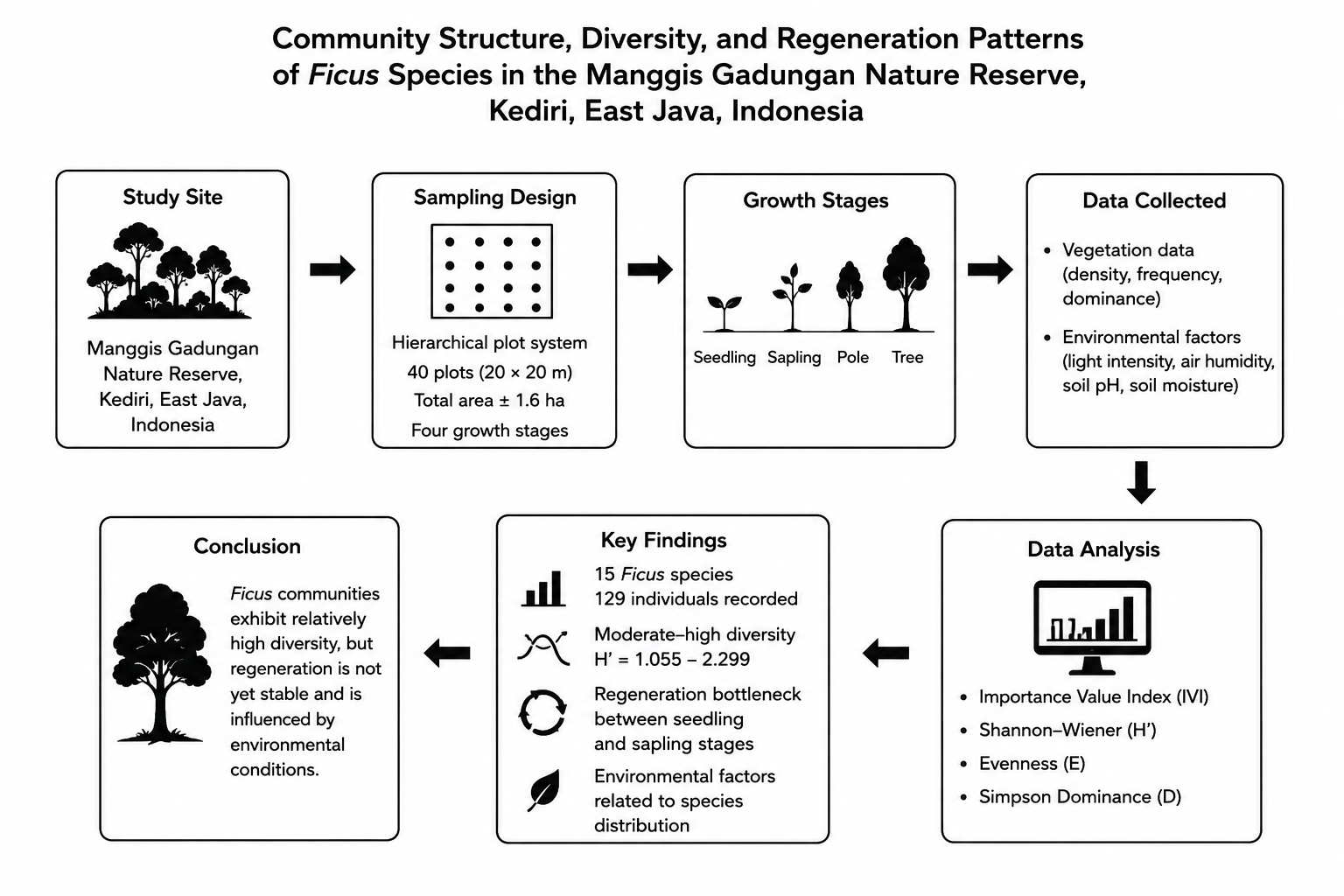
The genus Ficus plays a vital role in tropical forest ecosystems as a keystone species that supports biodiversity and ecosystem stability. This study aims to analyse vegetation structure, species diversity, regeneration patterns, and the influence of environmental factors on Ficus communities in the Manggis Gadungan Nature Reserve, East Java. The study employed a hierarchical plot method across 40 plots (20 × 20 m) with a total area of approximately 1.6 ha. Vegetation data were collected at the seedling, sapling, pole, and tree levels, and analysed using the Importance Value Index (IVI), the Shannon–Wiener index (H’), evenness index (E), Simpson’s dominance index (D). Environmental factors measured included light intensity, air humidity, soil pH, and soil moisture. Results showed 15 Ficus species with a total of 129 individuals. H’ values ranged from 2.1 to 2.8 (moderate to high diversity), with evenness of 0.62–0.81, indicating that individual distribution was not yet even. Dominance patterns varied between strata, with the highest INP at the pole level. Regeneration indicated a bottleneck at the seedling stage (regeneration bottleneck). Environmental factors, particularly light intensity and soil moisture, influenced species distribution. In conclusion, the Ficus community exhibits relatively high diversity, yet its regeneration is not yet stable and is influenced by environmental conditions.
References
Ambarwati, R., Rahayu, D. A., Rachmadiarti, F., & Khaleyla, F. (2021). DNA barcoding of lamp shells (Brachiopoda: Lingula anatina) from Probolinggo, East Java, Indonesia. Biodiversitas, 22(4), 1764–1774. https://doi.org/10.13057/biodiv/d220421
Abuel, J. W., Dagdagui, G. T., Paltiyan-Bugtong, J. C., & Napaldet, J. T. (2025). The role of native trees in tropical forest regeneration: The case of Ficus minahassae (Teijsm. & De Vriese) Miq. (Moraceae) in Benguet, Philippines. Journal of Tropical Forest Science, 37(4), 449–462. https://doi.org/10.26525/jtfs2025.37.4.449
Azhari, M. F., Soendjoto, M. A., & Putra, A. P. (2024). Diversity and Distribution of Ficus on the Campus of Universitas Lambung Mangkurat, Banjarmasin, Indonesia. Prisma Sains: Journal of Mathematics and Science Education Research, IKIP Mataram, 12(3), 439–450.
Azizah, S., Shofiyyah, R., Firmansyah, F., Ramadhan, A. M. W., Aprylasari, D., & Irsyan, N. A. (2024). Challenges & Opportunities for Livestock Farming in Besowo Nature Reserve. Drestanta Pelita Indonesia Foundation.
Bongers, F., Poorter, L., Hawthorne, W. D., & Sheil, D. (2020). The intermediate disturbance hypothesis applies to tropical forests, but disturbance contributes little to tree diversity. Ecology Letters, 23(4), 1–10. https://doi.org/10.1111/ele.13456
Castillo-Diaz, D., Chen, H., Harrison, R. D., Wen, B., & Goodale, U. M. (2021). Seedling emergence and environmental filters determine Ficus recruitment in a subtropical landscape. Forest Ecology and Management, 497, 119536. https://doi.org/10.1016/j.foreco.2021.119536
Diena, F., Setyowati, I. S., Maharani, A., Sihotang, R. L., Julyta, N. N., Afsari, J. D., & Alifin, E. (2025). Identification of Plant Species to Assess Biodiversity in the Serengseng Forest Ecosystem. Jurnal Media Akademik (JMA), 3(12).
Fujita, T. (2021). Fire Suppression and Seed Dispersal Play Critical Roles in The Establishment of Tropical Forest Tree Species In Southeastern Africa. Scientific Reports, 11, 16391. https://doi.org/10.1038/s41598-021-95752-7
Hartati, P., Asmarahman, C., Riniarti, M., Safe’i, R., & Darmawan, A. (2025). Dominance of vegetation diversity across various forest disturbance areas in the Way Waya Forest Management Unit, Central Lampung Regency. ULIN: Journal of Tropical Forests, 9(1), 174–190.
Hendrayana, Y., Sudiana, E., Adhya, I., & Ismail, A. Y. (2022). Bird diversity in three Ficus species in the Kuningan Lowland Forest, West Java, Indonesia. Biodiversitas: Journal of Biological Diversity, 23(5).
Hendrayana, Y., Widodo, P., Kusmana, C., & Widhiono, I. (2019). Diversity and distribution of figs (Ficus spp.) across altitudes in Gunung Tilu, Kuningan, West Java, Indonesia. Biodiversitas, 20(6), 1568–1574. https://doi.org/10.13057/biodiv/d200612
Idris, M. H., Latifah, S., & Setiawan, B. (2020). The state of community-based forest vegetation in the villages of Aik Bual and Setiling, Lombok Island. Jurnal Sylva Lestari, 8(2), 218–229. https://doi.org/10.23960/jsl28218-229
Kailola, R., Kastanya, A., & Sahureka, M. (2021). Vegetation structure and species diversity in tropical forest ecosystems of small islands in Maluku. Jurnal Sylva Lestari, 9(3), 412–423. https://doi.org/10.23960/jsl.v9i3.517
Komul, Y. D., Sahupala, A., Siahaya, T. E., & Sahupala, G. L. (2024). Dominance, richness and evenness of vegetation species in coastal forests at the regeneration stage in Kairatu Sub-district, West Seram Regency. Jurnal Hutan Lestari, 12(1), 12–21.
Matsuo, T., Martínez-Ramos, M., Onoda, Y., Bongers, F., Lohbeck, M., & Poorter, L. (2023). Light competition drives species replacement during secondary tropical forest succession. Forest Ecology and Management, 529, 120706. https://doi.org/10.1016/j.foreco.2022.120706
Maulidia, O., Al Amin, S. F., Dharma, Y., Hasibuan, M. M., & Rahmasari, S. N. (2025). Analysis of Vegetation Structure and Species Diversity in the Ranggawulung Urban Forest Area. Journal of Tropical Biology, 25(4), 5527–5539.
Menezes Pinto, Í., Emer, C., Cazetta, E., & Morante-Filho, J. C. (2021). Deforestation simplifies understory bird seed-dispersal networks in human-modified landscapes. Frontiers in Ecology and Evolution, 9, 640210. https://doi.org/10.3389/fevo.2021.640210
Mensah, S., Salako, V. K., Assogbadjo, A. E., Glèlè Kakaï, R. L., & Sinsin, B. (2020). Functional Trait Diversity Is A Stronger Predictor Of Ecosystem Functioning Than Species Diversity In Tropical Forests. Ecological Indicators, 115, 106375. https://doi.org/10.1016/j.ecolind.2020.106375
Naharuddin, N. (2020). Structure and Associations of Mangrove Vegetation in the Lower Torue River Basin, Parigi Moutong, Central Sulawesi. Jurnal Sylva Lestari, 8(3), 378–389. https://doi.org/10.23960/jsl38378-389
Nurlaili, Siti., Putra, ADK., Dhanarko, Topo, B. (2025). Ficus in the Manggis Gadungan Nature Reserve and the Besowo Gadungan Nature Reserve. Ministry of Forestry. Jakarta
Poorter, L., Bongers, F., Aide, T. M., Zambrano, A. M. A., Balvanera, P., Becknell, J. M., ... & Rozendaal, D. M. A. (2021). Multidimensional tropical forest recovery. Science, 374(6573), 1370–1376. https://doi.org/10.1126/science.abh3629
Prastyaningsih, S. R., Effendy, I., Azwin, A., & Repi, R. (2025). Species Diversity of Tropical Peat Swamp Forests with High Conservation Value (HCV). Journal of Forest Research and Nature Conservation, 22(1), 15–28.
Qayim, I., & Chikmawati, T. (2022). A Study on Diversity and Distribution of Figs (Ficus, Moraceae) in Bogor City, West Java, Indonesia. Journal of Tropical Biodiversity & Biotechnology, 7(2), 23-34.
Raji, I. A., & Downs, C. T. (2022). Tree visitation and potential seed dispersal of keystone Ficus species by vertebrates in an urban mosaic landscape in eastern South Africa. Acta Oecologica, 117, 103865 https://doi.org/10.1016/j.actao.2022.103865
Razafindratsima, O. H., Raoelinjanakolona, N. N., Heriniaina, R. R., Nantenaina, R. H., Ratolojanahary, T. H., & Dunham, A. E. (2021). Simplified communities of seed-dispersers limit the composition and flow of seeds in edge habitats. Frontiers in Ecology and Evolution, 9, 655441. https://doi.org/10.3389/fevo.2021.655441
Salsabila, R., Hariyadi, H., & Santoso, N. (2021). Tree Health Management Strategy in the Cianjur Urban Forest. Jurnal Sylva Lestari, 9(1), 86–103. https://doi.org/10.23960/jsl1986-103
Sulfayanti, R., Dirhamzah, D., & Nurindah, N. (2023). Analysis of understorey vegetation in the Topidi Conservation Forest Area, Tinggimoncong Sub-district, Gowa Regency. Filogeni: Biology Student Journal, 3(1), 38–43.
Wang, X., Liu, L., Xie, J., Wang, X., Gu, H., Li, J., ... & Yang, X. (2023). Research Status And Prospects On The Construction Methods Of Temperature And Humidity Environmental Models In Arbor Tree Cultivation. Agronomy, 14(1), 58.
Wijaya, I. M. S., & Defiani, M. R. (2021). Diversity and distribution of figs (Ficus: Moraceae) in Gianyar District, Bali, Indonesia. Biodiversitas, 22(1), 233–246. https://doi.org/10.13057/biodiv/d220129
Yang, Y., Zhang, J., Wang, B., Zhao, Y., & Chen, J. (2021). Seedling emergence and environmental filters determine Ficus recruitment in a subtropical landscape. Forest Ecology and Management, 497, 119536. https://doi.org/10.1016/j.foreco.2021.119536
Zhao, Y., Zou, Y., Wang, L., Su, R., He, Q., Jiang, K., & Wang, C. (2021). Tropical rainforest successional processes can facilitate the successful recovery of extremely degraded tropical forest ecosystems following intensive mining operations. Frontiers in Environmental Science, 9, 701210. https://doi.org/10.3389/fenvs.2021.701210
RESEARCH HIGHLIGHTS
• Fifteen Ficus species and 129 individuals were recorded in the reserve.
• Species dominance shifted across seedling, sapling, pole, and tree stages.
• Regeneration showed a bottleneck between seedling and sapling stages.
• Light and soil moisture shaped Ficus distribution and regeneration.
Downloads
Published
How to Cite
Issue
Section
License
Copyright (c) 2026 Jurnal Riset Biologi dan Aplikasinya

This work is licensed under a Creative Commons Attribution-NonCommercial 4.0 International License.
 Abstract views: 0
,
Abstract views: 0
, PDF Downloads: 0