Morphological and Morphometric Study of Pila celebensis (Gastropoda: Ampullariidae) from Madura Island, Indonesia
DOI:
https://doi.org/10.26740/jrba.v7n2.p160-167Abstract
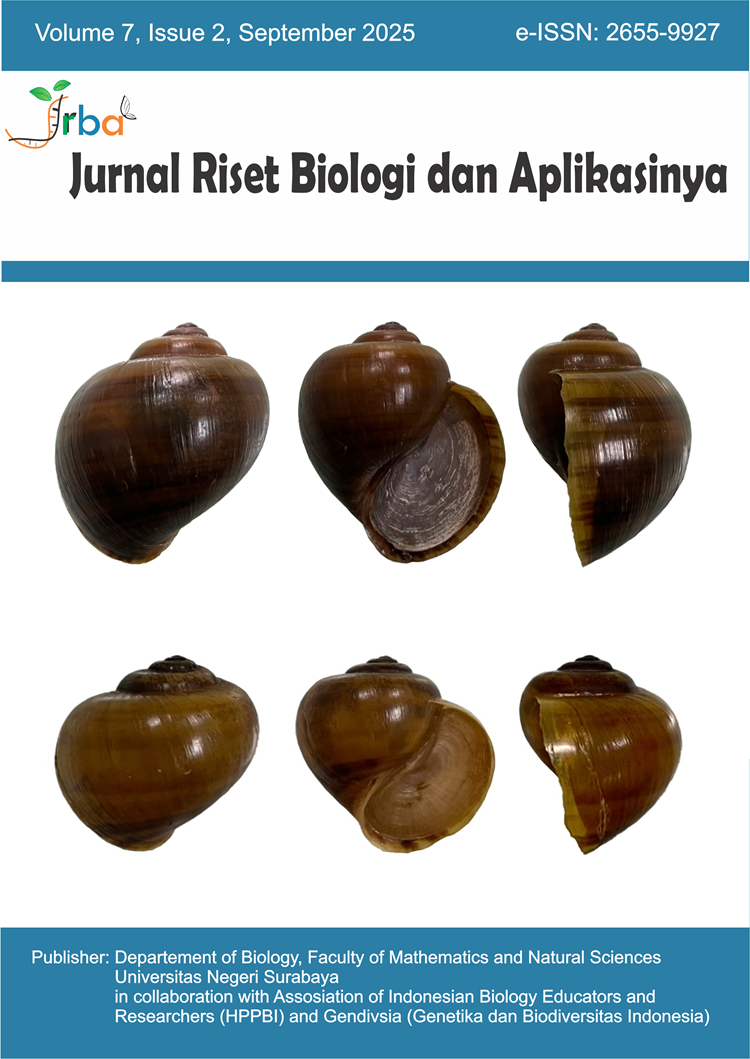
Pila celebensis (family Ampullariidae) is a native freshwater snail species found in Asia, including Indonesia, and possesses significant ecological and economic importance. However, Pila populations face various threats due to the invasiveness of Pomacea, as well as human activities. This study aimed to document the presence of P. celebensis on Madura Island and describe its morphological and morphometric characteristics. Samples were collected from four localities in Madura. All specimens had a similar morphological shell, including a spherical shell with a prominent brown color and dark brown spiral pattern, an oval to elongate lunar aperture, a thin or closed umbilicus, and a concentric operculum. However, morphometric size varied significantly by location. The largest individuals were found in the rice fields of South Poter Village, while the smallest were found in a stream in Nyalabuh Laok Village. This difference reveals that environmental factors, notably habitat conditions and food quality, have a significant impact on shell growth, with higher nutrition supporting larger sizes.Pila celebensis (family Ampullariidae) is a native freshwater snail species found in Asia, including Indonesia, and possesses significant ecological and economic importance. However, Pila populations face various threats due to the invasiveness of Pomacea, as well as human activities. This study aimed to document the presence of P. celebensis on Madura Island and describe its morphological and morphometric characteristics. Samples were collected from four localities in Madura. All specimens had a similar morphological shell, including a spherical shell with a prominent brown color and dark brown spiral pattern, an oval to elongate lunar aperture, a thin or closed umbilicus, and a concentric operculum. However, morphometric size varied significantly by location. The largest individuals were found in the rice fields of South Poter Village, while the smallest were found in a stream in Nyalabuh Laok Village. This difference reveals that environmental factors, notably habitat conditions and food quality, have a significant impact on shell growth, with higher nutrition supporting larger sizes.
References
Bae, M. J., Kim, E. J., & Park, Y. S. (2021). Comparison of invasive apple snail (Pomacea canaliculata) behaviors in different water temperature gradients. Water (Switzerland), 13(9). https://doi.org/10.3390/w13091149
Broto, R. T. D. W., Arifan, F., Setyati, W. A., Eldiarosa, K., & Zein, A. R. (2020). Crackers from Fresh Water Snail (Pila ampullacea) Waste as Alternative Nutritious Food. IOP Conference Series: Earth and Environmental Science, 448(1). https://doi.org/10.1088/1755-1315/448/1/012039
Cazzaniga, N. J. (2006). Pomacea canaliculata: Harmless and useless in its natural realm (Argentina). In R. C. Joshi & L. S. Sebastian (Eds.), Global advances in ecology and management of golden apple snails (pp. 37–60). PhilRice.
Dharma, B. (2005). Recent and Fossil Indonesian Shells. Conchbooks.
Djajasasmita, M. (1987). Keong Gondang Pila ampullacea Makanan dan Reproduksinya (Gastropoda : Ampullaritoae), Berita Biologi, 3(7), 342–346.
Djeddour, D., Pratt, C., Makale, F., Rwomushana, I., & Day, R. (2021). The apple snail, Pomacea canaliculata: an evidence note on invasiveness and potential economic impacts for East Africa. In CABI Working Paper (Issue 21). https://doi.org/10.1079/CABICOMM-62-8149
Fatimah, I., Aulia, G. R., Puspitasari, W., Nurillahi, R., Sopia, L., & Herianto, R. (2018). Microwave-synthesized hydroxyapatite from paddy field snail (Pila ampullacea) shell for adsorption of bichromate ion. Sustainable Environment Research, 28(6), 462–471. https://doi.org/10.1016/j.serj.2018.10.003
Hayes, K. A., Cowie, R. H., & Thiengo, S. C. (2009). A global phylogeny of apple snails: Gondwanan origin, generic relationships, and the influence of outgroup choice (Caenogastropoda: Ampullariidae). Biological Journal of the Linnean Society, 98(1), 61–76. https://doi.org/10.1111/j.1095-8312.2009.01246.x
Hayes, K. A., Burks, R. L., Castro-Vazquez, A., Darby, P. C., Heras, H., Martín, P. R., Qiu, J. W., Thiengo, S. C., Vega, I. A., Wada, T., Yusa, Y., Burela, S., Cadierno, M. P., Cueto, J. A., Dellagnola, F. A., Dreon, M. S., Frassa, M. V., Giraud-Billoud, M., Godoy, M. S., … Cowie, R. H. (2015). Insights from an integrated view of the biology of apple snails (caenogastropoda: Ampullariidae). Malacologia, 58(1–2), 245–302. https://doi.org/10.4002/040.058.0209
Ihsani, K., Afifah, D. N., Anantyo, D. T., Mulyono, Nugroho, T. W., Wahyudi, F., & Nuryanto. (2020). Nutrient content and shelf life analysis of freshwater snail (Pila ampullacea) instant baby porridge. Food Research, 4(S3), 184–196. https://doi.org/10.26656/fr.2017.4(s3).s20
Ip, J. C. H., Mu, H., Chen, Q., Sun, J., Ituarte, S., Heras, H., Van Bocxlaer, B., Ganmanee, M., Huang, X., & Qiu, J. W. (2018). AmpuBase: A transcriptome database for eight species of apple snails (Gastropoda: Ampullariidae). BMC Genomics, 19(1), 1–10. https://doi.org/10.1186/s12864-018-4553-9
Isnaningsih, N. R., & M Marwoto, R. (2011). Keong hama Pomacea di Indonesia: karakter morfologi dan sebarannya(Mollusca, Gastropoda: Ampullariidae). Berita Biologi, 10(4), 441–447. https://e-journal.biologi.lipi.go.id/index.php/berita_biologi/article/view/761
Jabal, A. R., Akbar, H., Setyaji, F. A. D., Riyadi, N. R., Balyas, A. B., Putra, I. P., Toemon, A. I., & Ratnasari, A. (2022). Freshwater Snail as Intermediate Host of Trematode in Water Channels of Palangka Raya City. Al-Kauniyah: Jurnal Biologi, 15(1), 164–170. https://doi.org/10.15408/kauniyah.v15i1.25957
Jadhav, A., Das, N. K., Sil, M., & Aravind, N. A. (2023). Snails on the plate: Edible freshwater molluscs of Northeast India. Indian Journal of Traditional Knowledge, 22(2), 409–419. https://doi.org/10.56042/ijtk.v22i2.55225
Kasim, S., Hala, Y., & Sri Rahayu, L. (2023). Application of Rice Field Snails (Pila ampullacea) Extract as an Alternative Substitute for Protein Sources in Export-Quality Catfish Feed (Clarias sp.). Indo. J. Chem. Res., 11(2), 118–127. https://doi.org/10.30598/ijcr.2023.11-sya
Komalamisra, C., Nuamtanong, S., & Dekumyoy, P. (2009). Pila Ampullacea and Pomacea Canaliculata, as new paratenic hosts of Gnathostoma spinigerum. Southeast Asian Journal of Tropical Medicine and Public Health, 40(2), 243–246.
Kumaladewi, P. (2009). Tingkat konsumsi pada dua populasi keong murbei (Pomacea canaliculata) sebagai alternatif penanganan gulma air [Undergraduate thesis, Institut Pertanian Bogor]. IPB Repository. https://repository.ipb.ac.id/handle/123456789/12985
Kurnianto, A. S., Purnomo, H., & Septiadi, L. (2022). The Influence of Agrochemicals on Macroinvertebrate Community Structure in Various Agricultural Rivers in Jember Regency. Journal of Tropical Biodiversity and Biotechnology, 7(1), 1–15. https://doi.org/10.22146/jtbb.69425
Luo, D., Li, Y., & Li, J. (2023). Concerns on research history overview, distribution patterns, and potentially neglected ecological consequences of the invasive apple snail (Pomacea sp.): A review. BioRxiv. Advance online publication. http://biorxiv.org/content/early/2023/12/24/2023.12.23.573227
Ma, Y., Gomez, E., Luneau, B., Iwere, F., Young, T. J., & Cox, D. L. (2011). Integrated reservoir modeling of a pinedale tight-gas reservoir in the Greater Green River Basin, Wyoming. AAPG Memoir, 96, 89–106. https://doi.org/10.1306/13301409M963458
Martín, P. R., Burela, S., Seuffert, M. E., Tamburi, N. E., & Saveanu, L. (2019). Invasive Pomacea snails: Actual and potential environmental impacts and their underlying mechanisms. CAB Reviews: Perspectives in Agriculture, Veterinary Science, Nutrition and Natural Resources, 14(042). https://doi.org/10.1079/PAVSNNR201914042
Marwoto, R. M., Isnaningsih, N. R., Mujiono, N., Heryanto, Alfiah, & Riena. (2011). Keong air tawar Pulau Jawa (Moluska, Gastropoda). Pusat Penelitian Biologi, Lembaga Ilmu Pengetahuan Indonesia.
Marwoto, R. M., Heryanto, H., & Joshi, R. C. (2020a). The invasive apple snail Pomacea canaliculata in Indonesia: a case study in Lake Rawa Pening, Central Java. BIO Web of Conferences, 19, 19–23. https://doi.org/10.1051/bioconf/20201900014
Marwoto, R. M., Heryanto, Isnaningsih, N., Mujiono, N., Alfiah, & Prihandini, R. (2020b). Moluska Jawa (Gastropoda & Bivalvia) (Issue May). LIPI Press
Marwoto, R. M., & Isnaningsih, N. R. (2014). Tinjauan Keanekaragaman Moluska Air Tawar di Beberapa Situ di DAS Ciliwung - Cisadane. Berita Biologi, 13(2), 181–189.
Md Latip, S. N. H., & Clement, M. U. (2021). The effects of different water temperatures on survival and growth rate of juvenile invasive apple snail, Pomacea canaliculata (Lamarck, 1822) under controlled environment. IOP Conference Series: Earth and Environmental Science, 685(1). https://doi.org/10.1088/1755-1315/685/1/012021
MolluscaBase Eds. (2024). MolluscaBase. Ampullariidae J. E. Gray, 1824. Accessed at: https://www.molluscabase.org/aphia.php?p=taxdetails&id=549357 on 2024-10-21.
Ng, T. H., Low, M., & Tan, S. K. (2014). Singapore Mollusca: 7. The family Ampullariidae (Gastropoda: Caenogastropoda: Ampullarioidea). Nature in Singapore, 31-47.
Ng, T. H., Tan, S. K., Ahmad, A., Van Tu, D., Joshi, R. C., Wang, W. Y., Tan, H. H., & Yeo, D. C. J. (2019). Not in the Least Concern: Anthropogenic influences on a South-east Asian apple snail Pila scutata (Ampullariidae). Oryx, 53(2), 230–238. https://doi.org/10.1017/S0030605318000443
Ng, T. H., Annate, S., Jeratthitikul, E., Sutcharit, C., Limpanont, Y., & Panha, S. (2020). Disappearing apple snails (Caenogastropoda: Ampullariidae) of Thailand: A comprehensive update of their taxonomic status and distribution. Journal of Molluscan Studies, 86(4), 290–305. https://doi.org/10.1093/mollus/eyaa015
Normasitah, S., Rousdy, D. W., & Setyawati, T. R. (2023). Morfologi Keong Sawah (Pila ampullacea Linnaeus, 1758) yang Terpapar Logam Berat di Area Perswahan. Jurnal Protobiont, 12(3), 73–76.
Panda, F., Pati, S. G., Das, K., Samanta, L., Sahoo, D. K., & Paital, B. (2022). Biochemical and molecular responses of the freshwater snail Pila sp. to environmental pollutants, abiotic, and biotic stressors. Frontiers in Environmental Science, 10(November), 1–19. https://doi.org/10.3389/fenvs.2022.1033049
Patel, R. J., & Kurhe, A. R. (2023). Freshwater shellfish, Pila globosa: a review on its ecological and economical importance, nutritive and ethno-medicinal values. Environmental and Experimental Biology, 21(2), 61–66. https://doi.org/10.22364/eeb.21.08
Rahman, A. (2018). Aplikasi Mad Ento “Madura Explore and Tour” dengan penerapan metode Location Based Service (LBS) berbasis Android. Jurnal Mahasiswa Teknik Informatika, 2(1), 84–91.
Razy, M. R. O. A., & Mahzuni, D. (2021). Sosial Ekonomi Masyarakat Madura Abad 19-20: Sebuah Kajian Ekologi Sejarah. Jurnal Siginjai, 1(2), 65–79. https://doi.org/10.22437/js.v1i2.16241
Rompas, J. J. I., Laatung, S., Gunawan, W. Ben, Widayanti, I. S., Yusuf, V. M., Yusuf, T. W., Salindeho, N., Samtiya, M., & Nurkolis, F. (2023). Rice field snail shell anticancer properties: An exploration opinion. Frontiers in Oncology, 12(January), 1–5. https://doi.org/10.3389/fonc.2022.1078981
Septiani, N. I., Yuniarti, E., Helendra, H., & Atifah, Y. (2023). Analysis of Vitamine C Levels in Rice Snail Mucus (Pila ampullacea). Jurnal Biologi Tropis, 23(3), 189–193. https://doi.org/10.29303/jbt.v23i3.4995
Sil, M., Aravind, N. A., & Karanth, K. P. (2020). Into-India or out-of-India? Historical biogeography of the freshwater gastropod genus Pila (Caenogastropoda: Ampullariidae). Biological Journal of the Linnean Society, 129(3), 752–764. https://doi.org/10.1093/biolinnean/blz171
Suarmustika, I. G. A., Suartini, N. M., & Subagio, J. N. (2018). Variasi Morfometri dan Karakter Morfologi Keong Mas (Pomacea canaliculata) Pada Sawah di Desa Abiansemal Badung-Bali. Simbiosis, 6(2), 60. https://doi.org/10.24843/jsimbiosis.2018.v06.i02.p06
Suartini, N. M., & Sudatri, N. W. (2022). Density, Morphology and Egg Clusters of Pila scutata Snails at Rice Fields Area in Peringsari Village, Bali. KnE Life Sciences, 2022, 435–443. https://doi.org/10.18502/kls.v7i3.11150
Thaewnon-ngiw, B., Lauhachinda, N., Sri-Aroon, P., & Lohachit, C. (2003). Distribution of Pila polita in a southern province of Thailand. The Southeast Asian Journal of Tropical Medicine and Public Health, 34 Suppl 2(Suppl 2), 128–130.
Downloads
Published
How to Cite
Issue
Section
License
Copyright (c) 2025 Jurnal Riset Biologi dan Aplikasinya

This work is licensed under a Creative Commons Attribution-NonCommercial 4.0 International License.
 Abstract views: 554
,
Abstract views: 554
, PDF Downloads: 455