The Relationship Between Liquid Limit and the Fully Softened and Residual Friction Angles in High-Plasticity Stiff Overconsolidated Clays
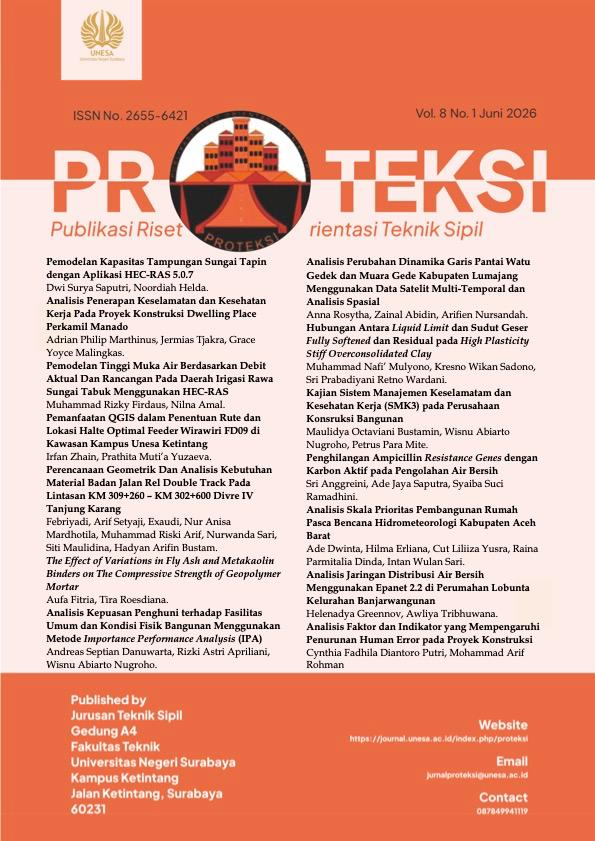
Hubungan Antara Liquid Limit dan Sudut Geser Fully Softened dan Residual pada High Plasticity Stiff Overconsolidated Clay
Keywords:
direct shear, fully softened shear strength, high plasticity, landslide, residual shear strengthAbstract
Landslide in high plasticity stiff overconsolidated clays frequently occur despite high safety factors obtained from analyses based on undrained shear strength. This is because the parameters used in such analyses do not adequately represent slope conditions subjected to repeated deformation and weathering. This study aims to identify the fully softened and residual shear strength parameters, to examine their relationship with the liquid limit (LL) for this soil type, and to find out the suitability of the relationship graph with that developed by Stark & Hussain. Fully softened and residual shear strengths were obtained from direct shear slow reversal test. Remoulded specimens prepared using the slurry method and consolidated under normally consolidated conditions were used. Soil samples were collected from three landslide sites in Semarang. The test results indicate very high LL values (94-105%) with clay fractions exceeding 50% at all sampling locations. Overall, the results show consistency with the regression bounds relating LL to fully softened and residual friction angles developed by Stark & Hussain. The correlation demonstrates good agreement and is applicable to local clayshales.
References
Adisurya, H. & Makarim, C. A. 2022. “Perilaku kegagalan konstruksi jalan raya yang bertumpu pada fondasi tiang di tanah clay shale,” JMTS: Jurnal Mitra Teknik Sipil, vol. 5, no. 1, pp. 55–70.
Alatas, I. M., Kamaruddin, S. A., Nazir, R., Irsyam, M. & Himawan, A. 2015. “Shear strength degradation of Semarang–Bawen clay shale due to weathering process,” Jurnal Teknologi, vol. 77, no. 11, pp. 109–118.
Andriansyah, A., Mulyono, M. N. & Aulia, M. R. 2025. “Slope stability in Gombel Lama: A Comparative Analysis of Peak, Fully Softened, and Residual Conditions”, Bentang: Jurnal Teoritis dan Terapan Bidang Rekayasa Sipil, vol. 13, no. 2, pp. 161–170.
sDas, B. M. & Sobhan, K. 2016. “Principles of Geotechnical Engineering”, 9th ed. Boston, MA, USA: Cengage Learning.
Duncan, J. M., Wright, S. G. & Brandon, T. L. 2014. “Soil Strength and Slope Stability”, 2nd ed. Hoboken, NJ, USA: John Wiley & Sons, Inc.
Head, K. H. 1994. “Manual of Soil Laboratory Testing, Vol. 2: Permeability, Shear Strength and Compressibility Tests”, 2nd ed. New York, NY, USA: John Wiley & Sons, Inc.
Hunt, R. E. 2006. “Characteristics of Geologic Materials and Formations: A Field Guide for Geotechnical Engineers”, Boca Raton, FL, USA: CRC Press.
Kayyal, M. K. & Wright, S. G. 1991. “Investigation of long-term strength properties of Paris and Beaumont clays in earth embankments,” Research Rep. 1195-2F, Center for Transportation Research, Univ. of Texas at Austin, Austin, TX, USA.
Lutton, R. J. 1975. “Study of Clay Shale Slopes along the Panama Canal, Report 2: History, Geology, and Mechanics of Development of Slides in Gaillard Cut, Vol. I: Text”, Soils and Pavements Laboratory, U.S. Army Engineer Waterways Experiment Station, Vicksburg, MS, USA.
Mesri, G. & Shahien, M. 2003. “Residual shear strength mobilized in first-time slope failures,” Journal of Geotechnical and Geoenvironmental Engineering, vol. 129, no. 1, pp. 12–30.
Rogers, J. D. 2014. “The American engineers that built the Panama Canal,” in Proc. Sessions Honoring the 100th Anniversary of the Panama Canal at the ASCE Global Engineering Conference, Panama City, Panama, Oct. 7–11, 2014, pp. 112–349.
Skempton, A. W. 1964. “Long-term stability of clay slopes,” Géotechnique, vol. 14, no. 2, pp. 77–102.
Stark, T. D., Choi, H. & McCone, S. 2005. “Drained shear strength parameters for analysis of landslides,” Journal of Geotechnical and Geoenvironmental Engineering, vol. 131, no. 5, pp. 575–588.
Stark, T. D. & Duncan, J. M. 1991. “Mechanisms of Strength Loss in Stiff Clays”, Journal of Geotechnical Engineering, vol. 117, no. 1, pp. 139–154.
Stark, T. D. & Eid, H. T. 1997. “Slope stability analyses in stiff fissured clays,” Journal of Geotechnical and Geoenvironmental Engineering, vol. 123, no. 4, pp. 335–343.
Stark, T. D. & Hussain, M. 2013. “Empirical correlations: Drained shear strength for slope stability analyses,” Journal of Geotechnical and Geoenvironmental Engineering, vol. 139, no. 6, pp. 853–862.
Walkinshaw, J. L. & Santi, P. M. 1996. “Shales and Other Degradable Materials”, Special Report—National Research Council, Transportation Research Board, no. 247, pp. 555–576.
Wright, S. G. 2005. “Evaluation of Soil Shear Strengths for Slope and Retaining Wall Stability Analyses with Emphasis on High Plasticity Clays”, Center for Transportation Research, Univ. of Texas at Austin, Austin, TX, USA.
Wrigth, S. G., Zornberg, J. G. & Aguettant, J. E. 2007. “The fully softened shear strength of high plasticity clays,” Center for Transportation Research, Univ. of Texas at Austin, Austin, TX, USA.
Downloads
Published
Issue
Section
License
Copyright (c) 2026 Muhammad Nafi' Mulyono, Kresno Wikan Sadono, Sri Prabadiyani Retno Wardani

This work is licensed under a Creative Commons Attribution-NonCommercial 4.0 International License.
 Abstract views: 105
,
Abstract views: 105
, PDF Downloads: 143