Analysis of Changes in the Coastal Dynamics of Watu Gedek and Muara Gede in Lumajang Regency Using Multi-Temporal Satellite Data and Spatial Analysis
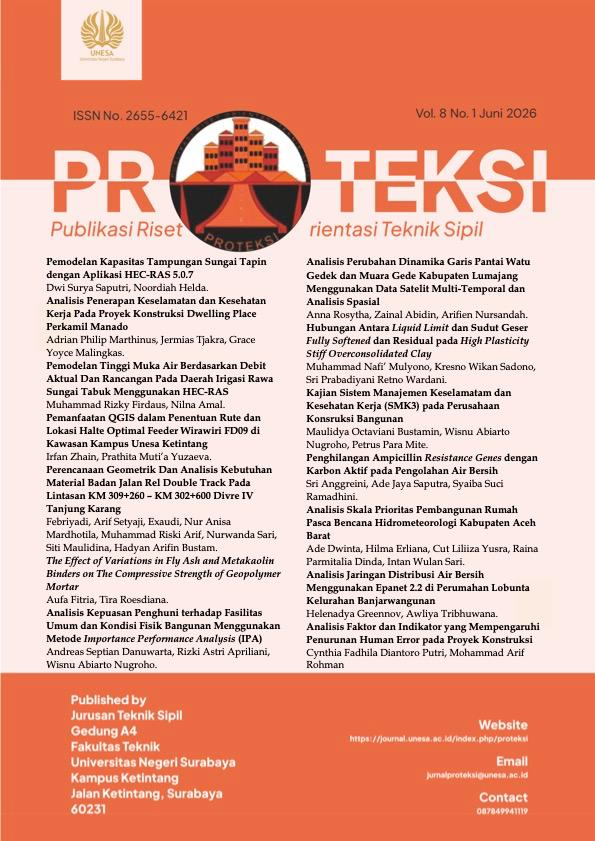
Analisis Perubahan Dinamika Garis Pantai Watu Gedek dan Muara Gede Kabupaten Lumajang Menggunakan Data Satelit Multi-Temporal dan Analisis Spasial
Keywords:
Shoreline, Erosion, Accretion, DSAS, Random ForestAbstract
The southern coastal area of Lumajang Regency experiences high shoreline dynamics due to Indian Ocean waves, ocean currents, river mouth sedimentation, and human activities. Shoreline changes in the form of erosion and accretion affect coastal geomorphology, ecosystem stability, and socio-economic activities. This study aims to analyze shoreline dynamics in the Watu Gedek and Muara Gede areas, Tempursari District, Lumajang Regency, using Landsat imagery from 2020–2025. The methods include shoreline extraction using MNDWI, quantitative analysis with the Digital Shoreline Analysis System (DSAS), and prediction approaches using QSCAT and Random Forest machine learning. The analyzed parameters include NSM, EPR, LRR, and SCE. The results show that erosion dominates approximately ±74% of the transects, with a maximum rate of -11.49 m/year. The most severe erosion occurs in the central segment, while limited accretion occurs in the eastern and western parts with rates up to +2.45 m/year due to local sediment supply. QSCAT and Random Forest results show consistent patterns with DSAS. These findings highlight the importance of adaptive and spatial-data-based coastal management.
References
Belgiu, M., & Drăguţ, L. (2016). Random forest in remote sensing: A review of applications and future directions. ISPRS Journal of Photogrammetry and Remote Sensing, 114(24–31). https://doi.org/https://doi.org/10.1016/j.isprsjprs.2016.01.011
Bird, E. C. F. (2008). Coastal geomorphology: An introduction (2nd ed.). John Wiley & Sons.
Boak, E. H., & Turner, I. L. (2005). Shoreline definition and detection: A review. Journal of Coastal Research, 21(4), 688–703.
Gens, R. (2010). Remote sensing of coastlines: Detection, extraction and monitoring. International Journal of Remote Sensing, 31(7), 1819–1836.
Hapke, C. J., Himmelstoss, E. A., Kratzmann, M. G., List, J. H., & Thieler, E. R. (2013). National assessment of shoreline change: Historical shoreline change along the New England and Mid-Atlantic coasts. U.S. Geological Survey Open-File Report.
Himmelstoss, E. A., et al. (2018). Digital Shoreline Analysis System (DSAS) v5.0. USGS.
Maxwell, A. E., Warner, T. A., & Fang, F. (2018). Implementation of machine-learning classification in remote sensing: An applied review. International Journal of Remote Sensing, 39(9), 2784–2817. https://doi.org/https://doi.org/10.1080/01431161.2018.1433343
Pardo-Pascual, J. E., Almonacid-Caballer, J., Ruiz, L. A., & Palomar-Vázquez, J. (2012). Automatic extraction of shorelines from Landsat TM and ETM+ multi-temporal images with subpixel precision. Remote Sensing of Environment, 123, 1–11.
Santoso, A., & Hidayat, R. (2020). Analisis perubahan garis pantai menggunakan citra Landsat multi temporal di wilayah pesisir Jawa Timur. Urnal Teknik ITS, 9(2), C123–C129.
Supriyadi, I. H., & Setiawan, K. T. (2019). Analisis perubahan garis pantai menggunakan metode DSAS di pesisir utara Jawa. Jurnal Kelautan Nasional, 14(2), 87–98.
Wicaksono, P., & Lazuardi, W. (2018). Mapping shoreline changes using Landsat imagery and DSAS in coastal area of Indonesia. Indonesian Journal of Geography, 50(2), 145–155.
Xu, Z., et al. (2023). Deep learning rainfall estimation. Remote Sensing. https://doi.org/https://doi.org/10.3390/rs15092345
Downloads
Published
Issue
Section
License
Copyright (c) 2026 Anna Rosytha, Zainal Abidin, Arifien Nursandah Nursandah

This work is licensed under a Creative Commons Attribution-NonCommercial 4.0 International License.
 Abstract views: 126
,
Abstract views: 126
, PDF Downloads: 159