
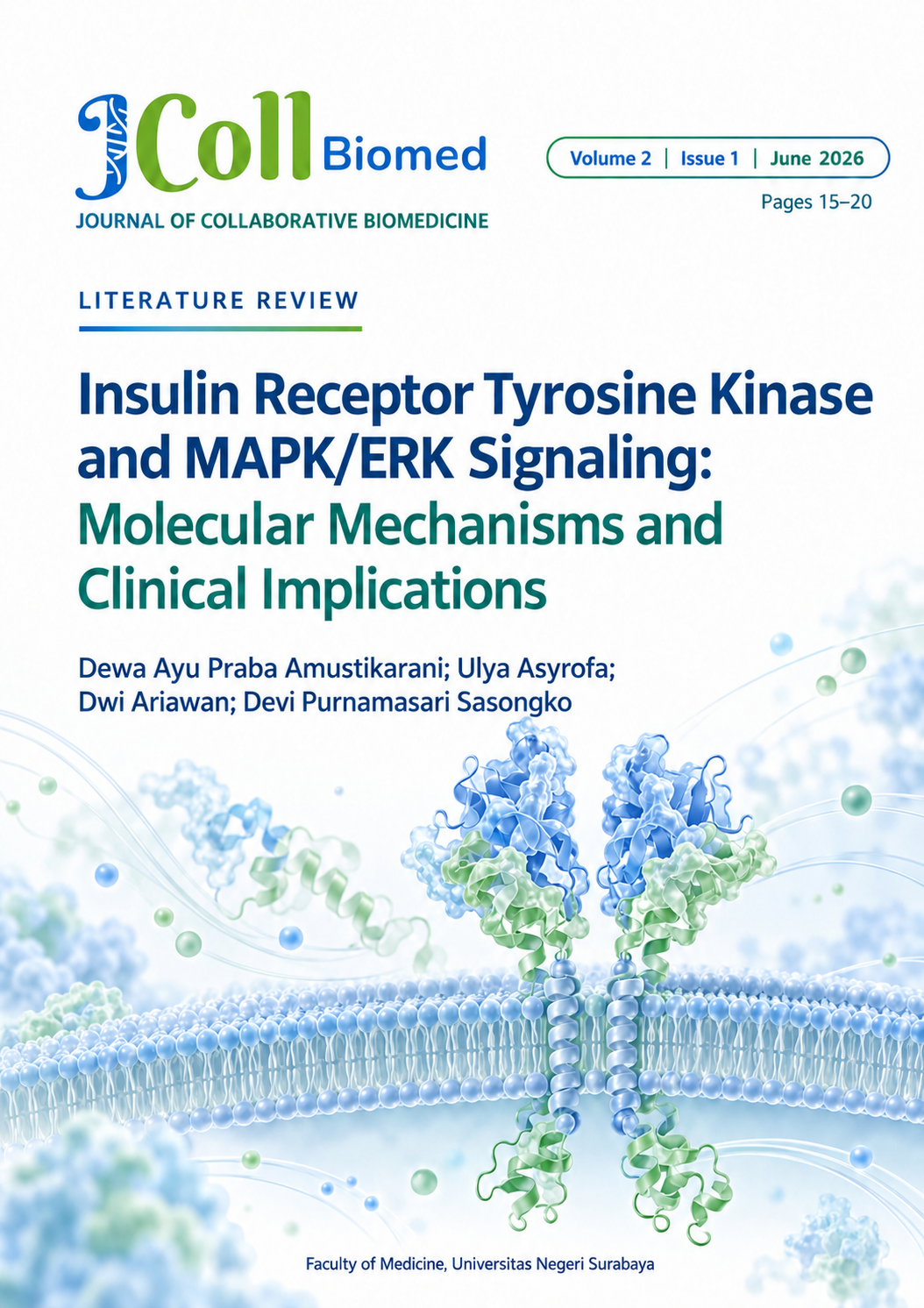
Insulin Receptor Tyrosine Kinase and MAPK/ERK Signaling: Molecular Mechanisms and Clinical Implications
Article Sidebar
Main Article Content
Abstract
Insulin is a peptide hormone that coordinates glucose availability with anabolic, growth, vascular, and survival responses through the insulin receptor (IR), a preformed receptor tyrosine kinase. Insulin binding reorganizes the extracellular receptor and brings the intracellular kinase domains into an active configuration, producing trans-autophosphorylation and phosphorylation of adaptor proteins. These phosphotyrosine-dependent docking events divide insulin signaling into interconnected metabolic and mitogenic branches. The mitogenic branch is initiated mainly through SHC and GRB2/SOS, activates Ras, and proceeds through the Raf-MEK-ERK mitogen-activated protein kinase (MAPK) cascade. Activated ERK1/2 phosphorylates cytoplasmic, cytoskeletal, and nuclear proteins, including transcriptional regulators such as Elk-1, c-Myc, c-Fos, HIF-1alpha, PDX1, and BETA2, thereby influencing proliferation, differentiation, migration, survival, metabolism, and gene expression. Signal duration is limited by receptor trafficking, protein tyrosine and serine/threonine phosphatases, and inhibitory feedback. Dysregulation contributes to insulin resistance, type 2 diabetes, endothelial dysfunction, reproductive and hepatic metabolic disorders, diabetic complications, chronic inflammation, and context-dependent tumor-promoting signaling. Future work should define tissue-specific signaling thresholds and exploit receptor conformational bias to preserve metabolic efficacy while minimizing excessive mitogenic signaling
Article Details

References
1. Le TKC, Dao XD, Nguyen DV, Luu DH, Bui TMH, Le TH, et al. Insulin signaling and its application. Front Endocrinol (Lausanne). 2023;14:1226655.
2. Zhao X, An X, Yang C, Sun W, Ji H, Lian F. The crucial role and mechanism of insulin resistance in metabolic disease. Front Endocrinol (Lausanne). 2023;14:1149239.
3. Makhijani P, Basso PJ, Chan YT, Chen N, Baechle J, Khan S, et al. Regulation of the immune system by the insulin receptor in health and disease. Front Endocrinol (Lausanne). 2023;14:1128622.
4. Wang X, Cardoso S, Cai K, Venkatesh P, Hung A, Ng M, et al. Tuning insulin receptor signaling using de novo-designed agonists. Mol Cell. 2025;85:4064–4081.
5. Gogg S, Smith U, Jansson PA. Increased MAPK activation and impaired insulin signaling in subcutaneous microvascular endothelial cells in type 2 diabetes: the role of endothelin-1. Diabetes. 2009;58(10):2238–2245.
6. Feng J, Lu S, Ou B, Liu Q, Dai J, Ji C, et al. The role of JNK signaling pathway in obesity-driven insulin resistance. Diabetes Metab Syndr Obes. 2020;13:1399–1406.
7. Saadati S, Godini R, Reddy A, Teede H, Mousa A. Metabolic crossroads in insulin resistance: exploring lipid dysregulation and inflammation. Front Immunol. 2025;16:1692742.
8. Xu H, Liu T, Dai Y, Li N, Cao Z. The role of ERK1/2 signaling in diabetes: pathogenic and therapeutic implications. Front Pharmacol. 2025;16:1600251.
9. Zhang W, Thompson BJ, Hietakangas V, Cohen SM. MAPK/ERK signaling regulates insulin sensitivity to control glucose metabolism in Drosophila. PLoS Genet. 2011;7(12):e1002429.
10. Kisiała M, Mazepa W, Bauer D, Tabaka P, Gas M, Sowiński A, et al. Molecular mechanisms of insulin resistance and altered carbohydrate metabolism in PCOS: a scoping review. Front Endocrinol (Lausanne). 2026;17:1810805.
11. Guevara-Ramírez P, Paz-Cruz E, Cadena-Ullauri S, Ruiz-Pozo VA, Tamayo-Trujillo R, Felix ML, et al. Molecular pathways and nutrigenomic review of insulin resistance development in gestational diabetes mellitus. Front Nutr. 2023;10:1228703.
12. He Y, Yang X, He X, Wang G, Li C, Yuan P, et al. Mechanisms and therapeutics of insulin signaling transduction genes in diabetic cardiomyopathy: a comprehensive updated review. Front Endocrinol (Lausanne). 2025;16:1589695.
13. Targher G, Byrne CD, Tilg H. MASLD: a systemic metabolic disorder with cardiovascular and malignant complications. Gut. 2024;73:691–702.
14. Berbudi A, Khairani S, Tjahjadi AI. Interplay between insulin resistance and immune dysregulation in type 2 diabetes mellitus: implications for therapeutic interventions. Immunotargets Ther. 2025;14:359–382.
15. Teng JA, Wu SG, Chen JX, Li Q, Peng F, Zhu Z, et al. The activation of ERK1/2 and JNK MAPK signaling by insulin/IGF-1 is responsible for the development of colon cancer with type 2 diabetes mellitus. PLoS One. 2016;11(2):e0149822.