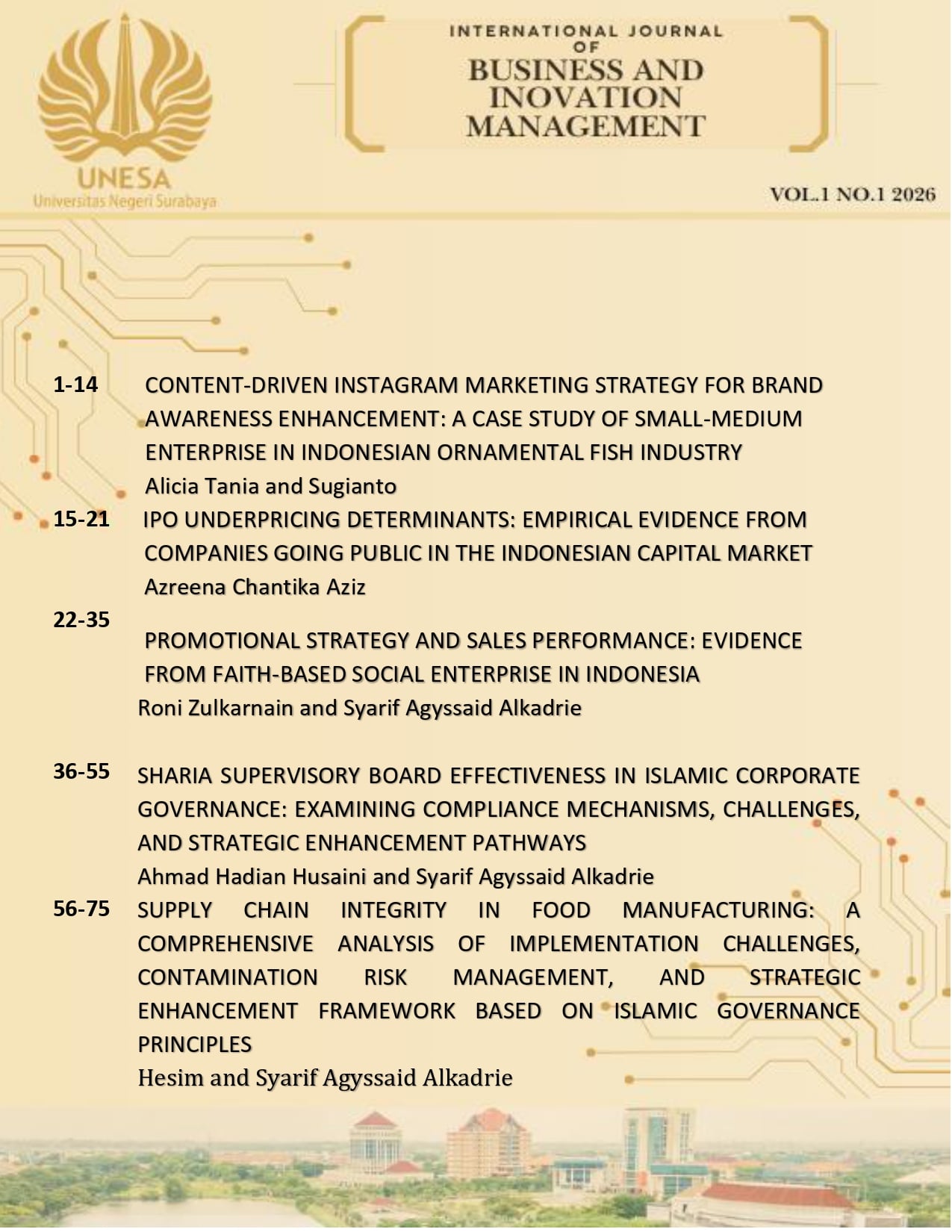
Modeling Supply Chain Integrity in Food Manufacturing: Contamination Risk, Implementation Barriers, and an Islamic Governance-Based Framework
Keywords:
Halal supply chain management; food industry; contamination prevention; halal certification; supply chain integrityAbstract
Background: Halal supply chain management serves as a critical governance framework to ensure religious compliance across food production and distribution systems. Despite increasing regulatory attention, integrating Islamic jurisprudential principles with modern supply chain practices remains a challenge, particularly in emerging markets.
Objective: This study aims to examine implementation mechanisms, contamination risks, and strategic enhancements in halal food supply chains within the regulatory context of Indonesia, particularly under Law No. 33/2014 on Halal Product Assurance.
Methods: A systematic literature review was conducted by synthesizing regulatory frameworks, industry standards, academic studies, and fatwa interpretations from Majelis Ulama Indonesia. The analysis adopts an integrative approach combining Islamic governance principles with operations management perspectives.
Results: The findings indicate that effective halal supply chain management requires coordinated control across procurement, production, storage, transportation, distribution, traceability, and consumer communication. Key challenges include limited halal literacy, high certification costs, inadequate dedicated logistics infrastructure, weak monitoring systems, and regulatory fragmentation.
Conclusion: This study highlights the importance of integrating Islamic principles with operational strategies to ensure compliance and competitiveness. Strengthening institutional coordination, enhancing technological adoption, and improving stakeholder capabilities are essential for achieving sustainable halal supply chain performance in the global market.
References
Ab Rashid, N., & Bojei, J. (2020). The relationship between halal traceability system adoption and environmental factors on halal food supply chain integrity in Malaysia [Article]. Journal of Islamic Marketing, 11(1), 117-142. https://doi.org/10.1108/JIMA-01-2018-0016
Ahamat, H., & Rahman, N. A. (2018). HALAL FOOD, MARKET ACCESS AND EXCEPTION TO WTO LAW: NEW ASPECTS LEARNED FROM INDONESIA — CHICKEN PRODUCTS [Article]. Asian Journal of WTO and International Health Law and Policy, 13(2), 355-373. https://www.scopus.com/inward/record.uri?eid=2-s2.0-85172024793&partnerID=40&md5=b61d73d2ee0664fd2721f503d0676a94
Amelia, E., Fatimah, C. E. A., & Amalia, E. (2025). Strengthening The Halal Industry in The Micro-Small Business Sector Through The Development of An Integrated Islamic Microfinance Institution Model [Article]. International Journal of Accounting and Economics Studies, 12(4), 627-636. https://doi.org/10.14419/ym1jdq07
Andespa, R., Yurni, Y., Aldiyanto, A., & Efendi, G. (2024). Challenges and Strategies in Halal Supply Chain Management for MSEs in West Sumatra: A Participatory Action Research Study [Article]. International Journal of Safety and Security Engineering, 14(3), 907-921. https://doi.org/10.18280/ijsse.140322
Andini, Z., Khabibah, K., & Shabah, M. A. A. (2023). Pemilihan Makanan dan Minuman Yang Tidak Memiliki Sertifikat Halal: Kajian Maqashid Asy-Syari’ah [Article]. Al-Mazaahib, 11(1), 93-114. https://doi.org/10.14421/al-mazaahib.v11i1.3079
Azmi, F. R., Sukri, N. M., Sundram, V. P. K., Mahmood, W. H. W., & Himawan, A. F. I. (2025). A Dynamic Capabilities Framework for Managing Supply Chain Risk and Building Resilience in Malaysia’s Priority Manufacturing Sectors [Article]. Paper Asia, 41(5), 402-409. https://doi.org/10.59953/paperasia.v41i5b.762
Busyra, S. H. I., & Ardi, R. (2020). A Preliminary Findings of Risk Categories in Halal Supply Chain in Indonesia: Upstream Level of Meat Industry. ACM International Conference Proceeding Series,
Chaniago, S. A., Izza, M., Wijaya, B. S., & Rozi, F. F. P. (2024). Implementation of Halal Supply Chain in the Cooperative of Islamic Boarding School: Maqashid Syariah Perspective [Article]. Jurnal Hukum Islam, 22(1), 57-88. https://doi.org/10.28918/jhi_v22i1_3
De Lima, F. A., & Seuring, S. (2023). A Delphi study examining risk and uncertainty management in circular supply chains [Article]. International Journal of Production Economics, 258, Article 108810. https://doi.org/10.1016/j.ijpe.2023.108810
Fiteuanto, A., Sofi, M., & Muzakki, A. (2024). Inclusive Halal Standards: Societal Effects on Religious Minorities in Indonesia and Malaysia [Article]. Islamic Quarterly, 68(4), 451-479.https://www.scopus.com/inward/record.uri?eid=2-s2.0-105019565068&partnerID=40&md5=94946b3c5e7ca81e015feab894b84093
Halim, M. A. A., Osman, S., Baharudin, D. F., Salleh, M. M. M., Ismail, W., & Rosley, N. A. B. (2024). Exploring an Appropriate Legal Mechanism for Consumers in Halal Food Abuse Cases. In Contributions to Management Science (Vol. Part F2529, pp. 721-730). https://doi.org/10.1007/978-3-031-48770-5_58
Hasanah, H. (2025). Implementation of the Principles of Halal and Tayyib at the Slaughterhouse in Sustainable Development Goals. In Implementing Halal Principles and Regulations in Business Governance (pp. 81-104). https://doi.org/10.4018/9798337339177.ch004
Humble, N., & Mozelius, P. (2021). Content Analysis or Thematic Analysis: Similarities, Differences and Applications in Qualitative Research. Proceedings of the European Conference on Research Methods in Business and Management Studies,
Khan, S., Haleem, A., & Khan, M. I. (2023). Risk assessment model for halal supply chain using an integrated approach of IFN and D number [Article]. Arab Gulf Journal of Scientific Research, 41(3), 338-358. https://doi.org/10.1108/AGJSR-09-2022-0160
Khan, S., Haleem, A., Ngah, A. H., & Khan, M. I. (2023). Exploration of risks with halal logistics: a case of emerging economy [Article]. Journal of Global Operations and Strategic Sourcing, 16(3), 745-772. https://doi.org/10.1108/JGOSS-01-2022-0001
Kirihara, M. (2025). The Dual Nature of Syariah Compliance and the Diversity of Halal Standardisation: A Comparative Study of Malaysia and Japan. In The Halal Industry in Asia: Perspectives from Brunei Darussalam, Malaysia, Japan, Indonesia and China (pp. 41-55). https://doi.org/10.1007/978-981-96-0393-0_3
Latif, M. A. (2020). Halal international standards and certification. In The Halal Food Handbook (pp. 205-226). https://doi.org/10.1002/9781118823026.ch14
Latiff, J. A., Zakaria, Z., & Man, S. (2024). The Islamic Principles of Legal Status Criteria according to the Qur͗an and Hadith in Fostering ḤalālVaccine Certification in Malaysia [Article]. AlBayan, 22(1), 1-18. https://doi.org/10.1163/22321969-20240143
Nazri, M. Z., Kamal, A. J., Rashid, S. N. A. A., Mustafa, R. R., Karim, H. A. A., Sani, M. S. A., & Zaidel, D. N. A. (2025). Preliminary analysis of standard animal gelatines through FTIR-ATR spectroscopy coupled with multivariate data analysis and pattern recognition for halal verification [Article]. Malaysian Journal of Analytical Sciences, 29(4), Article 1516. https://www.scopus.com/inward/record.uri?eid=2-s2.0-105017994258&partnerID=40&md5=9fee03f2e14fbddf867ad037f21bc010
Nezamoddini, N. (2020). Robust optimization and risk management of supply chain networks. Proceedings of the 2016 Industrial and Systems Engineering Research Conference, ISERC 2016,
Osman, O. A. (2023a). The Importance of Halal Food and Its Legality in Both Islamic and Non-Islamic Communities Around the World. In Halal and Kosher Food: Integration of Quality and Safety for Global Market Trends (pp. 1-15). https://doi.org/10.1007/978-3-031-41459-6_1
Osman, O. A. (2023b). Standards and Their Application to the Production, Manufacture, and Storage of Halal Food. In Halal and Kosher Food: Integration of Quality and Safety for Global Market Trends (pp. 145-155). https://doi.org/10.1007/978-3-031-41459-6_12
Pan, H., Zou, N., Wang, R., Ma, J., & Liu, D. (2025). Artificial Intelligence Usage and Supply Chain Resilience: An Organizational Information Processing Theory Perspective [Article]. Systems, 13(9), Article 724. https://doi.org/10.3390/systems13090724
Peng, X., Wei, X., Xu, L., Cao, Y., & Prybutok, V. (2022). An organizational framework for sustainable supply chain management: An integrated theoretical perspective [Article]. Quality Management Journal, 29(4), 267-288. https://doi.org/10.1080/10686967.2022.2112928
Pope, C., Ziebland, S., & Mays, N. (2019). Analysis. In Qualitative Research in Health Care (pp. 111-133). https://doi.org/10.1002/9781119410867.ch9
Prasad, V. M. (2025). A theoretical study on "Supply Chain Management" in the contemporary state of technological innovations: Their role and their impact. In Global Partnerships and Governance of Supply Chain Systems (pp. 29-63). https://doi.org/10.4018/979-8-3693-6987-6.ch002
Pujiastuti, Y., Asmaul Mustaniroh, S., & Sucipto, S. (2024). Analysis of the Institutional Risk of the Halal Supply Chain in the Potato Chips Micro Scale using the SCOR Methods. IOP Conference Series: Earth and Environmental Science,
Putro, M. Z. A. E., Fakhruddin, M., & Mardamin, A. (2024). Halal Certification for Small Scale Enterprise in Indonesia: Policy Changing Impacts [Article]. International Journal of Islamic Thought, 25, 78-84. https://doi.org/10.24035/ijit.25.2024.287
Rahmati, A., Benazir, B., & Ibrahim, A. (2026). Muslim Millennials and Food Choices: Unpacking the Halal Awareness Gap in Aceh, Indonesia [Article]. Jurnal Ilmiah Peuradeun, 14(1), 27-50. https://doi.org/10.26811/peuradeun.v14i1.1497
Ramlan, N., Sahari, N. H., Shafie, N. A., Usop, N. I. S., Said, S., & Izham, S. S. (2025). Assessing Consumer Confidence in Halal Authorities: A Comparative Study between Malaysia and Brunei [Article]. Indonesian Journal of Halal Research, 7(1), 17-29. https://doi.org/10.15575/ijhar.v7i1.38330
Riad, M., Naimi, M., & Okar, C. (2024). Enhancing Supply Chain Resilience Through Artificial Intelligence: Developing a Comprehensive Conceptual Framework for AI Implementation and Supply Chain Optimization [Article]. Logistics, 8(4), Article 111. https://doi.org/10.3390/logistics8040111
Wæraas, A. (2022). Thematic analysis: Making values emerge from texts. In Researching Values: Methodological Approaches for Understanding Values Work in Organisations and Leadership (pp. 153-170). https://doi.org/10.1007/978-3-030-90769-3_9
Wiltshire, G., & Ronkainen, N. (2021). A realist approach to thematic analysis: making sense of qualitative data through experiential, inferential and dispositional themes [Article]. Journal of Critical Realism, 20(2), 159-180. https://doi.org/10.1080/14767430.2021.1894909
Yaacob, T. Z., Abd Razak, S. S., & Hashim, H. I. (2023). Sertu and Halal critical point for managing risks in halal transportation. In Innovation of Food Products in Halal Supply Chain Worldwide (pp. 221-228). https://doi.org/10.1016/B978-0-323-91662-2.00018-1
Yen, N. C., Neo, H. F., Teo, C. C., Mangruwa, R. D., & Yuen, Y. Y. (2025). Halal Certification Traceability for Restaurants via Mobile Application. 2025 International Conference on Green Energy, Computing and Sustainable Technology, GECOST 2025,
Yuanitasari, D., Harrieti, N., & Salaeh, Y. (2025). Harmonizing Sharia-Based Halal Standards with International Trade Law: A Comparative Legal Study [Article]. Lampung Journal of International Law, 7(1), 47-62. https://doi.org/10.25041/lajil.v7i1.4468
Zahari, H. M., & Zain, R. M. (2024). The Impact of the Theory of Planned Behaviour (TPB) and the Theory of Reasoned Action (TRA) on the Growing Field of Halal Technology. In Emerging Technology and Crisis Management in The Halal Industry: Issues and Recent Developments (pp. 83-102). https://doi.org/10.1007/978-981-97-1375-2_6
Zain, C. R. C. M., & Zakaria, Z. (2022). A REVIEW OF HALAL GOVERNANCE IN MALAYSIA FROM THE PERSPECTIVES OF MAQASID AL-SHARIAH [Article]. Journal of Shariah Law Research, 7(2), 199-222. https://doi.org/10.22452/jslr.vol7no2.3
Zainuddin, N., Saifudin, A. M., Deraman, N., & Osman, A. A. (2020). The effect of halal traceability system on halal supply chain performance [Article]. International Journal of Supply Chain Management, 9(1), 490-498. https://www.scopus.com/inward/record.uri?eid=2-s2.0-85080917162&partnerID=40&md5=e7c2edb047146115b991caddfa99e240
Zakariah, A. A., bin Mohd Yusob, M. L., & Musa, M. K. (2024). Future Food and Islam: A Perspective From Malaysia. In The Changing Food Law Landscape: Food Security, Sustainability and the Environment (pp. 174-191). https://doi.org/10.4324/9781003392279-12
Downloads
Published
How to Cite
Issue
Section
License
Copyright (c) 2026 Hesim, Syarif Agyssaid Alkadrie

This work is licensed under a Creative Commons Attribution 4.0 International License.
 Abstract views: 351
,
Abstract views: 351
, PDF Downloads: 227