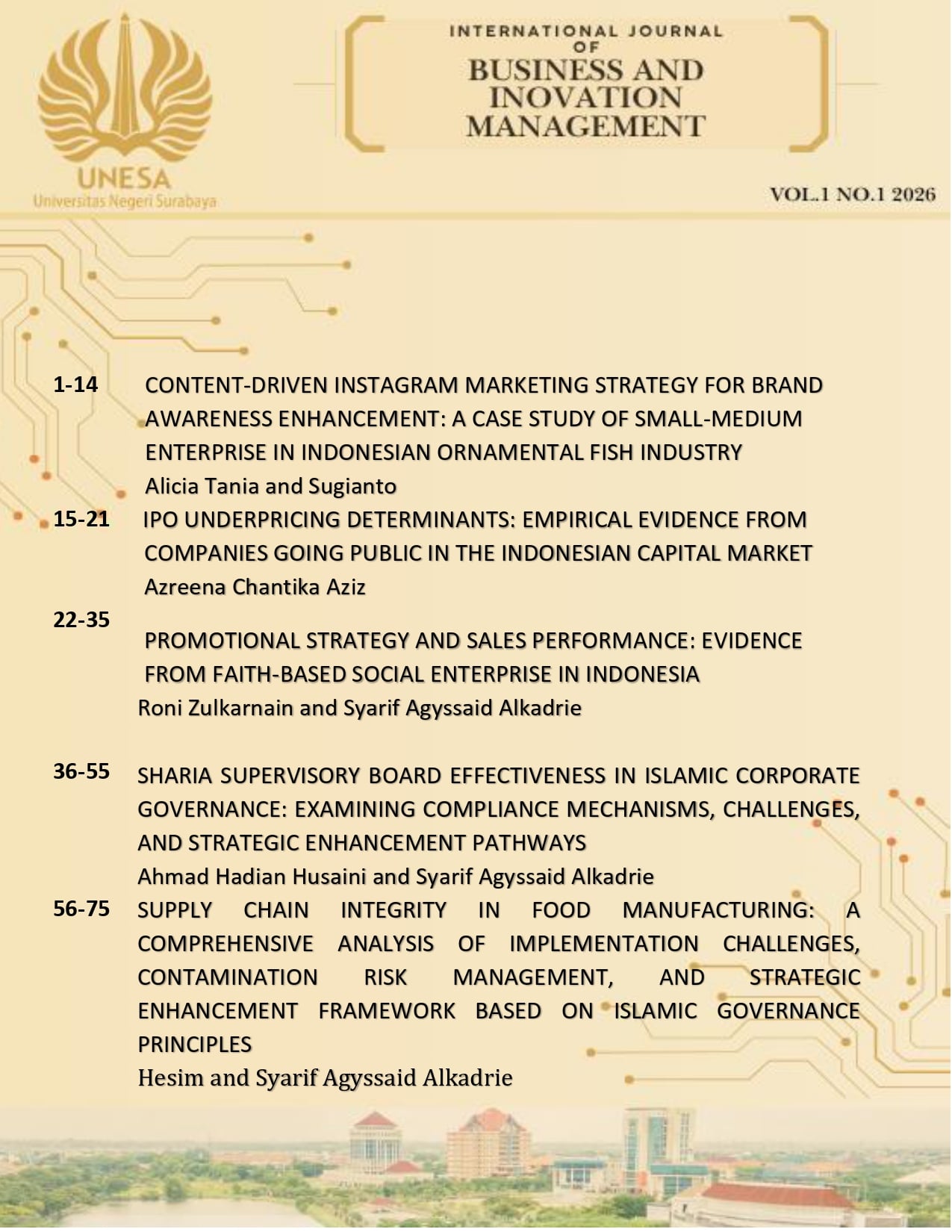
Promotional Strategy and Sales Performance: Evidence from Faith-Based Social Enterprise in Indonesia
Keywords:
Promotional Strategy; Sales Performance; Social Enterprise; Faith-Based Organization; Emerging MarketsAbstract
Background: Faith-based social enterprises play a significant role in promoting economic empowerment and community development in emerging markets. However, limited research has examined how these organizations implement promotional strategies within resource-constrained environments.
Objective: This study aims to analyze the promotional strategies employed by a faith-based social enterprise, focusing on a paving block manufacturing unit operated by an Islamic boarding school in West Kalimantan, Indonesia.
Methods: A qualitative case study approach was adopted using in-depth interviews, observations, and document analysis. Data were analyzed through an interpretative approach to identify key promotional practices and influencing factors.
Results: The findings reveal that promotional strategies remain predominantly conventional, relying on banners, brochures, and word-of-mouth through alumni networks. Although digital platforms such as Facebook and WhatsApp are utilized, their use is not systematically managed. Sales performance is influenced by product quality consistency, competitive pricing, and institutional trust derived from the organization’s reputation. Key barriers include limited market reach, weak targeting strategies, and low digital marketing capabilities.
Conclusion: The study highlights the need to integrate traditional promotional approaches with strategically managed digital channels. Strengthening digital capabilities while leveraging institutional trust can enhance market reach and sustainability of faith-based social enterprises.
References
Abed, S. S., Dwivedi, Y. K., & Williams, M. D. (2015). SMEs’ adoption of e-commerce using social media in a Saudi Arabian context: a systematic literature review. International Journal of Business Information Systems, 19(2), 159–179.
Ablett, P., Morley, C., Noble, C., & Cowden, S. (2020). The Routledge handbook of critical pedagogies for social work.
Chaffey, D., Ellis-Chadwick, F., & Mayer, R. (2009). Internet marketing: strategy, implementation and practice. Pearson education.
Creswell, J. W., & Creswell, J. D. (2017). Research design: Qualitative, quantitative, and mixed methods approaches. Sage publications.
Dees, J. G. (1998). The meaning of social entrepreneurship. Kauffman Foundation and Stanford University.
Denzin, N. K. (2005). The Sage handbook of qualitative research. (No Title).
Fandy, T. (2020). Strategi Pemasaran Prinsip dan Penerapan. Penerbit Andi. Yogyakarta.
Fill, C., & Turnbull, S. (2019). Marketing communications. Pearson UK.
Ingenbleek, P. T. M. (2015). Price strategies for sustainable food products. British Food Journal, 117(2), 915–928.
Kitchen, P. J., & Burgmann, I. (2015). Integrated marketing communication: Making it work at a strategic level. Journal of Business Strategy, 36(4), 34–39.
Kotler, P., Armstrong, G., & Armstrong, G. M. (2010). Principles of marketing. Pearson Education India.
Lovelock, C. H., & Wirtz, J. (2001). Services marketing: people, technology, strategy. (No Title).
Miles, M. B., Huberman, A. M., & Saldana, J. (2014). Qualitative data analysis: A methods sourcebook. (No Title).
Nyssens, M., & Defourney, J. (2021). Social enterprise in Central and Eastern Europe: theory, models and practice.
Odoom, R., Anning-Dorson, T., & Acheampong, G. (2017). Antecedents of social media usage and performance benefits in small-and medium-sized enterprises (SMEs). Journal of Enterprise Information Management, 30(3), 383–399.
Palinkas, L. A., Horwitz, S. M., Green, C. A., Wisdom, J. P., Duan, N., & Hoagwood, K. (2015). Purposeful sampling for qualitative data collection and analysis in mixed method implementation research. Administration and Policy in Mental Health and Mental Health Services Research, 42(5), 533–544.
Qomariyah, N., & Darwis, M. (2023). Peran Pondok Pesantren Salaf di Era Society 5.0. Risalatuna Journal of Pesantren Studies, 3(2), 220–234.
Ramdani, B., Chevers, D., & Williams, D. A. (2013). SMEs’ adoption of enterprise applications: A technology-organisation-environment model. Journal of Small Business and Enterprise Development, 20(4), 735–753.
Ryan, D. (2016). Understanding digital marketing: marketing strategies for engaging the digital generation. Kogan Page Publishers.
Suciana, D. A., & Syahputra, E. (2023). Analisis Strategi Promosi Dalam Meningkatkan Penjualan Produk Pada Resto Dan Pusat Oleh-Oleh Putra Nirwana Magetan Di Era Pandemi Covid. Digital Bisnis: Jurnal Publikasi Ilmu Manajemen Dan E-Commerce, 2(2), 95–115.
Tajvidi, R., & Karami, A. (2021). The effect of social media on firm performance. Computers in Human Behavior, 115, 105174.
Tisdell, E. J., Merriam, S. B., & Stuckey-Peyrot, H. L. (2025). Qualitative research: A guide to design and implementation. John Wiley & Sons.
Tuten, T. L. (2023). Social media marketing.
Zeithaml, V. A., Bitner, M. J., & Gremler, D. D. (2000). Services marketing: Integrating customer focus across the firm. (No Title).
Downloads
Published
How to Cite
Issue
Section
License
Copyright (c) 2026 Roni Zulkarnain, Syarif Agyssaid Alkadrie

This work is licensed under a Creative Commons Attribution 4.0 International License.
 Abstract views: 123
,
Abstract views: 123
, PDF Downloads: 118