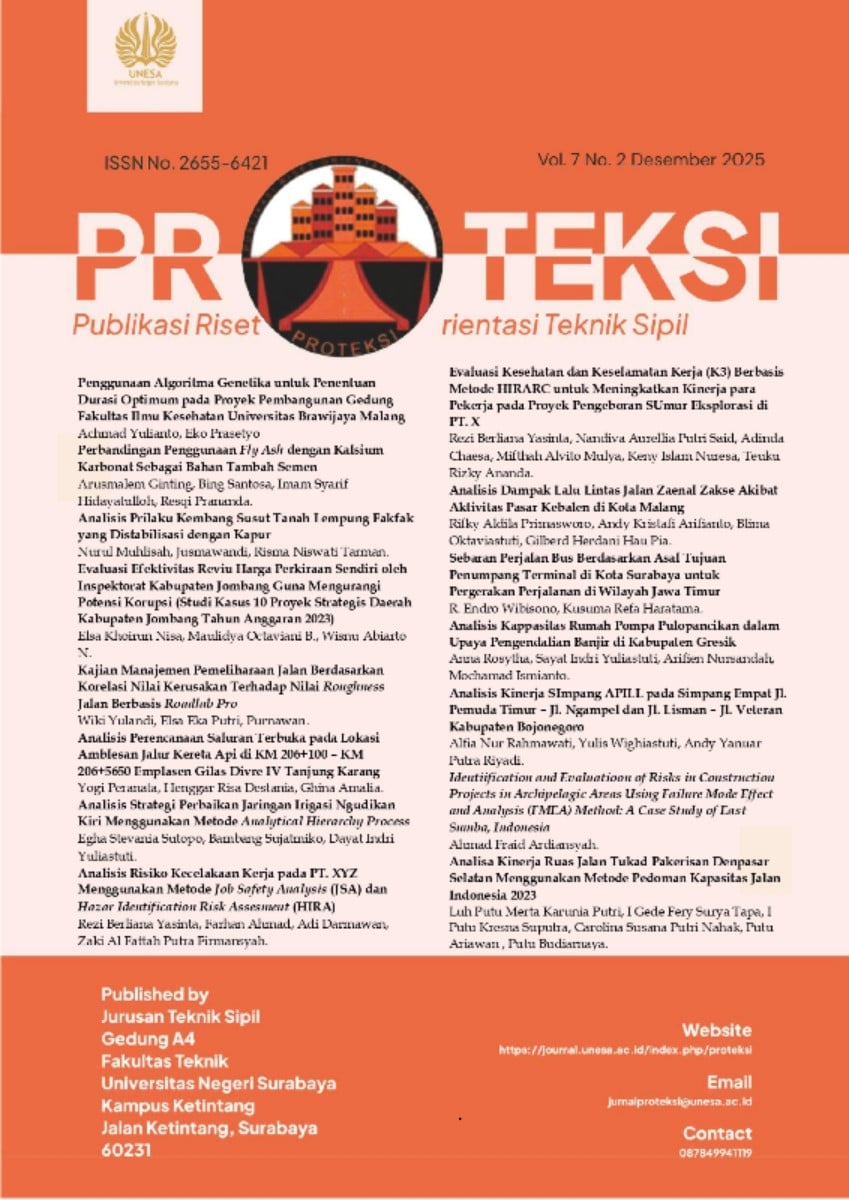
Identification and Evaluation of Risks in Construction Projects in Archipelagic Areas Using the Failure Mode and Effect Analysis (FMEA) Method A Case Study of East Sumba, Indonesia
DOI:
https://doi.org/10.26740/proteksi.v7n2.p212-222Keywords:
Construction Risk, Semi-arid Regions, FMEA, Probability – Impact MatrixAbstract
Construction projects in semi-arid coastal zones operate within complex environmental and managerial constraints that heighten vulnerability to multiple risks. This research analyzes those dynamics through a systematic application of Failure Mode and Effect Analysis (FMEA) to identify, classify, and prioritize critical risk factors affecting project reliability. The results show that material shortages, heat exposure, and unstable energy supply are the most pressing risks, often intensified by weak procurement systems, inaccurate budgeting, and low compliance with environmental and safety protocols.
A comparison of managerial and field-level perceptions reveals notable gaps: while both groups recognize similar degrees of severity, on-site workers view risks as more frequent and difficult to detect, reflecting unequal access to information and experience. When combined, the Probability–Impact Matrix and Risk Priority Number assessment indicate that most hazards fall within the high-risk category.
The study argues that sustainable construction in such climates requires a move from reactive to anticipatory management. It recommends optimizing local resources through adaptive technologies, reinforcing safety culture and workforce skills, and ensuring transparency via digital governance tools. These integrated measures strengthen resilience, operational reliability, and environmental sustainability in resource-constrained construction contexts
References
Al-Faruq, U., Sagala, S., Rianawati, E., Currie, E., & Al Faruq, U. (n.d.). Working Paper Series Assessment of Renewable Energy Impact to Community Resilience in Sumba Island Editorial Team: Assessment of Renewable Energy Impact to Community Resilience in Sumba Island *.
Alshihri, S., Al‐gahtani, K., & Almohsen, A. (2022). Risk Factors That Lead to Time and Cost Overruns of Building Projects in Saudi Arabia. Buildings, 12(7). https://doi.org/10.3390/buildings12070902
Ariany, Z., Pitana, T., & Vanany, I. (2023). RISK ASSESSMENT OF NEW FERRY SHIP CONSTRUCTION IN INDONESIA USING THE FAILURE MODE EFFECT AND ANALYSIS (FMEA) METHOD. Journal of Applied Engineering Science, 21(3), 872–883. https://doi.org/10.5937/jaes0-43711
Başhan, V., Demirel, H., & Gul, M. (2020). An FMEA-based TOPSIS approach under single valued neutrosophic sets for maritime risk evaluation: the case of ship navigation safety. Soft Computing, 24(24), 18749–18764. https://doi.org/10.1007/s00500-020-05108-y
Bhattacharjee, P., Dey, V., & Mandal, U. K. (2020). Risk assessment by failure mode and effects analysis (FMEA) using an interval number based logistic regression model. Safety Science, 132. https://doi.org/10.1016/j.ssci.2020.104967
Budi Puspitasari, N., Padma Arianie, G., & Adi Wicaksono, P. (2017). ANALISIS IDENTIFIKASI MASALAH DENGAN MENGGUNAKAN METODE FAILURE MODE AND EFFECT ANALYSIS (FMEA) DAN RISK PRIORITY NUMBER (RPN) PADA SUB ASSEMBLY LINE (Studi Kasus : PT. Toyota Motor Manufacturing Indonesia). In Jurnal Teknik Industri (Vol. 12, Issue 2).
DeJoy, D. M. (2005). Behavior change versus culture change: Divergent approaches to managing workplace safety. Safety Science, 43(2), 105–129. https://doi.org/https://doi.org/10.1016/j.ssci.2005.02.001
Giri, O. P. (2025). Assessment of Key Risk Factors Impacting Construction Project Performance. International Journal of Multidisciplinary Research and Growth Evaluation, 6(1), 1231–1241. https://doi.org/10.54660/.ijmrge.2025.6.1.1231-1241
Gong, C., Zhang, H., Yang, J., & Tao, D. (2017). Learning with Inadequate and Incorrect Supervision. 2017 IEEE International Conference on Data Mining (ICDM), 889–894. https://doi.org/10.1109/ICDM.2017.110
Hong Pham, L., & Hadikusumo, H. (2014). Schedule delays in engineering, procurement, and construction petrochemical projects in Vietnam: A qualitative research study. International Journal of Energy Sector Management, 8(1), 3–26. https://doi.org/10.1108/IJESM-06-2013-0009
Hossein, K., B, T. T. R., B, D. G., M, G. P., & Cidambi, S. (2018). Impact of Skilled Labor Availability on Construction Project Cost Performance. Journal of Construction Engineering and Management, 144(7), 04018057. https://doi.org/10.1061/(ASCE)CO.1943-7862.0001512
International Organization for Standardization. (2015). ISO 14001:2015 – Environmental Management Systems: Requirements with Guidance for Use. https://www.iso.org/standard/60857.html
International Organization for Standardization. (2018). ISO 31000:2018 – Risk Management: Guidelines. https://www.iso.org/standard/65694.html
Jae-Seob, L. (2016). Estimating Cumulative Damages due to Disruptions in Repetitive Construction. Journal of Construction Engineering and Management, 142(11), 04016064. https://doi.org/10.1061/(ASCE)CO.1943-7862.0001184
Jia, G., Yang, F., Wang, G., Hong, B., & You, R. (2011). A study of mega project from a perspective of social conflict theory. International Journal of Project Management, 29(7), 817–827. https://doi.org/10.1016/j.ijproman.2011.04.004
Khodakarami, V., & Abdi, A. (2014). Project cost risk analysis: A Bayesian networks approach for modeling dependencies between cost items. International Journal of Project Management, 32(7), 1233–1245. https://doi.org/10.1016/j.ijproman.2014.01.001
Khursheed, S., Sharma, S., Paul, V. K., Alzubaidi, L. H., & Israilova, D. (2024). Review of the Factors Inducing Delay in Construction Project Material Management. E3S Web of Conferences, 563. https://doi.org/10.1051/e3sconf/202456302044
Lange, Bettina. (1999). Compliance Construction in the Context of Environmental Regulation. Social & Legal Studies, 8(4), 549–567. https://doi.org/10.1177/a010430
Liu, X., Tang, Q., Zhang, X., & Sun, S. (2018). Projected Changes in Extreme High Temperature and Heat Stress in China. Journal of Meteorological Research, 32(3), 351–366. https://doi.org/10.1007/s13351-018-7120-z
Maruf, B., Prihandono, M., Syairudin, B., & Ma’ruf, B. (2017). SHIPBUILDING RISKS ANALYSIS (CASE STUDY OF NEW BUILD PERTAMINA TANKER 3.500 DWT ON PT. DUMAS TANJUNG PERAK SHIPYARDS). https://www.researchgate.net/publication/325319674
Muya, M., Kaliba, C., Sichombo, B., & Shakantu, W. (2013). Cost Escalation, Schedule Overruns and Quality Shortfalls on Construction Projects: The Case of Zambia. International Journal of Construction Management, 13(1), 53–68. https://doi.org/10.1080/15623599.2013.10773205
Nabinejad, S., & Schüttrumpf, H. (2023). Flood Risk Management in Arid and Semi-Arid Areas: A Comprehensive Review of Challenges, Needs, and Opportunities. In Water (Switzerland) (Vol. 15, Issue 17). Multidisciplinary Digital Publishing Institute (MDPI). https://doi.org/10.3390/w15173113
Panova, Y., & Hilletofth, P. (2018). Managing supply chain risks and delays in construction project. Industrial Management & Data Systems, 118(7), 1413–1431. https://doi.org/10.1108/IMDS-09-2017-0422
Sagala, S. A., Lassa, J., & Arrafisena, F. (n.d.). Insights from Sumba: Compilation of Ideas on Adaptive Social Protection against Climate Change.
Salah A. Sheibani. (2024). THE IMPACT OF ENVIRONMENTAL FACTORS ON CONSTRUCTION BUILDINGS IN LIBYA. Malaysian Journal of Industrial Technology, 8(3), 29–38. https://doi.org/https://doi.org/10.70672/xfjbm376
Singh, J. (2025). Risk Assessment and Mitigation in Construction Building Projects. Journal of Construction and Building Materials Engineering, 11(1), 14–23. https://doi.org/10.46610/jocbme.2025.v011i01.002
Tam, V. W. Y., Tam, C. M., Zeng, S. X., & Chan, K. K. (2006). Environmental performance measurement indicators in construction. Building and Environment, 41(2), 164–173. https://doi.org/https://doi.org/10.1016/j.buildenv.2005.01.009
Wijesuriya, R., & Sugathadasa, N. (2025). Causes of Building Permit Delays: A Case Study of a Sri Lankan Local Government Authority. Journal of Real Estate Studies, 22(2), 16–29. https://doi.org/10.31357/jres.v22i2.8270
Wu, G., Liu, C., Zhao, X., & Zuo, J. (2017). Investigating the relationship between communication-conflict interaction and project success among construction project teams. International Journal of Project Management, 35(8), 1466–1482. https://doi.org/https://doi.org/10.1016/j.ijproman.2017.08.006
Yang, N., & Bai, F. (2017). Damage analysis and evaluation of light steel structures exposed to wind hazards. In Applied Sciences (Switzerland) (Vol. 7, Issue 3). MDPI AG. https://doi.org/10.3390/app7030239
Downloads
Published
Issue
Section
License
Copyright (c) 2025 Ahmad Farid Ardiansyah

This work is licensed under a Creative Commons Attribution-NonCommercial 4.0 International License.
 Abstract views: 582
,
Abstract views: 582
, PDF Downloads: 363