
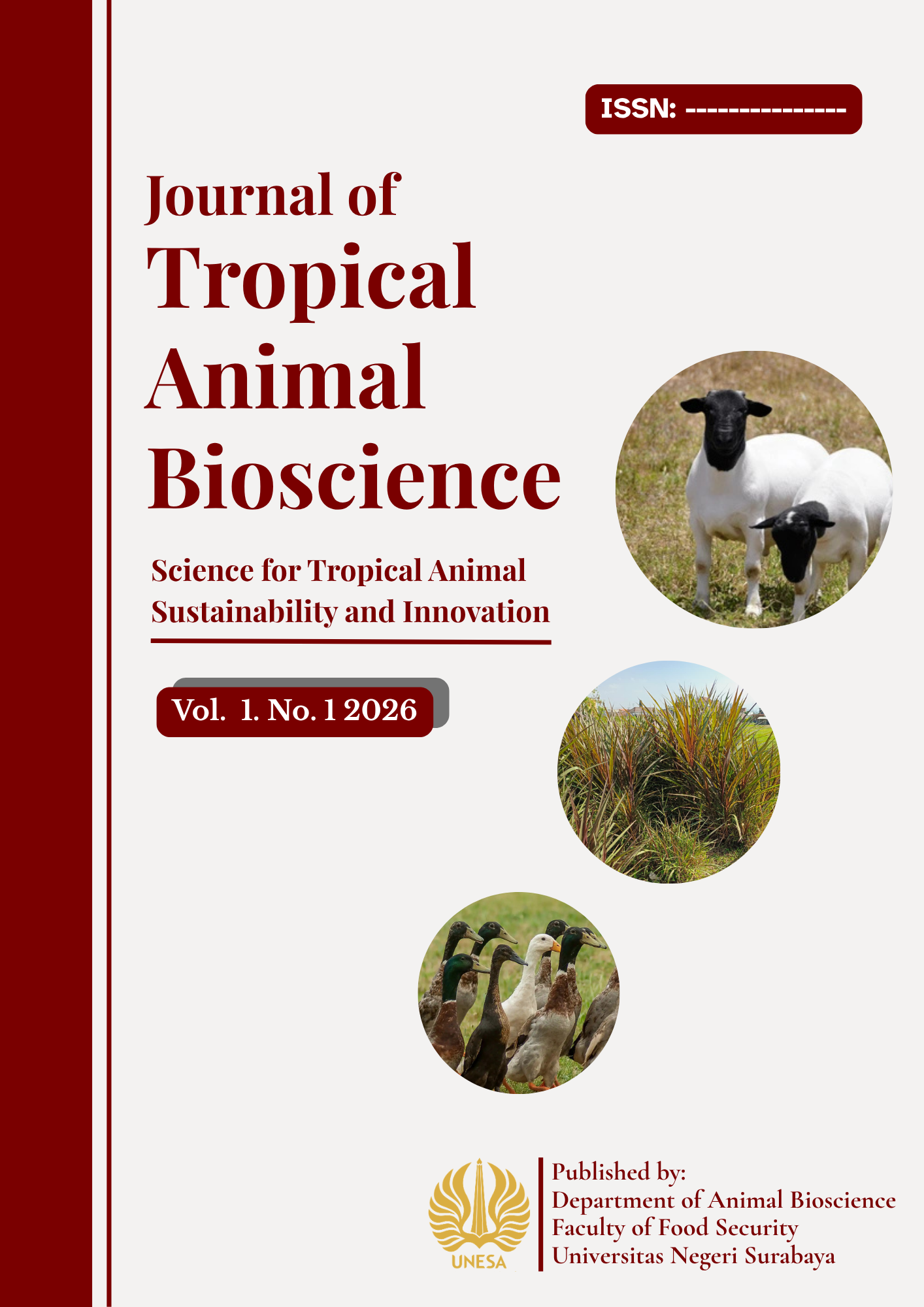
The Effect of Breed on Production Performance in Ewe Lambs Under Intensive Management
Keywords:
Ewe, Dorper F1, ADG, FCR, IOFCAbstract
Crossbreeding local sheep with Dorper sheep has been widely adopted to improve growth performance and meat production. This study aimed to evaluate the effect of breed differences (Dorper F1 vs. Local) on the production performance of ewe lambs in an intensive fattening system. The study was conducted over 63 days using 28 weaned ewe lambs (14 Dorper F1 and 14 Local) with initial weights ranging from 10–18 kg. The measured parameters included dry matter intake (DMI), average daily gain (ADG), feed conversion ratio (FCR), feed cost per gain (FCG), and income over feed cost (IOFC). The results of the t-test showed that the DM intake of Dorper F1 (1.01 kg/day) was significantly higher (P<0.05) than that of the Local breed (0.78 kg/day); however, when expressed as a percentage of body weight, both were equivalent at 4.2–4.3%. Despite the higher feed intake, breed had no significant effect (P > 0.05) on the average daily gain rate (0.16 vs. 0.14 kg/day) or the FCR (6.61 vs. 5.69). Although both sheep breeds had equivalent levels of biological efficiency, economic analysis demonstrated that raising Dorper F1 sheep yielded a numerically higher IOFC value (Rp672,914/head) compared to Local sheep (Rp233,875/head). It is concluded that Dorper F1 sheep are more recommended for commercial-scale development owing to their greater economic returns and higher market value.
Downloads
Published
Issue
Section
License
Copyright (c) 2026 Fitria et al.

This work is licensed under a Creative Commons Attribution 4.0 International License.
 Abstract views: 148
,
Abstract views: 148
, PDF Downloads: 113


