
Research Misconduct Policy
PROCESS FOR IDENTIFICATION OF AND DEALING WITH ALLEGATIONS OF RESEARCH MISCONDUCT
1. General Principles
The Journal of Sports Medicine and Physiotherapy is committed to maintaining research integrity, transparency, and ethical standards in scholarly publishing. The journal takes all allegations of research misconduct seriously and handles them fairly, objectively, and confidentially in accordance with established publication ethics principles.
Research misconduct refers to actions that violate the principles of honesty, accuracy, transparency, and accountability in research and scholarly publication.
2. Types of Research Misconduct
Research misconduct includes, but is not limited to:
-
Plagiarism and Self-Plagiarism: Using another person's work, ideas, or text without appropriate acknowledgment, or reusing previously published material without proper disclosure.
-
Data Fabrication: Inventing research data, results, or experimental findings that have not been obtained.
-
Data Falsification: Manipulating research materials, equipment, processes, or data to produce misleading results.
-
Duplicate or Redundant Publication: Submitting or publishing substantially similar manuscripts in multiple journals without appropriate disclosure.
-
Authorship Misconduct: Inappropriate attribution or omission of authorship, including gift authorship and ghost authorship.
-
Citation Manipulation: Inappropriately adding citations to artificially increase citation metrics or influence scholarly recognition.
-
Image Manipulation: Inappropriately altering research images or figures in a way that misrepresents the original findings.
-
Peer-Review Manipulation: Interfering with or manipulating the peer-review process, including the use of fabricated reviewer identities.
-
Undisclosed Conflicts of Interest: Failing to disclose relationships or interests that may influence research or editorial decisions.
3. Reporting Allegations
Allegations of research misconduct may be reported by authors, reviewers, readers, researchers, or other concerned parties.
Reports should be submitted to the Editor-in-Chief through the journal's official contact channels and should include a description of the alleged misconduct, relevant supporting evidence, and references to the affected manuscript or published article.
All allegations are treated seriously and assessed objectively, regardless of the identity or institutional affiliation of the reporting party.
4. Preliminary Assessment
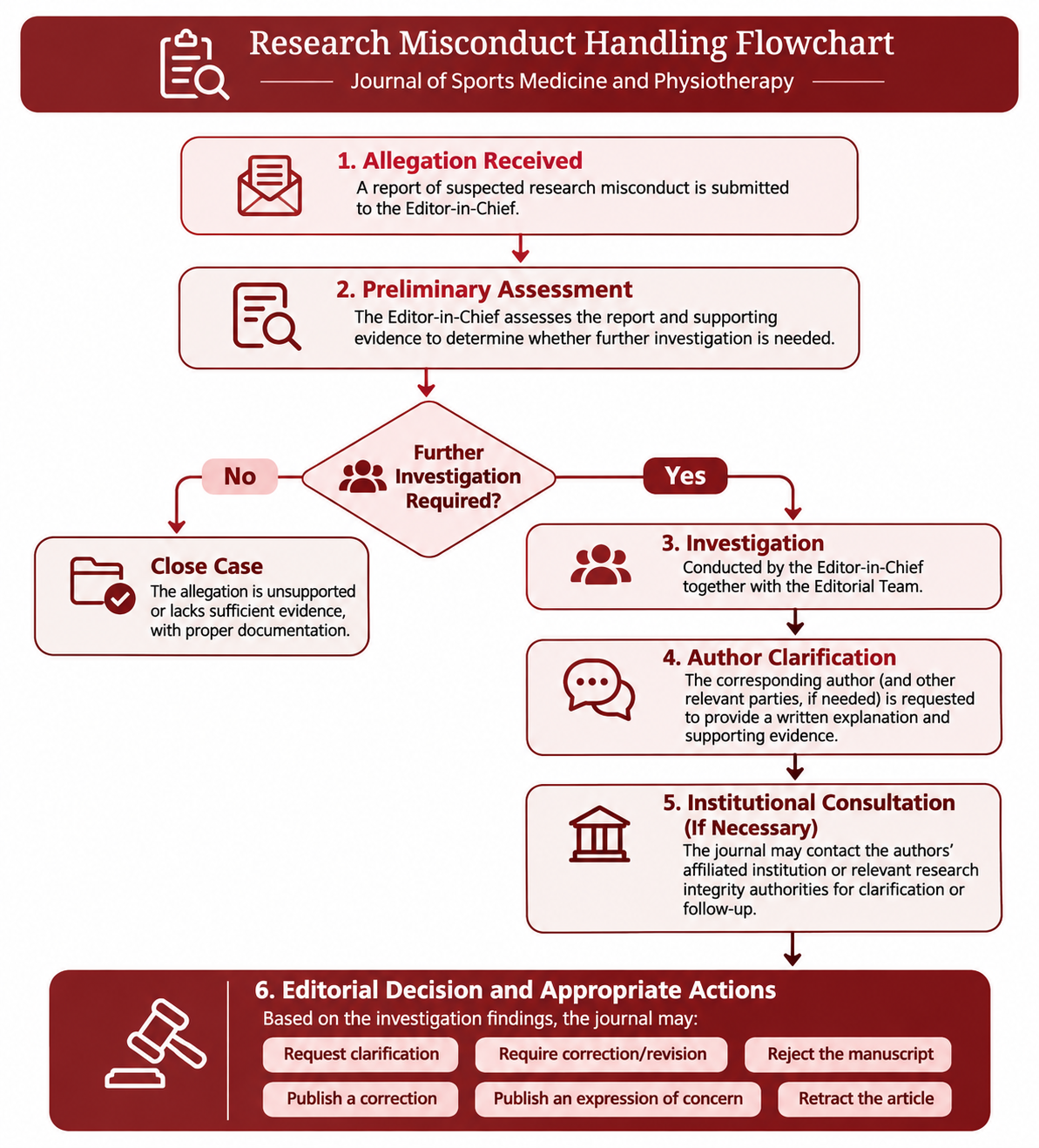
Upon receiving an allegation, the Editor-in-Chief conducts a preliminary assessment to determine whether the report provides sufficient grounds for further examination.
The preliminary assessment may include reviewing manuscript records, examining relevant documents, checking publication histories, and using appropriate plagiarism detection or image analysis tools when necessary.
If the allegation is considered credible, the Editor-in-Chief initiates a further investigation in coordination with the Editorial Team. If the allegation is unsupported or lacks sufficient evidence, the matter may be closed with appropriate documentation.
5. Investigation and Response
Investigations of suspected research misconduct are conducted by the Editor-in-Chief in collaboration with the Editorial Team.
The corresponding author or other relevant parties may be contacted and requested to provide written explanations, supporting documents, or additional evidence concerning the allegation. Authors are given a reasonable opportunity to respond and clarify the issues raised.
When necessary, the journal may consult independent experts or relevant specialists to support the investigation. For serious allegations or cases requiring institutional verification, the journal may contact the authors' affiliated institutions or relevant research integrity authorities to request clarification or appropriate follow-up.
All investigations are conducted fairly, impartially, and confidentially. Editorial team members involved in an investigation must disclose any potential conflicts of interest.
6. Editorial Actions and Outcomes
The actions taken by the journal depend on the nature, severity, and findings of the investigation. Possible actions include:
-
Requesting clarification or additional supporting documents from the authors.
-
Requiring corrections or revisions to the manuscript.
-
Rejecting a manuscript when serious misconduct is established before publication.
-
Publishing a correction or an expression of concern when appropriate.
-
Retracting a published article when the findings indicate that retraction is warranted.
-
Notifying the authors' affiliated institutions or relevant research integrity authorities when necessary.
All decisions are based on available evidence and established publication ethics standards.
7. Confidentiality and Protection of Reporting Parties
The Journal of Sports Medicine and Physiotherapy maintains the confidentiality of allegations and investigation records to the extent possible.
The identity of individuals reporting suspected misconduct will be protected where appropriate. Retaliation against individuals who report concerns in good faith is not tolerated.
8. Ethical Standards and Guidelines
The journal follows established publication ethics principles and refers to the guidelines and recommendations of the Committee on Publication Ethics (COPE) when identifying, assessing, and handling allegations of research misconduct.
All authors, reviewers, and editorial team members are expected to uphold research integrity, transparency, and accountability throughout the scholarly publication process.
9. Research Misconduct Handling Flowchart