Globalisation and Unemployment Rates in The United States: An ARDL Econometric Approach (1974-2023)
Keywords:
Globalisation, Unemployment, FDI, Economic Growth, ARDL, Time Series AnalysisAbstract
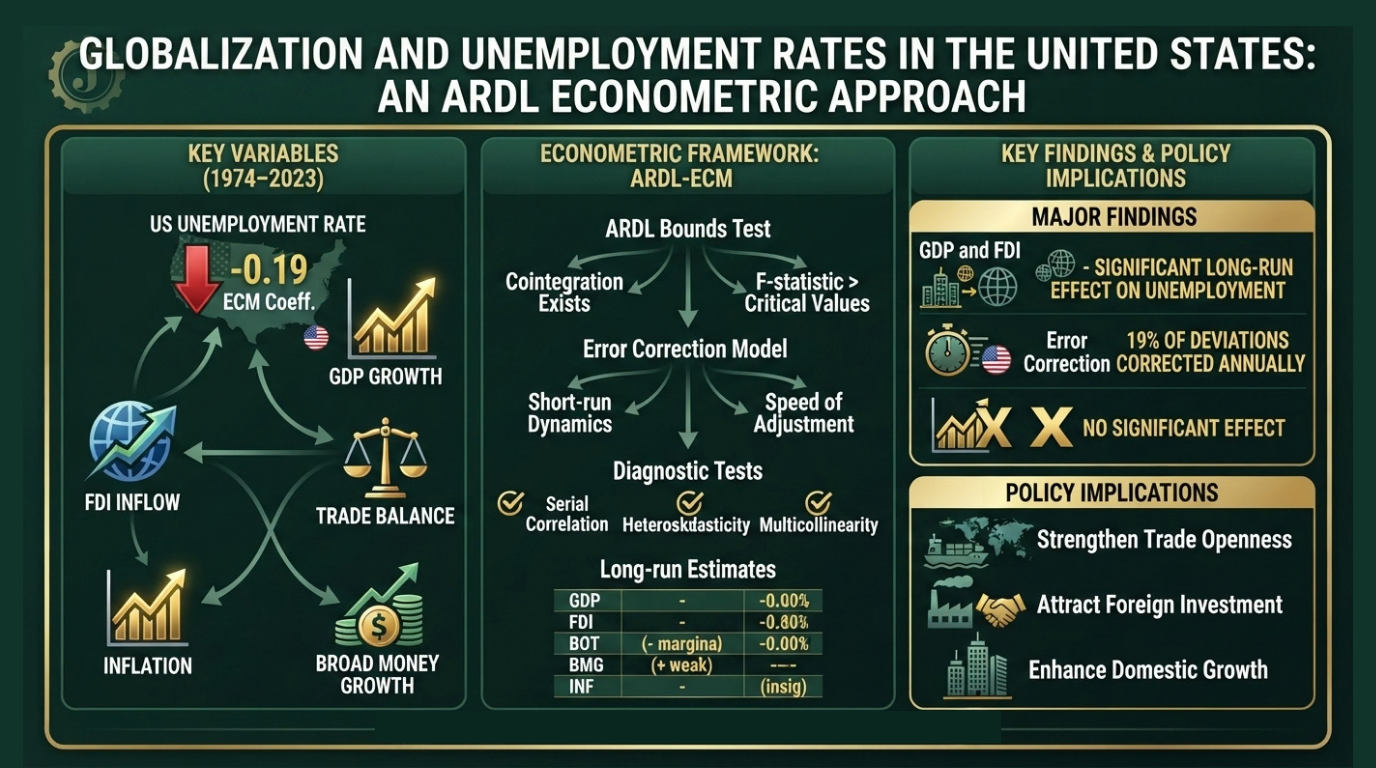
This study analyses the influence of economic growth (GDP), foreign direct investment (FDI), inflation (INF), trade balance (BOT), and money supply growth (BMG) on the unemployment rate in the United States and tests the long- term relationship among these variables. Using annual time series data for the period 1974–2023. The Augmented Dickey-Fuller (ADF) and Phillips-Perron (PP) tests indicate that the research variables exhibit mixed levels of integration, I(0) and I(1), so the Autoregressive Distributed Lag (ARDL) approach was applied. The Bounds Test is used to detect cointegration, and the Error Correction Model (ECM) is estimated to identify short-term dynamics and the speed of adjustment toward long-term equilibrium, along with diagnostic tests to ensure model accuracy. The research findings indicate cointegration among the variables, with long-term results showing that GDP and FDI have a negative and significant impact on unemployment; BOT has a negative impact with marginal significance; BMG has a positive impact with weak significance; and inflation is not significant. The error-correction coefficient of -0.19 indicates that approximately 19% of the long-term imbalance is corrected each period, and all diagnostic tests confirm that the model is free of autocorrelation, heteroskedasticity, and multicollinearity. By applying ARDL-ECM to a long dataset, this study makes an empirical contribution that enriches our understanding of unemployment dynamics in the United States. The results are expected to help policymakers design strategies to reduce unemployment by strengthening the economy, increasing foreign investment, and implementing more effective wage and trade policies.
References
Abdi, A. H., Mohamed, A. A., Mohamed, A. A., & Mohamed, A. A. (2025c). Do globalization, foreign direct investment, and inflation drive income inequality? Evidence from Somalia within the Kuznets curve hypothesis. Research in Globalization, 11, 100301. https://doi.org/10.1016/j.resglo.2025.100301
Alfalih, A. A. (2024). The impact of oil prices, foreign direct investment, and trade openness on unemployment rates in an oil-exporting country: The case of Saudi Arabia. Heliyon, 10 (3), e25094. https://doi.org/10.1016/j.heliyon.2024.e25094
Apostolov, M. (2016). Cobb–Douglas production function on FDI in Southeast Europe. Journal of Economic Structures, 5 (1), 10. https://doi.org/10.1186/s40008-016-0043-x
Arif-Ur-Rahman, M., & Inaba, K. (2020). Financial integration and total factor productivity: In consideration of different capital controls and foreign direct investment. Journal of Economic Structures, 9 (1), 25. https://doi.org/10.1186/s40008-020-00201-9
Asafo-Adjei, E., Qabhobho, T., & Adam, A. M. (2023). Conditional effects of local and global risk factors on the co-movements between economic growth and inflation: Insights into G8 economies. Heliyon, 9 (9), e19570. https://doi.org/10.1016/j.heliyon.2023.e19570
Autor, D. H., Dorn, D., & Hanson, G. H. (2013). The China Syndrome: Local Labor Market Effects of Import Competition in the United States. American Economic Review, 103(6), 2121-2168. https://doi.org/10.1257/aer.103.6.2121
Bajrami, R., Tafa, S., Gashi, A., & Hashani, M. (2025). Analysing the impact of money supply on economic growth: A panel regression approach for Western Balkan countries (2000–2023). Regional Science Policy & Practice, 17 (2), 100159. https://doi.org/10.1016/j.rspp.2024.100159
Baks, K., & Kramer, C. (1999). Global liquidity and asset prices: Measurement, implications, and spillovers. IMF Working Paper, 99(168). Retrieved from https://www.elibrary.imf.org/downloadpdf/view/journals/001/1999/168/001.1999.issue- 168-en.pdf
Bouattour, A., Kalai, M., & Helali, K. (2024). Threshold effects of technology import on industrial employment: A panel smooth transition regression approach. Journal of Economic Structures, 13 (1), 1. https://doi.org/10.1186/s40008-023-00322-x
Bustaman, A., Indiastuti, R., Budiono, B., & Anas, T. (2022). Quality of Indonesia’s domestic institutions and export performance in the era of global value chains. Journal of Economic Structures, 11 (1), 35. https://doi.org/10.1186/s40008-022-00293-5
Campos, N. F., Eichenauer, V. Z., & Sturm, J.-E. (2025a). Are unemployment differentials among advanced economies still explained by the Shocking Institutions Hypothesis? Economic Systems, 101325.
Choga, I., Dundu, L., & Khobai, H. (2024). Impact of globalization on income inequality in South Africa. Problems and Perspectives in Management, 22 (3), 475–490. https://doi.org/10.21511/ppm.22(3).2024.36
Dawid, H., & Neugart, M. (2023). Effects of technological change and automation on industry structure and (wage) inequality: Insights from a dynamic task-based model. Journal of Evolutionary Economics, 33 (1), 35–63. https://doi.org/10.1007/s00191-022-00803-5
Fritsch, M., & Mueller, P. (2008). The effect of new business formation on regional development over time: The case of Germany. Small Business Economics, 30 (1), 15–29. https://doi.org/10.1007/s11187-007-9067- 9
Gozgor, G. (2017). The Impact of Globalization on Structural Unemployment: An Empirical Reappraisal. International Economic Journal, 31 (4), 471–489. https://doi.org/10.1080/10168737.2017.1408666 Koyuncu, J. Y., & Songur, D. (n.d.). The Impact of Globalization on Unemployment: An Empirical Study (1990).
Llop, M. (2022). Quantifying the employment impacts of gross exports: A global accounting perspective. Journal of Economic Structures, 11 (1), 25. https://doi.org/10.1186/s40008-022-00285-5
Mahembe, E., & Odhiambo, N. M. (2014). Foreign direct investment and economic growth: A theoretical framework. Journal of Governance and Regulation, 3 (2), 63–70. https://doi.org/10.22495/jgr_v3_i2_p6
Mohamed, A. A. (2024). Economic growth and unemployment nexus: Empirical test of Okun’s law in Somalia. Journal of Economic Structures, 13 (1), 16. https://doi.org/10.1186/s40008-024-00337-y
Mohler, L., Weder, R., & Wyss, S. (2018). International trade and unemployment: Towards an investigation of the Swiss case. Swiss Journal of Economics and Statistics, 154 (1), 10. https://doi.org/10.1186/s41937-017-0006-7
Nusair, S. A. (2020). The asymmetric effects of oil price changes on unemployment: Evidence from Canada and
the U.S. The Journal of Economic Asymmetries, 21, e00153. https://doi.org/10.1016/j.jeca.2019.e00153
Pesaran, M. H., Shin, Y., & Smith, R. J. (2001). Bounds testing approaches to the analysis of level relationships. Journal of Applied Econometrics, 16 (3), 289–326. https://doi.org/10.1002/jae.616
Potrafke, N. (2013). Globalization and labor market institutions: International empirical evidence. Journal of Comparative Economics, 41 (3), 829–842. https://doi.org/10.1016/j.jce.2013.02.002
Reme, B.-A., Røgeberg, O., Wörn, J., Bratsberg, B., & Skirbekk, V. F. (2025). The distribution of technology induced job loss: Evidence from a population-wide study in Norway. PLOS ONE, 20 (4), e0321072. https://doi.org/10.1371/journal.pone.0321072
Rong, S., Liu, K., Huang, S., & Zhang, Q. (2020). FDI, labor market flexibility and employment in China. China Economic Review, 61 , 101449. https://doi.org/10.1016/j.chieco.2020.101449
Rüffer, R., & Stracca, L. (2006). What is global excess liquidity, and does it matter? ECB Working Paper, 371. https://www.econstor.eu/bitstream/10419/152805/1/ecbwp0371.pdf
Shahzad, U., He, X., & Muhammad, S. (2023). How Terms of Trade Impact Economic Growth: The Case of the
United States. Sage Open, 13 (2), 21582440231176452. https://doi.org/10.1177/21582440231176452
Sié, K. J. F. (2023). Industrial policy and labor productivity growth in Africa: Does the technology choice matter?
Journal of Economic Structures, 12 (1), 10. https://doi.org/10.1186/s40008-023-00305-y
Sousa, J., & Zaghini, A. (2004). Monetary policy shocks in the Euro area and global liquidity spillovers. ECB Working Paper. Retrieved from https://www.econstor.eu/bitstream/10419/152794/1/ecbwp0360.pdf
Szymczak, S. (2024). The impact of global value chains on wages, employment, and productivity: A survey of theoretical approaches. Journal for Labor Market Research, 5(1), 9. https://doi.org/10.1186/s12651-024-00367-w
Zhang, Z. (2024). A Comparative Analysis of the Impact of Import and Export Trade on the Economy Between
China and the United States. Advances in Economics, Management and Political Sciences,
Downloads
Published
How to Cite
Issue
Section
License
Copyright (c) 2026 Journal of Economic Policy and Financial Systems

This work is licensed under a Creative Commons Attribution 4.0 International License.
 Abstract views: 4
,
Abstract views: 4
, PDF Downloads: 4