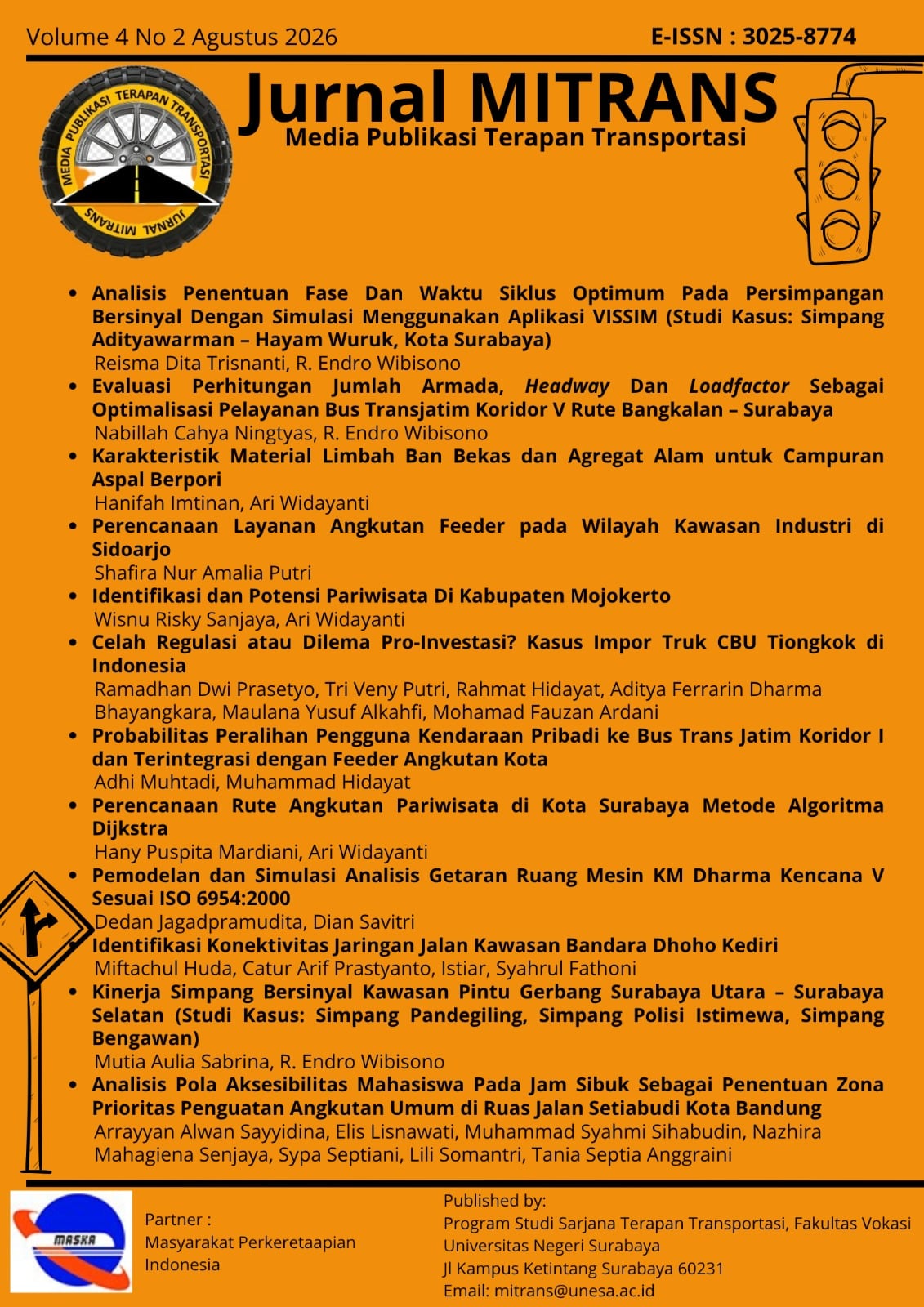
Analisis Pola Aksesibilitas Mahasiswa Pada Jam Sibuk Sebagai Penentuan Zona Prioritas Penguatan Angkutan Umum di Ruas Jalan Setiabudi Kota Bandung
DOI:
https://doi.org/10.26740/mitrans.v4n2.p577-590Keywords:
Transportasi Umum, Aksesibilitas, Kemacetan, Kota Bandung, Sistem Informasi GeografiAbstract
Ketergantungan masyarakat Kota Bandung dalam penggunaan kendaraan pribadi menjadi faktor utama dalam peningkatan volume kendaraan di beberapa ruas jalan. Terutama pada pusat kegiatan seperti kawasan perguruan tinggi yang tidak menggunakan sistem zonasi sehingga pengguna jalan cenderung berasal dari wilayah yang beragam. Disisi lain, fasilitas transportasi umum Kota Bandung masih belum memadai untuk merubah pola penggunaan kendaraan pribadi masyarakat. Tentunya perlu melakukan analisis lebih lanjut terkait ketersediaan transportasi umum dari Kota Bandung sebagai langkah awal dalam penanggulangan masalah tersebut. Dalam penelitian ini analisis dilakukan menggunakan pendekatan sistem informasi geografis yang menganalisis data statistik melalui visualisasi peta. Melalui pemetaan choropleth dan teknik isokron, ketersediaan transportasi umum di berbagai wilayah Kota Bandung berdasarkan waktu tempuh mahasiswa dapat teridentifikasi. Pola aksesibilitas mahasiswa pun perlu dianalisis menggunakan K-Means Clustering sebagai variabel tambahan dalam penentuan wilayah prioritas penguatan angkutan umum. Hasil pada penelitian ini menunjukkan dominasi penggunaan kendaraan pribadi sebesar 74,5%, yang mengindikasikan tingginya ketergantungan terhadap kendaraan pribadi. Waktu tempuh mahasiswa menuju kawasan kampus didominasi oleh durasi 15 - 45 menit pada pagi hari, namun cenderung mengalami peningkatan pada sore hari. Sedangkan waktu tempuh terlama konsisten dialami oleh mahasiswa yang berasal dari kecamatan gedebage yaitu > 6o menit.
References
Alrasyid, P. A., Andaru, N. M., & Nurrizkyta, D. (2025). The four-step model approach for improving publictransportation in Malang City. Jurnal Indonesia Sosial Sains, 6(8), 2713–2728.https://doi.org/10.59141/jiss.v6i8.1844
Badan Pusat Statistik Kota Bandung. (2018). Kota Bandung dalam angka 2018. BPS Kota Bandung. https://bandungkota.bps.go.id/
Bhellar, M. G., Talpur, M. a. H., Khahro, S. H., Ali, T. H., & Javed, Y. (2023). Visualizing travel accessibility in a congested city Center: A GIS-Based Isochrone Model and trip Rate Analysis considering Sustainable Transportation Solutions. Sustainability, 15(23), 16499. https://doi.org/10.3390/su152316499
Bradley, D., Zhang, B., Jay, C., & Stewart, A. J. (2023). Choropleth maps can convey absolute magnitude through the range of the accompanying colour legend. Behaviourand Information Technology, 43(12),2821–2837. https://doi.org/10.1080/0144929x.2023.2260889
D’Auria, A., Di Ruocco, I., & Gioia, A. (2025). An integrated isochrone-based geospatial analysis of mobility policies and vulnerability hotspots in the Lazio Region, Italy. ISPRS International Journal of Geo-Information, 14(10), 395. https://doi.org/10.3390/ijgi14100395 Dawud, J. (2019).
PENELITIAN TINGKAT KEPUASAN MASYARAKAT ATAS PELAYANAN TRANSPORTASI DI KOTA BANDUNG. Jurnal Ilmu Administrasi Media Pengembangan Ilmu Dan Praktek Administrasi, 2(4), 03. https://doi.org/10.31113/jia.v2i4.464
Dirgahayani, P., & Sutanto, H. (2020). The effect of transport demand management policy on the intention to use public transport: A case in Bandung, Indonesia. Case Studies on Transport Policy, 8(3), 1062–1072. https://doi.org/10.1016/j.cstp.2020.03.004
Evelyn, M., Meidiana, C., & Firdausiyah, N. (2025). Overlay analysis to determine the potential location of the new TPS 3R in Pacet District, East Java. IOP Conference Series Earth and Environmental Science, 1452(1), 012036. https://doi.org/10.1088/1755-1315/1452/1/012036
Expat Life in Indonesia. (2025, January 28). Worse than Jakarta, Bandung and Medan rank among the world’s most congested cities. Expat Life in Indonesia
Hassan, Y. N., Mohammed, H. A., Abuhayya, M., & Jombach, S. (2025). Assessing travel-time accessibility to urban green spaces in car-dependent cities: Evidence from Erbil and Sulaimaniyah, Kurdistan Region of Iraq. Land, 14(9), 1886. https://doi.org/10.3390/land14091886
Indonesia, P. G. F. P. I. P. S. U. P. I. B., & Ramadhanni, F. (2026). Di Balik Kemacetan Jalan Setiabudi: Infrastruktur, Ruang Sosial, dan Integrasi Transportasi. Geodika Jurnal Kajian Ilmu Dan Pendidikan Geografi, 10(1), 110–121. https://doi.org/10.29408/geodika.v10i1.30465
Lucky, M. L. (2025, January 12). Bandung semakin macet, warga diimbau gunakan transportasi umum. Galamedia News. https://galamedia.pikiran-rakyat.com/news/pr-358961350/bandung-semakin-macet-warga-diimbau-gunakan-transportasi-umum
Maharjan, S., Tilahun, N., & Ermagun, A. (2022). Spatial equity of modal access gap to multiple destination types across Chicago. Journal of Transport Geography, 104, 103437. https://doi.org/10.1016/j.jtrangeo.2022.103437
Palermo, A., Tucci, G., & Chieffallo, L. (2025). Definition of spatio-temporal levels of accessibility: Isochronous analysis of regional transport networks. TeMA Journal of Land Use, Mobility and Environment, 18(1), 23–38. https://doi.org/10.6093/1970-9870/11146
Rahayu, L., & Kipuw, D. M. (2024). Spatial distribution and the sustainability of student mobility of top u niversities in Bandung, Indonesia. IOP Conference Series Earth and Environmental Science, 1318(1)012003. https://doi.org/10.1088/1755-1315/1318/1/012003
Indonesia traffic report | TomTom Traffic Index. (n.d.). Retrieved from https://www.tomtom.com/traffic-index/country/indonesia
Ramadhan, M. F., & Susanti, A. (2024). Analisa Kebutuhan Prasarana Terintegrasi Sepanjang Daerah
Bundaran Aloha Hingga Bundaran Dolog. Jurnal Mesia Publikasi Transportasi V2N3. 243-252.
Ramlan, M. F., Aprilian, I. T., & Pratama, N. A. (2025). Sustainable urban mobility through traffic engineering and public transport integration: A microsimulation approach using Planung Transport Verkehr (PTV) Vissim. Sustainable Technology and Urban Management, 2(1). https://doi.org/10.61511/stum.v2i1.2025.2398
Rathod, R., Joshi, G., & Shriniwas, A. (2024). Evaluation of Spatiotemporal Transit Accessibility: Weighted Indexing Using the CRITIC-MCDM Approach and Performance Gap Analysis. Journal of Advanced Transportation, 2024, 1–22. https://doi.org/10.1155/2024/6343594
Ridwan, D. (2025, December 11). Ini titik-titik kemacetan di Kota Bandung menurut Wali Kota Farhan: Mana tata kelolanya? Ayo Bandung
Rizki, M., Joewono, T. B., & Belgiawan, P. F. (2021). Does multitasking improve the travel experience of public transport users? Investigating the activities during commuter travels in the Bandung Metropolitan Area, Indonesia. Public Transport, 13, 429–454. https://doi.org/10.1007/s12469-021-00254-3
Rizqa, M. (2017). Jakarta commute time. Medium. https://medium.com/datasekitar/jakarta-commute-time-c73b54644933
Rohman, D., Annisa, R., Efendi, D. I., & Solahudin, D. (2024). Clustering bencana alam menggunakan K-Means pada wilayah Jawa Barat. JATI (Jurnal Mahasiswa Teknik Informatika), 8(1), 493–500. https://www.ejournal.itn.ac.id/jati/article/view/8409/5011
Syakur, M. A., Khotimah, B. K., Rohman, E. M., & Satoto, B. D. (2018). Integration K-means clustering method and elbow method for identification of the best customer profile cluster. IOP Conference Series: Materials Science and Engineering, 336, 012017. https://doi.org/10.1088/1757-899X/336/1/012017
Wang, C., Zhao, S.-j., Ren, Z.-q., & Long, Q. (2023). Place-centered bus accessibility time series classification with floating car data: An actual isochrone and dynamic time warping distance-based k-medoids method. ISPRS International Journal of Geo-Information, 12(7), 285. https://doi.org/10.3390/ijgi12070285
Zini, A., Roberto, R., Corrias, P., Felici, B., & Noussan, M. (2024). Accessibility measures to evaluate public transport competitiveness: The case of Rome and Turin. Smart Cities, 7(6), 129. https://doi.org/10.3390/smartcities7060129
 Abstract views: 146
,
Abstract views: 146
, PDF Downloads: 112